
Explosion proof LED lights are designed for hazardous areas where flammable gases, vapors, combustible dusts…
ATEX Explosion-Proof Lighting: Zones, Markings & Selection Guide
ATEX explosion-proof lighting is designed for workplaces where flammable gases, vapors, mists or combustible dust may create a potentially explosive atmosphere. Selecting the correct luminaire is not simply a matter of choosing the required wattage or IP rating. The hazardous zone, substance group, temperature class, equipment protection level and certified ambient temperature range must all match the actual site conditions.
This guide explains ATEX hazardous-area classifications, gas and dust zones, explosion-protection markings and the main factors engineers, contractors and procurement teams should evaluate when selecting LED lighting for hazardous locations.
What Is an Explosive Atmosphere?
An explosive atmosphere is a mixture of air and flammable substances in the form of gas, vapor, mist or combustible dust that can ignite and allow combustion to spread throughout the unburned mixture.
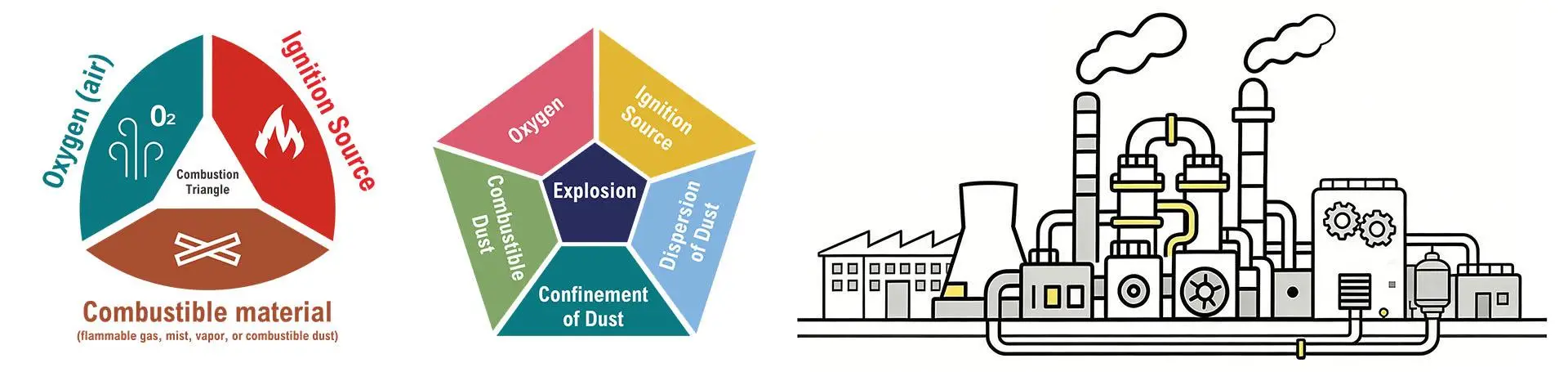
An explosion normally requires three elements:
- Oxygen
- Combustible material
- An effective ignition source
Potential ignition sources include electrical sparks, hot surfaces, static electricity, open flames and mechanical friction. Removing one element of this combustion triangle can reduce the risk, but hazardous-area electrical equipment must still be selected according to the applicable zone and certification requirements.
Explosive atmospheres may occur in:
- Oil and gas production facilities
- Petroleum refineries
- Chemical processing plants
- Fuel storage and transfer terminals
- Paint and coating facilities
- Pharmaceutical factories
- Flour and grain processing plants
- Coal handling facilities
- Metal powder processing areas
- Wastewater treatment plants
- Marine and offshore facilities
Ordinary industrial LED lights should not be installed in a classified hazardous area unless their certification specifically covers the relevant zone and hazardous substance.
What Is ATEX Explosion-Proof Lighting?
ATEX explosion-proof lighting refers to luminaires intended for use in potentially explosive atmospheres and placed on the European market in accordance with the applicable ATEX requirements.
The principal product legislation is the ATEX Directive 2014/34/EU, which covers equipment and protective systems intended for use in potentially explosive atmospheres. It establishes essential health and safety requirements and conformity-assessment procedures that must be completed before covered equipment is placed on the EU market.
The Workplace Directive 1999/92/EC addresses employer responsibilities, including risk assessment, hazardous-area classification and the protection of workers who may be exposed to explosive atmospheres.
Official information is available from the European Commission ATEX portal.
ATEX requirements work alongside relevant EN and IEC 60079 standards, including:
- IEC/EN 60079-0: General requirements
- IEC/EN 60079-1: Flameproof enclosure protection “d”
- IEC/EN 60079-7: Increased safety protection “e”
- IEC/EN 60079-10-1: Classification of explosive gas atmospheres
- IEC/EN 60079-10-2: Classification of explosive dust atmospheres
- IEC/EN 60079-31: Equipment dust ignition protection by enclosure “t”
The exact standards listed on a certificate depend on the product design and its intended protection method.
ATEX Hazardous Area Classification
Hazardous areas are classified according to the type of combustible material and how frequently an explosive atmosphere is present.
The classification must be completed by a qualified professional familiar with the site process, release sources, ventilation and applicable regulations. A luminaire manufacturer should not determine the site’s hazardous zone without the necessary engineering information.
Gas, Vapor and Mist Zones
Zone 0
An area where an explosive atmosphere consisting of gas, vapor or mist is present continuously, for long periods or frequently.
Zone 0 requires equipment with a very high level of protection. Conventional fixed lighting products are not automatically suitable for this zone.
Zone 1
An area where an explosive gas atmosphere is likely to occur occasionally during normal operation.
Lighting used in Zone 1 must carry certification and markings appropriate for that zone, gas group, temperature class and ambient temperature.
Zone 2
An area where an explosive gas atmosphere is not likely to occur during normal operation. If it does occur, it will normally exist only for a short period.
Zone 2 does not mean that ordinary lighting is automatically acceptable. The equipment must still have a protection level and certification suitable for the classified location.

Combustible Dust Zones
Zone 20
An area where combustible dust in the form of a cloud is present continuously, for long periods or frequently.
Zone 21
An area where a cloud of combustible dust is likely to occur occasionally during normal operation.
Zone 22
An area where a cloud of combustible dust is not likely to occur during normal operation. If it occurs, it will persist only briefly.
Dust hazards require special attention because dust can accumulate on a luminaire and affect its surface temperature and heat dissipation. Conductive dust may also introduce additional electrical risks.
How Is a Hazardous Area Zone Determined?
Hazardous-area classification should consider the complete operating environment rather than one isolated factor.
Important considerations include:
- The type of flammable gas, vapor, mist or dust.
- The frequency and duration of a potential release.
- Whether the release occurs during normal or abnormal operation.
- The concentration and ignition characteristics of the hazardous substance.
- Natural or mechanical ventilation conditions.
- Openings, enclosed spaces and nearby release sources.
- Ambient temperature and operating conditions.
- Local laws, codes and project specifications.
Before requesting an ATEX lighting proposal, the customer should provide the classified zone, gas or dust group, required temperature class, ambient temperature range and installation conditions.
How to Read an ATEX Lighting Marking
An ATEX marking communicates the environment and protection level for which the equipment has been assessed. The actual marking shown on the luminaire nameplate and certificate must be reviewed as a complete designation.
A typical gas-atmosphere marking may look like:
II 2G Ex db IIC T6 Gb
Its elements generally mean:
- II: Equipment Group II for non-mining industries
- 2: Equipment Category 2
- G: Intended for explosive gas atmospheres
- Ex: Explosion-protected equipment
- db: Flameproof enclosure protection
- IIC: Gas group covering demanding gases such as hydrogen and acetylene
- T6: Maximum equipment surface temperature of 85°C under the certified conditions
- Gb: Equipment Protection Level for use where a high level of gas protection is required
A typical dust-atmosphere marking may look like:
II 2D Ex tb IIIC T80°C Db
Its elements generally mean:
- II: Equipment Group II
- 2: Equipment Category 2
- D: Intended for combustible dust atmospheres
- Ex: Explosion-protected equipment
- tb: Protection against dust ignition by enclosure
- IIIC: Conductive dust group
- T80°C: Maximum marked surface temperature of 80°C under the certified conditions
- Db: Equipment Protection Level for dust atmospheres
The T6 gas temperature class and the T80°C dust surface-temperature marking are not the same notation. T6 corresponds to a maximum surface temperature of 85°C, while T80°C directly specifies 80°C.

Gas Groups and Dust Groups
Explosion-protected equipment is also classified according to the substances for which it is suitable.
Common gas groups include:
- IIA: Typical lower-risk industrial gases such as propane
- IIB: Gases requiring a higher level of protection, such as ethylene
- IIC: Gases with demanding ignition characteristics, including hydrogen and acetylene
An IIC-rated product may cover IIA and IIB applications when all other certification conditions are satisfied. However, the complete certificate and marking must still be checked.
Common dust groups include:
- IIIA: Combustible flyings
- IIIB: Non-conductive dust
- IIIC: Conductive dust
The installation must be assessed according to the actual hazardous material present at the site.
Temperature Classes for Explosion-Proof Lighting
For gas atmospheres, the temperature class indicates the maximum permitted surface temperature of the equipment under its certified operating conditions.
Common temperature classes include:
- T1: 450°C
- T2: 300°C
- T3: 200°C
- T4: 135°C
- T5: 100°C
- T6: 85°C
The selected luminaire’s maximum surface temperature must remain below the ignition temperature of the hazardous gas or vapor, with the required safety considerations.
For combustible dust environments, the marking may specify an exact maximum surface temperature, such as T80°C. Dust-layer thickness and installation conditions may also affect the permitted temperature.
ATEX vs IECEx vs NEC
ATEX, IECEx and the North American hazardous-location system are related but not interchangeable.
ATEX is based on European Union legislation. It covers equipment placed on the EU market and also includes workplace requirements through a separate directive.
IECEx is an international conformity-assessment system based on IEC standards for explosive atmospheres. It is widely recognized in many international markets, but an IECEx certificate does not automatically replace the legal requirements applicable in the European Union.
NEC hazardous-location classifications are mainly used in the United States. North American projects may use Class and Division or Class and Zone systems, depending on the application and governing code.
A product approved for one system should not automatically be represented as certified for another. Always verify the exact approval, certificate and marking required by the project location.
For additional North American guidance, see the OSHA hazardous classified locations standard.
How to Select ATEX Explosion-Proof Lighting
Correct product selection begins with the hazardous-area assessment and certificate, not with lumen output alone.
1. Confirm the Hazardous Zone
Determine whether the installation is in Zone 0, 1 or 2 for gases, or Zone 20, 21 or 22 for dusts.
2. Identify the Hazardous Substance
Confirm whether the hazard involves gas, vapor, mist, combustible dust or conductive dust. Record the applicable gas or dust group.
3. Check the Temperature Requirement
Select a temperature class or marked surface temperature suitable for the ignition characteristics of the hazardous substance.
4. Verify the Complete Ex Marking
Compare the product marking with the project specification. Do not rely only on the words “explosion-proof” or “ATEX.”
5. Review the Certificate
Verify:
- Certificate number
- Certified model number
- Issuing body
- Protection method
- Gas or dust group
- Temperature class
- Equipment Protection Level
- Ambient temperature range
- Special conditions of use
The model number on the product should match the model covered by the certificate.
6. Evaluate Environmental Protection
Check the required:
- IP rating
- Corrosion resistance
- Impact resistance
- Operating temperature
- Chemical exposure resistance
- Marine or offshore protection
- Cable-entry and gland requirements
An IP rating alone does not make a fixture explosion-proof.
7. Calculate the Lighting Performance
After confirming safety and certification requirements, evaluate:
- Required illuminance
- Mounting height
- Beam angle
- Lighting uniformity
- Glare control
- Color temperature
- Color rendering
- Emergency-lighting requirements
- Maintenance accessibility
A photometric layout can help determine the number, wattage and placement of luminaires.
Applications for Explosion-Proof LED Lighting
Properly selected explosion-proof LED luminaires may be used in:
- Oil refineries
- Petrochemical facilities
- Offshore platforms
- Chemical plants
- Fuel storage areas
- Gas processing facilities
- Paint spray booths
- Pharmaceutical facilities
- Grain and flour processing plants
- Coal handling areas
- Metal powder facilities
- Wastewater treatment plants
- Marine and shipyard projects
Each project must be evaluated individually. Two areas within the same facility may have different zones, gas groups or temperature requirements.
You can review ROKEE’s industrial and explosion-proof lighting products or provide the project conditions for a suitable fixture recommendation.
ATEX Lighting Specification Checklist
Before requesting a quotation, prepare the following information:
- Installation country
- Hazardous zone
- Gas or dust environment
- Gas or dust group
- Required temperature class
- Ambient temperature range
- Required Ex marking
- Mounting height
- Target illuminance
- Input voltage and frequency
- Required beam angle
- IP and impact-resistance requirements
- Corrosion or chemical exposure
- Quantity and project schedule
Providing this information helps the supplier recommend an appropriate certified configuration and prepare a more accurate lighting proposal.
Get an ATEX Lighting Recommendation
Selecting ATEX explosion-proof lighting requires accurate site and certification information. Send us your hazardous zone, gas or dust group, temperature class, ambient temperature, mounting height and target illuminance.
Our team can help evaluate suitable LED lighting options and prepare a project-specific lighting proposal. Contact ROKEE Lighting to discuss your hazardous-area lighting requirements.