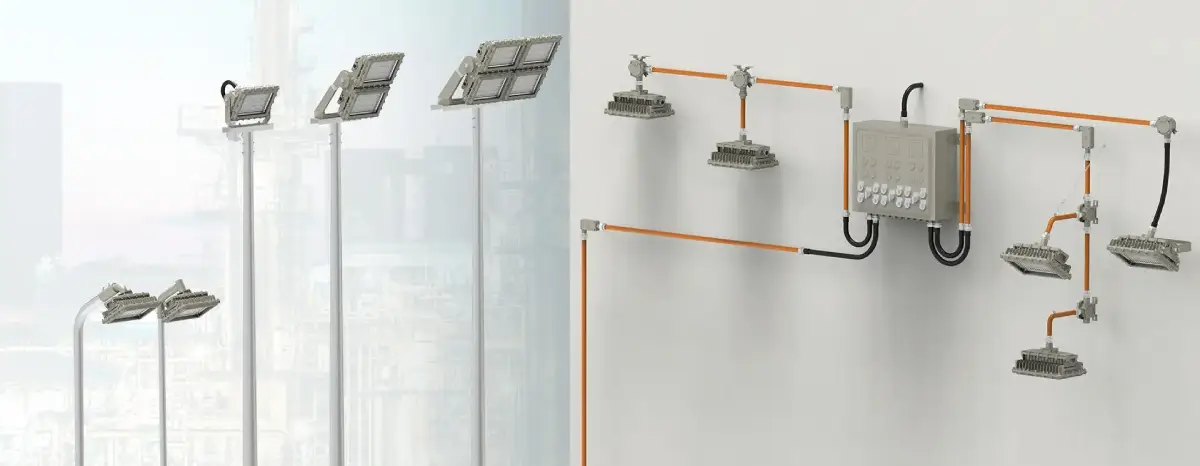
Explosion proof LED lights are designed for hazardous areas where flammable gases, vapors, combustible dusts…
High Mast LED Lights for Sports Fields: Design and Selection Guide
High mast LED lights allow a relatively small number of elevated mounting points to illuminate a large sports field. They are widely used for football, baseball, athletics, cricket, tennis complexes and multi-purpose facilities. Their height improves coverage and can reduce obstructions around the playing area, but it also increases the importance of optical control, accurate aiming and structural planning.
This guide explains what project teams should evaluate before choosing fixtures. It is not a substitute for a project-specific photometric study or structural design. The final system should be checked by qualified professionals against the governing sports standard and local codes.

Why Sports Fields Use High Mast LED Lights
Mounting luminaires high above the field can provide long throws, wider coverage and fewer poles close to players or spectators. LED technology adds instant start, dimming, zoning and more precise optics than many legacy systems. It can also reduce maintenance frequency when the fixture, driver and thermal system are designed for the operating environment.
These benefits are not automatic. Poorly selected high mast LED lights can create glare, uneven illumination, wasted spill light or difficult maintenance. The design should therefore begin with the field and performance target—not with a predetermined fixture wattage.
Define the Sports Lighting Requirements First
Document the sport, field dimensions, competition level, spectator areas and whether television coverage is expected. A lighting brief normally addresses horizontal illuminance, vertical illuminance, uniformity, glare, color quality and flicker. FIFA’s official stadium guideline resources include a lighting guide for football stadiums and training sites.
Targets differ by application. High mast LED lights for a recreational field used twice a week should not be specified exactly like a professional venue with high-speed broadcast cameras. Create several control scenes when the same facility serves training, community matches and major events.
How Pole Height Affects the Design
Taller poles can improve beam geometry and reduce the apparent brightness of luminaires in some viewing directions, but they require narrower distributions and careful structural engineering. Lower poles may simplify access yet increase glare risk and the number of mounting locations. Existing poles should never be assumed suitable without checking their condition, wind capacity, foundation and bracket arrangement.
The pole layout must also consider player sightlines. Fixtures located in common ball-flight or viewing directions can be distracting even when measured illuminance is adequate. A competent lighting calculation evaluates observer positions and not only the ground plane.
Select Beam Angles With Photometric Data
High mast LED lights are available with narrow, medium, wide and asymmetric distributions. Narrow beams reach distant zones; wider beams cover areas nearer the mast. A sports field usually needs several optics working together. Using the narrowest beam everywhere can create hot spots, while using beams that are too wide wastes light outside the target.
Request IES or LDT photometric files for the exact luminaire and optic. The calculation should show aiming points, average and minimum values, uniformity, vertical illuminance where relevant, glare and boundary spill. Explore ROKEE sports and high mast lighting products after the required beam patterns and outputs are known.

Control Glare and Spill Light
Glare affects players, officials, spectators and nearby road users. It depends on mounting height, aiming angle, source intensity and the relationship between the luminaire and the observer. Visors and shields can help, but they should be included in the photometric file rather than added as an afterthought.
Spill light must also be checked at property boundaries and nearby homes. DarkSky’s Five Principles for Responsible Outdoor Lighting recommend useful, targeted, low-level, controlled and warmer-colored light where practical. Training scenes, timers and shutoff schedules can reduce unnecessary operating hours.
Check Electrical and Control Requirements
Systems using high mast LED lights can have significant inrush current even when their steady-state power is lower than the equipment being replaced. Confirm circuit capacity, protective devices, cable size, voltage drop, surge protection and grounding. Drivers and controls should be compatible throughout the intended dimming range.
For centralized or remote-driver systems, account for enclosure ventilation, cable distance and service access. If DMX or another networked control protocol is used, define addressing, zoning, local overrides, failure behavior and responsibility for commissioning.
Evaluate the Fixture for Outdoor Duty
Compare high mast LED lights using verified data rather than wattage alone. Important factors include:
- delivered lumens and efficacy at operating temperature;
- tested photometric distributions;
- ingress and impact protection;
- surge protection and driver quality;
- thermal management and lumen maintenance;
- corrosion resistance for coastal or industrial sites;
- wind area, weight and mounting interface;
- availability of replacement drivers and optical parts.
A lower-wattage fixture is not necessarily the better choice if its optics cannot put light where needed. Likewise, the highest lumen output can be inefficient if it produces excessive overlap or glare.
Plan Installation, Aiming and Commissioning
Each luminaire should have an identification number, mounting position and aiming coordinate. Installers need clear drawings and a safe access method. After installation, aim the high mast LED lights with suitable instruments, activate every control scene and measure the field after dark.
Compare readings with the approved calculation and record the final settings. Also inspect boundary spill, spectator zones and critical player sightlines. Photos and measurements from completed sports field lighting projects can help project owners understand what commissioning should document.
Maintenance Matters at Height
Access cost can be a major part of lifetime expense. Establish cleaning intervals based on dust, salt, pollution and local weather. Inspect brackets, cables, seals, drivers and surge devices. Keep spare components and photometric records so a replacement does not change the field’s balance.
Where lowering systems or service platforms are used, include their inspection in the maintenance plan. Do not delay replacement of failed fixtures if the loss compromises uniformity or safety.
Frequently Asked Questions
What wattage should high mast sports lights use?
Wattage cannot be selected reliably without the pole layout, target light levels and photometric distribution. Compare delivered performance in a calculation, not wattage by itself.
Can LED fixtures replace metal-halide lights one for one?
Sometimes, but a one-for-one count is not a design method. Different optics and lumen output may require new aiming or a different quantity. Structural and electrical checks are also necessary.
How many poles are needed for a sports field?
The number depends on field geometry, lighting class, obstructions, glare limits and permitted pole locations. Four-, six- and eight-pole layouts are common, but only a site-specific design can confirm the best arrangement.
Get a Project-Specific High Mast Lighting Plan
High mast LED lights perform best when poles, optics, output, controls and aiming are designed together. Provide accurate drawings, mast heights, target standards and site conditions before requesting a final quotation.
For fixture selection and photometric support, send ROKEE Lighting your project requirements. Our team can review the layout and recommend a configuration for your sports field.
Related Posts