
CRI and TLCI both describe color performance, but they answer different questions. Learn how to specify LED sports lighting for spectators, players and broadcast cameras.
Flicker-Free Stadium Lighting for High-Speed Cameras
Flicker-free stadium lighting is a system requirement, not a label on an LED driver. A floodlight can look perfectly steady to the eye and still produce dark bands, pulsing exposure or colour shifts in slow-motion footage. The risk changes with camera frame rate, shutter angle, mains frequency, driver topology and dimming level. For a broadcast project, all of those conditions belong in the specification.
The sensible test is simple: agree on the cameras and operating scenes before selecting the lights, obtain measured temporal-light-modulation data for the proposed driver, then repeat the check after installation at every dimming level that will be used on air.
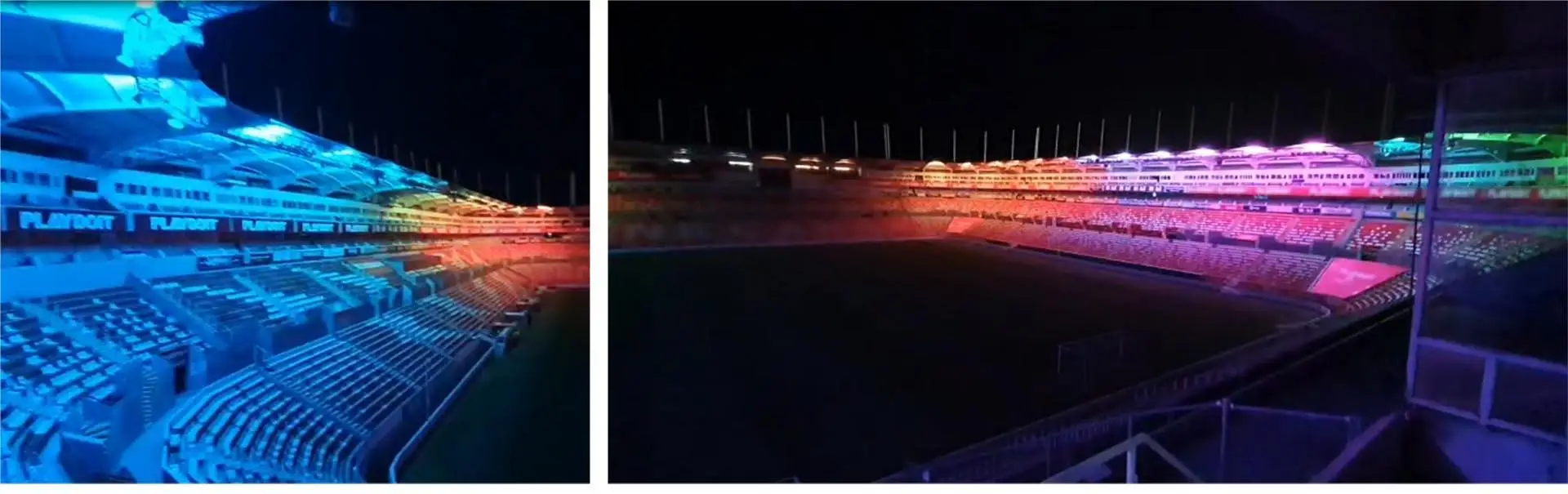
Why a light can flicker on camera but not to the eye
LEDs respond almost instantly to changes in current. If the driver output rises and falls with the AC supply or with a pulse-width-modulation signal, the light follows. Human vision often blends that variation into apparently continuous light. A camera samples the scene in short exposures, so it can record the variation frame by frame.
The result depends on timing. At one camera setting the picture may be clean; at another it may show horizontal bands. A fixture that performs well at 50 or 60 frames per second can fail when a production team switches to 300, 500 or 1,000 fps for replay. This is why “no visible flicker” and “suitable for high-speed broadcast” are not equivalent claims.
Terms that should appear in the quotation
| Term | What it describes | Why it matters |
|---|---|---|
| Temporal light modulation | Variation in light output over time | The underlying behaviour that a camera may record |
| Modulation depth | Difference between maximum and minimum output relative to the waveform | A large swing creates a greater risk of visible exposure change |
| Frequency | How often the waveform repeats | It interacts with frame rate and shutter speed |
| Waveform | The shape of the variation, not just its frequency | Two drivers with the same frequency can behave differently |
| SVM or PstLM | Metrics developed for human perception of temporal artefacts | Useful product data, but not a substitute for a camera test |
CIE TN 012:2021 gives a consistent measurement approach for temporal light modulation. It is useful because it asks laboratories to report the waveform and test conditions rather than relying on an unqualified “flicker-free” statement. Sports broadcasting still needs an additional camera-based check: human-perception metrics were not designed to guarantee clean pictures at every high-speed setting.
Plan flicker-free stadium lighting from the production brief
Before a supplier promises flicker-free stadium lighting, the production team should answer five questions:
- What are the normal and maximum camera frame rates?
- What shutter speeds or shutter angles will be used?
- Will ultra-slow-motion cameras operate at every match or only at major events?
- Which lighting scenes will be recorded: full match, training, entertainment and blackout effects?
- Are advertising boards, stands, tunnels and mixed light sources inside the camera frame?
The answers change the test plan. A community field recorded at 50/60 fps does not need the same driver specification as a stadium producing replay at 1,000 fps. Conversely, writing “1,000 fps compatible” into a tender without stating shutter and dimming conditions gives the contractor no reproducible acceptance test.
Why the driver decides flicker-free stadium lighting
LED brand, luminaire wattage and lumen output do not prove broadcast performance. The driver determines how stable the current remains through changes in input voltage, temperature and dimming command. Two floodlights using the same LED package can behave very differently on camera because their drivers use different rectification, filtering or dimming methods.
Ask for the exact driver model in the proposed configuration. The supporting report should identify input voltage and frequency, output current, ambient temperature, dimming protocol, dimming level, measurement bandwidth and the resulting waveform. A report for the driver alone is useful; a report for the complete luminaire is better because wiring, control gear and thermal conditions can alter the result.
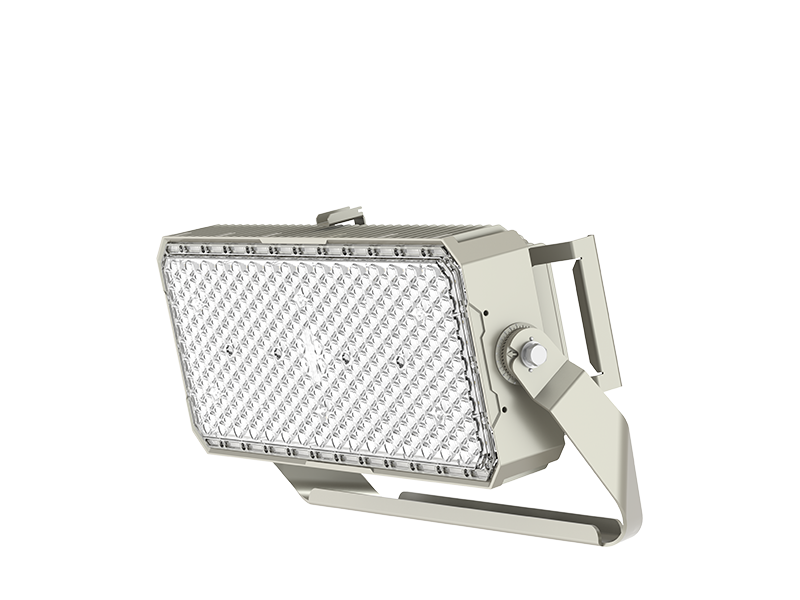
Dimming is where weak systems are exposed
Many stadiums create separate scenes for maintenance, training, competition, broadcast and entertainment. A driver that is stable at 100% output may show much deeper modulation at 20%, 40% or 60%. RGB and RGBW systems add another variable because individual colour channels may use pulse-width modulation at different duty cycles.
For that reason, the test schedule should follow the actual scene list rather than checking only maximum output. At minimum, measure full output, the lowest broadcast scene, the normal training scene and every level used during a televised light show. If a scene is intended only for audience entertainment and will never be filmed in slow motion, say so in the operating plan rather than pretending every effect is broadcast-safe.
Lighting quantity still matters to the camera
Removing modulation does not solve a dark picture. High-speed cameras use short exposure times and therefore collect less light per frame. The design must provide enough vertical illuminance toward the principal camera positions, not merely a bright horizontal playing surface.
CIE 083:2019 treats flicker alongside vertical illuminance, horizontal uniformity, colour temperature and colour rendering for television and film. Those subjects have to be calculated together. Increasing gain to compensate for insufficient vertical light adds noise; opening the lens reduces depth of field; neither is a lighting solution.
Use the approved camera positions in the photometric model and calculate vertical illuminance on the planes required by the broadcaster. Our stadium lighting design guide explains how camera directions, poles and aiming points fit into the wider layout.
Do not ignore colour consistency
Broadcast faults are not limited to bands and flashing. A mixed batch of luminaires can show colour differences across the pitch, and RGBW fixtures can shift colour while dimming if the channels are not controlled consistently. Specify a nominal CCT, permitted chromaticity tolerance and minimum colour-rendering requirement for the delivered batch. Verify the result after the luminaires have reached stable operating temperature.
If old metal-halide fixtures remain in the stands or concourse, put them in the camera test. A clean LED pitch with a flickering background still produces unusable replay.
Factory testing for flicker-free stadium lighting
A useful pre-shipment test is small enough to repeat and specific enough to settle a dispute:
- test the complete production luminaire, not an engineering sample;
- use the destination voltage and both relevant mains frequencies where the project requires them;
- warm the luminaire to stable output;
- record the optical waveform at full output and every broadcast dimming level;
- repeat the test through the supplied DALI, DMX or 0–10 V control path;
- film the luminaire or a uniformly lit target at the agreed frame rates and shutter settings;
- save the driver model, serial number, firmware and controller settings with the report.
One passed sample does not guarantee an entire shipment. For a large venue, agree on batch sampling and retain one reference unit so that later replacements can be compared with the original system.
Commissioning flicker-free stadium lighting on the field
Factory data reduces risk; it does not replace site acceptance. Cable length, supply quality, control gateways and firmware can all change behaviour. Test the installed system after final addressing and aiming, using the production cameras if possible.
| Site test | What to record |
|---|---|
| Match scene | All principal camera positions, normal and replay frame rates |
| Training scene | Lowest routinely used output level |
| Entertainment scenes | Static colours, fades, chases and transitions likely to appear on camera |
| Background sources | Scoreboards, ribbon displays, stand lights, tunnel lights and advertising |
| Power events | Scene recall and behaviour after a supply interruption |
Keep the camera files, meter results and controller scene export in the handover package. If the broadcast team later changes cameras, those records give the lighting engineer a reliable starting point.
Specification wording that can be tested
Avoid a single line that says “flicker-free.” A defensible flicker-free stadium lighting specification identifies the complete luminaire and driver, the test method, the supply condition, the dimming levels, the intended camera settings and the acceptance procedure. It should also require stable performance after warm-up and after the control system is commissioned.
ROKEE supplies LED sports lights with project-specific driver and control configurations. For broadcast work, send the field drawing, camera schedule, voltage and scene list through the project enquiry form. The useful answer is a tested configuration and an acceptance plan—not a generic badge.
Frequently asked questions
What does flicker-free stadium lighting mean?
It means the installed lighting remains acceptably stable for the agreed cameras, frame rates, shutter settings and dimming scenes. The phrase has little value unless those conditions and a test method are stated.
Can a phone camera prove that stadium lights are flicker-free?
No. A phone can reveal an obvious problem, but its automatic shutter, rolling sensor and image processing do not reproduce professional high-speed broadcast conditions.
Does DMX cause flicker?
DMX carries control instructions; it is not itself the optical waveform. Flicker depends on how the receiving driver or colour controller regulates LED current, especially at reduced output.
Should flicker be tested only at 100% brightness?
No. Drivers often behave differently when dimmed. Test every scene that may be recorded, particularly the lowest broadcast level and RGB/RGBW effects.
Is a low SVM value enough for high-speed cameras?
No. SVM is useful for evaluating a temporal artefact perceived by people, but camera performance also depends on frame rate, shutter and waveform. A camera test remains necessary.
Authoritative references
Related Posts