
An LED light salt spray test is an accelerated corrosion exposure, not a calendar that…
Solar Parking Lot Lights: Design and Buying Guide
Solar parking lot lights work best where trenching and grid extension are costly, but only when the system is sized for the site’s darkest season. A dependable design balances the nightly lighting load with the solar panel, battery, controller, LED luminaire, optics and local weather. Choosing from wattage alone can produce a bright demonstration on the first night and unreliable operation after several cloudy days.
This guide explains what a commercial buyer should establish before requesting quotations. Final illuminance, uniformity, glare and energy performance should be confirmed with a photometric layout and a location-specific solar calculation.
Good solar parking lot lights therefore begin as a site design, not as a product-catalog selection.
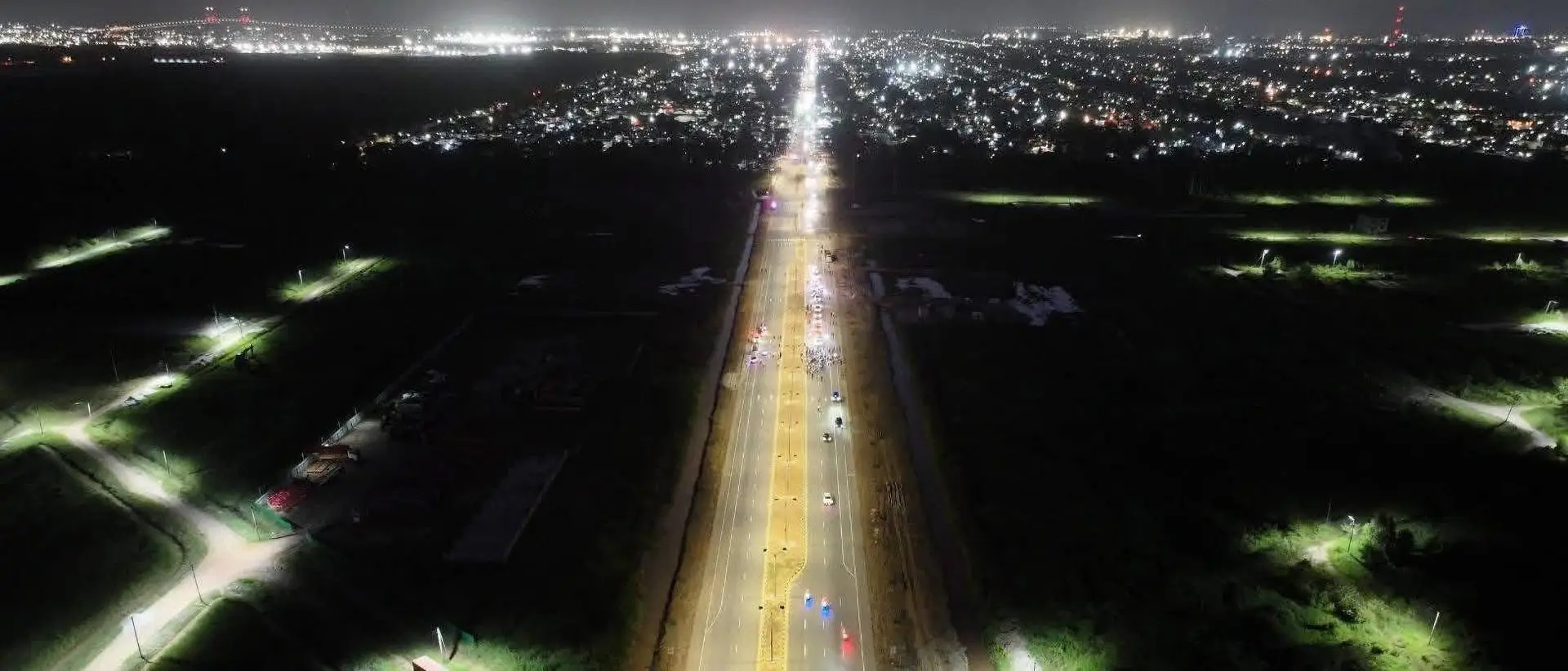
When solar parking lot lights make sense
Solar is especially attractive for remote lots, overflow parking, logistics yards, temporary facilities and new sites where the nearest electrical connection is far away. Independent poles can also limit the effect of a single cable fault and allow installation with less disruption to finished paving.
The business case is weaker where buildings, trees or terrain shade the panels; where winter solar resource is very low; or where the site requires high output at full power all night without room for sufficient panels and batteries. In these cases, grid-connected or hybrid lighting may be more reliable and economical.
Start with the lighting requirement
Do not size the solar hardware before defining what the parking area must look like at night. Record vehicle lanes, parking bays, pedestrian routes, entrances, loading zones, CCTV positions and neighboring properties. Then identify the applicable local standard and owner criteria.
A photometric plan should report maintained horizontal illuminance, uniformity, vertical light where faces or cameras matter, and spill at the site boundary. The U.S. Department of Energy’s solar-powered street and area lighting fact sheet likewise recommends evaluating application needs, system components, controls, operation and maintenance rather than comparing products on a single number.
Optics and pole locations
Parking-lot geometry determines the light distribution. A pole along the edge often needs a forward-throw asymmetric optic to place light inside the property and limit backlight. A pole within an open area may use a wider distribution. Mounting height and spacing must be developed together; widely spaced poles with narrow optics usually create bright islands and dark gaps.
The same lesson applies to street lighting design: lumens do not show where the light lands. Use the proposed luminaire’s actual IES or LDT file.
Build an honest nightly energy budget
The controller’s operating profile turns the lighting design into an energy requirement. For example, a light may run at a higher output during the evening, dim overnight and return to higher output before dawn. Motion sensing can conserve energy in low-activity zones, but it should not create unsafe transitions or reduce CCTV usefulness.
When comparing solar parking lot lights, ask each supplier to calculate the same schedule so panel and battery proposals are genuinely comparable.
At a basic level, daily lighting energy is the sum of power multiplied by operating hours for each step:
Nightly load (Wh) = Σ luminaire input power (W) × hours at that operating level
Add controller and communication consumption, then account for driver, battery and wiring losses. Treat “equivalent wattage” or LED-chip wattage as marketing language unless the supplier states the actual system input and measured luminaire output.
Size for winter, not the annual average
The critical design month is usually the period with long nights and weak solar irradiation, not the sunny annual average. The supplier needs the site coordinates, panel orientation, tilt, shading, required operating schedule and acceptable reduced-output behavior. Weather datasets and conservative loss assumptions should be documented in the proposal.
Battery autonomy describes how long the system can support its programmed load when solar charging is limited. There is no universal number of backup nights for every project. A security-sensitive facility may accept a larger battery and panel; a low-use overflow lot may accept controlled dimming during prolonged bad weather.

Check each part of the system
| Component | Information to request | Common mistake |
|---|---|---|
| LED luminaire | Input power, luminaire lumens, distribution file, CCT, CRI, ingress and surge protection | Using LED-chip lumens in the lighting calculation |
| Solar panel | Rated power, technology, orientation, tilt and temperature assumptions | Sizing from annual sunshine rather than the critical month |
| Battery | Chemistry, usable capacity, temperature limits, BMS and replacement method | Comparing nominal amp-hours without voltage and usable depth |
| Controller | Charging method, operating schedule, sensor logic, protections and data access | Leaving the dimming profile undefined |
| Pole and foundation | Projected area, wind region, soil data, structural calculation and anti-corrosion treatment | Assuming a standard foundation fits every soil and wind condition |
All-in-one or split solar design?
An all-in-one unit integrates the panel, battery and luminaire into a compact assembly. It can simplify installation and suits sites with good sun exposure and moderate loads. A split design allows the panel to face the best solar direction while the light follows the photometric aim. It also provides more flexibility for larger panels, batteries and service access.
There is no automatic winner. Compare complete-system performance, wind loading, theft risk, maintenance access and the visual requirements of the site. ROKEE offers multiple solar LED light configurations, including the G3 all-in-one solar street light and modular alternatives for project-specific sizing.
Controls, security and maintenance
A sensible control profile saves stored energy without hiding pedestrians. Coordinate dimming and motion behavior with facility operating hours, accessibility routes and cameras. The DOE’s exterior lighting controls guidance is a useful reference for occupancy, scheduling and commissioning considerations.
Maintenance still matters in an off-grid system. Panels collect dust and bird deposits, batteries age, nearby vegetation grows and pole foundations can move. The handover should include cleaning intervals, battery replacement access, spare components, controller settings and a method for checking faults. See ROKEE’s 7,000-unit solar lighting project for an example of solar deployment at project scale.
What to send with an RFQ
A complete RFQ allows solar parking lot lights to be evaluated on measurable performance rather than nominal wattage.
- Site coordinates and a dimensioned parking plan.
- Required lighting criteria and applicable standard.
- Operating hours, dimming steps and motion-control rules.
- Known shading, winter weather and temperature range.
- Wind, corrosion, soil and foundation requirements.
- Requested autonomy and acceptable low-energy fallback.
- Photometric report, solar calculation and warranty documentation required for approval.
Send these details through the ROKEE project enquiry form. A comparable quotation should show its assumptions instead of hiding them behind a claimed wattage.
Frequently asked questions
How many solar parking lot lights do I need?
The quantity depends on the lot geometry, pole locations, mounting height, optical distribution and required uniformity. It should be calculated with the exact luminaire photometric file.
Do solar parking lot lights work on cloudy days?
They can, if the panel, battery and control schedule are sized from local low-solar conditions. During unusually long poor-weather periods, a system may use planned dimming to protect critical operating time.
What battery is best for a solar area light?
The answer depends on temperature, usable energy, cycle requirements, safety design and service access. Compare the complete battery pack, BMS and warranty rather than chemistry alone.
Can solar lights replace grid lighting in every parking lot?
No. Heavy shading, high continuous light levels or limited room for solar hardware can make grid or hybrid systems more practical.
What information proves a solar lighting proposal will work?
Request a photometric calculation, a location-specific energy balance for the critical season, the operating profile, component data, structural assumptions and clear low-battery behavior.
Related Posts