
How street lighting is designed and specified: illuminance, uniformity, glare limits, pole layout, CIE 115:2010 classes and ROKEE LED luminaires up to 190 lm/W.
Explosion-protected products are critical for safety in areas where a flammable atmosphere can form. Such areas typically include oil and gas drilling platforms, refineries, chemical production facilities, flammable liquid storage installations, fuel transportation systems, gas stations, paint manufacturing plants, paper mills and more. Deploying suitable equipment in these zones provides substantial safety benefits.
This page covers hazardous area lighting from a selection standpoint: which zone needs which protection concept, which luminaire series fits each environment, and what documentation to request. The regulatory background — ATEX directives, IEC 60079 standards, marking syntax and gas/dust groups — is explained in our ATEX explosion-proof lighting guide.
Hazardous Area Lighting by Zone
Zone classification describes how often an explosive atmosphere is present. It determines the minimum protection level a luminaire must carry:
| Zone | Atmosphere | Presence | Typical locations |
|---|---|---|---|
| Zone 0 | Gas, vapor or mist | Continuously, for long periods or frequently | Inside tanks, vapor spaces above flammable liquids |
| Zone 1 | Gas, vapor or mist | Likely during normal operation | Pump areas, loading arms, refinery process units |
| Zone 2 | Gas, vapor or mist | Unlikely in normal operation; short duration if it occurs | Surrounding areas, ventilation boundaries, utility zones |
| Zone 20 | Combustible dust | Continuously, for long periods or frequently | Inside dust collectors, silos, milling equipment |
| Zone 21 | Combustible dust | Likely during normal operation | Bagging areas, transfer points, powder handling rooms |
| Zone 22 | Combustible dust | Unlikely; short duration if it occurs | Warehouse perimeters, dust extraction exits |
Classification is normally supplied by the site’s process safety or EHS team. Where it is not, it is derived from release level, opening type and ventilation quality — the method is summarised in the ATEX guide.
Protection Concepts and What They Mean for the Fixture
- Ex db (flameproof enclosure) — the housing contains an internal ignition and cools the escaping gas below ignition temperature. Used in Zone 1 and 2 gas areas, including hydrogen and acetylene environments under gas group IIC.
- Ex tb (dust-ignition-proof enclosure) — the enclosure excludes dust and limits surface temperature, protecting Zone 21 and 22 dust areas and conductive dusts such as aluminium or magnesium powder.
- Ex e (increased safety) — design measures prevent sparking and excessive temperature in normal operation, commonly used for terminal and control enclosures.
- Ex i (intrinsic safety) — energy is limited so that no ignition-capable spark or hot surface can occur; used in instrumentation rather than high-output lighting.
In practice, hazardous area lighting for refineries and shipyards is dominated by flameproof and dust-ignition-proof designs. Housing construction details matter as much as the certificate: explosion-proof joint width, gasket material, cable entry type and fastener grade all affect long-term compliance.
Hazardous Area Lighting Range
| Series | Power range | Positioning |
|---|---|---|
| G2 | 30–240 W | Zone 1/2/21/22 linear and flood formats; explosion-proof surface width over 10 mm |
| G4 | 30–1000 W | High-power flood version for large industrial sites; all connectors in SUS 304 |
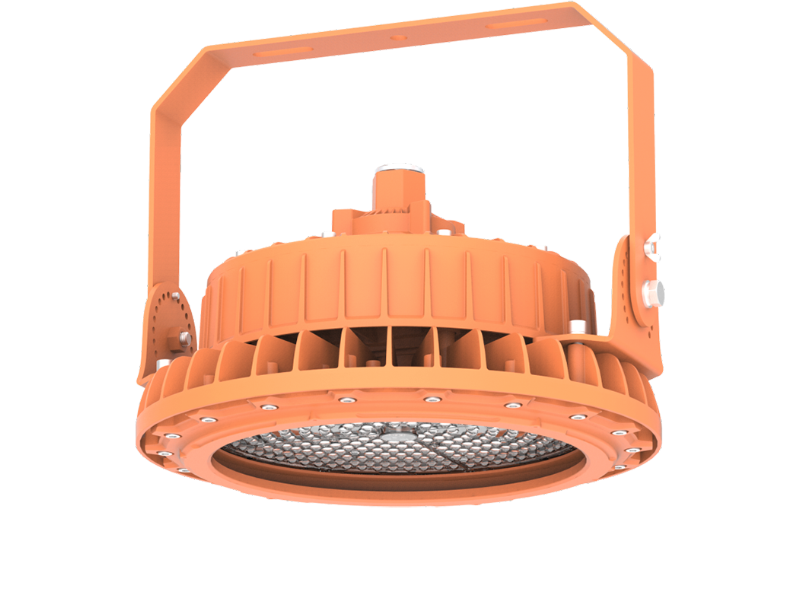
| G5 | 60–200 W | Compact ATEX luminaire for chemical plants; light source and driver spaces designed separately |
All series are manufactured to IEC/EN 60079 and supplied with ATEX certification for the quoted configuration. See the full explosion proof LED light range.
Environments That Define the Specification
Hazardous area lighting rarely faces a single stress. Most sites combine several:
- Petrochemical and refining — gas groups up to IIC, salt-laden air near coastal terminals, high ambient temperatures.
- Shipyards and ports — permanent salt spray, wind-driven rain, impact from handling equipment.
- Paint and coating plants — solvent vapours plus paint mist that coats the housing and reduces light output.
- Gas stations and fuel depots — canopy lighting where the fixture sits directly above dispenser areas.
- Dust processing — flour, wood, metal and coal dust, where surface temperature limits matter more than gas grouping.
- Wastewater and biogas — corrosive hydrogen sulphide atmospheres combined with humidity.
Specify for the worst combination, not the average: the luminaire must hold its certificate, its IP rating and its light output for the maintenance interval the site can realistically achieve.
Project Example
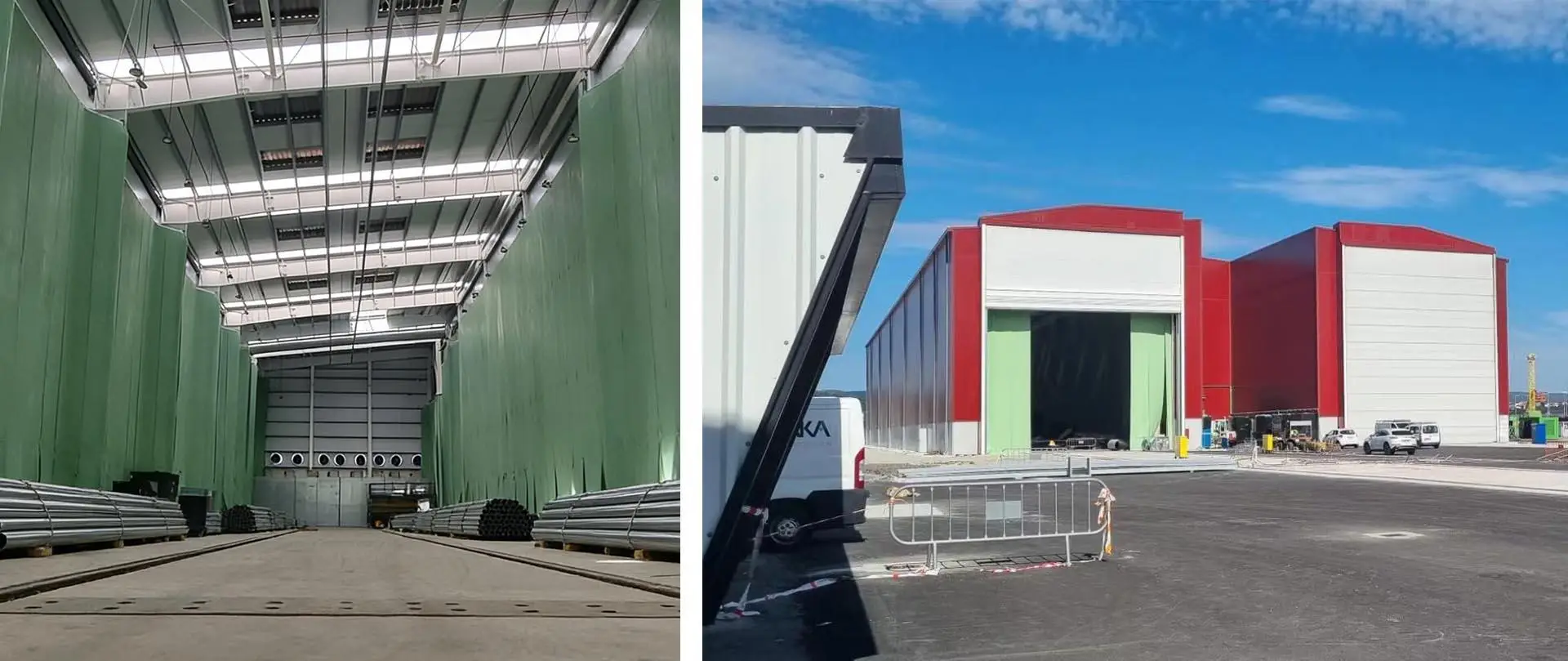
ROKEE supplied explosion-proof LED lighting for a shipyard hazardous-area project, where fixtures operate under continuous salt spray exposure combined with zone-classified areas. More installations are listed under hazardous area lighting projects.
ATEX Marking: A Quick Check
A typical gas-area marking reads II 2 G Ex db IIC T6 Gb: non-mining equipment, category 2 (Zone 1), gas atmosphere, flameproof enclosure, gas group IIC, surface temperature limited to 80 °C, equipment protection level Gb. A dust version reads II 2 D Ex tb IIIC T80°C Db.
Two checks catch most procurement errors: confirm the certificate lists the exact model and variant being quoted, and confirm the T-class is below the auto-ignition temperature of every substance on site. The marking syntax is broken down element by element in the ATEX marking guide.
Frequently Asked Questions
Can standard LED high bays be used in a hazardous area?
No. Only luminaires with valid certification matching the zone, gas or dust group and temperature class may be installed. A standard high bay can become an ignition source even if it is IP66 rated.
What is the difference between ATEX and IECEx for a project?
ATEX is mandatory for the European market; IECEx is a global certification scheme built on the same IEC 60079 standards and is widely accepted outside the EU. Many projects specify both.
Does higher wattage mean a lower temperature class?
Not automatically, but it can. Higher-output versions of the same housing may carry a different T-class, so the marking must be verified for the exact configuration quoted, including emergency and dimming options.
Request a Hazardous Area Lighting Proposal
Send your zone classification, gas or dust group, area drawings and lighting requirements through the contact page. The engineering team will return a compliant luminaire selection with photometric layout and certification documentation for each model.