
Most gas station canopy projects fail on one of two things: they are lit far…
Commercial LED Street Lights: A Specification Guide
Commercial sites buy street lighting for a different reason than a highway authority does. A municipality is protecting drivers; a business park, an industrial estate, a retail car park or a logistics yard is protecting people, vehicles and liability — and paying the electricity bill itself. That single difference changes almost every specification: the wattage, the optic, the controls, and how much the buyer cares about what the fixture looks like in year six.
This guide is written for that buyer. It covers how commercial LED street lights are sized by application rather than by wattage, what mounting height and spacing follow from it, which optic distributions belong where, and the documents to demand before a purchase order.
1. What makes a street light a “commercial” street light
The category is defined by the site, not by the product. Commercial LED street lights are the fixtures installed on privately owned or business-managed land: office and business parks, industrial estates, retail and supermarket car parks, hospitals and campuses, ports, logistics yards, hotels and resorts. Three practical consequences follow:
- The owner pays for the energy and the maintenance, so total cost of ownership beats purchase price — a fixture that costs 20% more and lasts twice as long wins.
- The site is closed at known times, which makes dimming and scheduling profitable in a way it rarely is on a public highway.
- There is usually a boundary — a neighbouring property, a road, a house — so spill light and backlight become commercial risks, not just design preferences.
Any supplier who quotes commercial LED street lights without asking about those three points is quoting a product, not a solution.
2. Wattage follows from the application
Buyers of commercial LED street lights tend to arrive with a wattage in mind, usually the wattage of whatever is being replaced. It is more useful to start from the application, because the wattage then falls out of the mounting height and the area to be covered:
| Application | Typical wattage | Mounting height | Optic note |
|---|---|---|---|
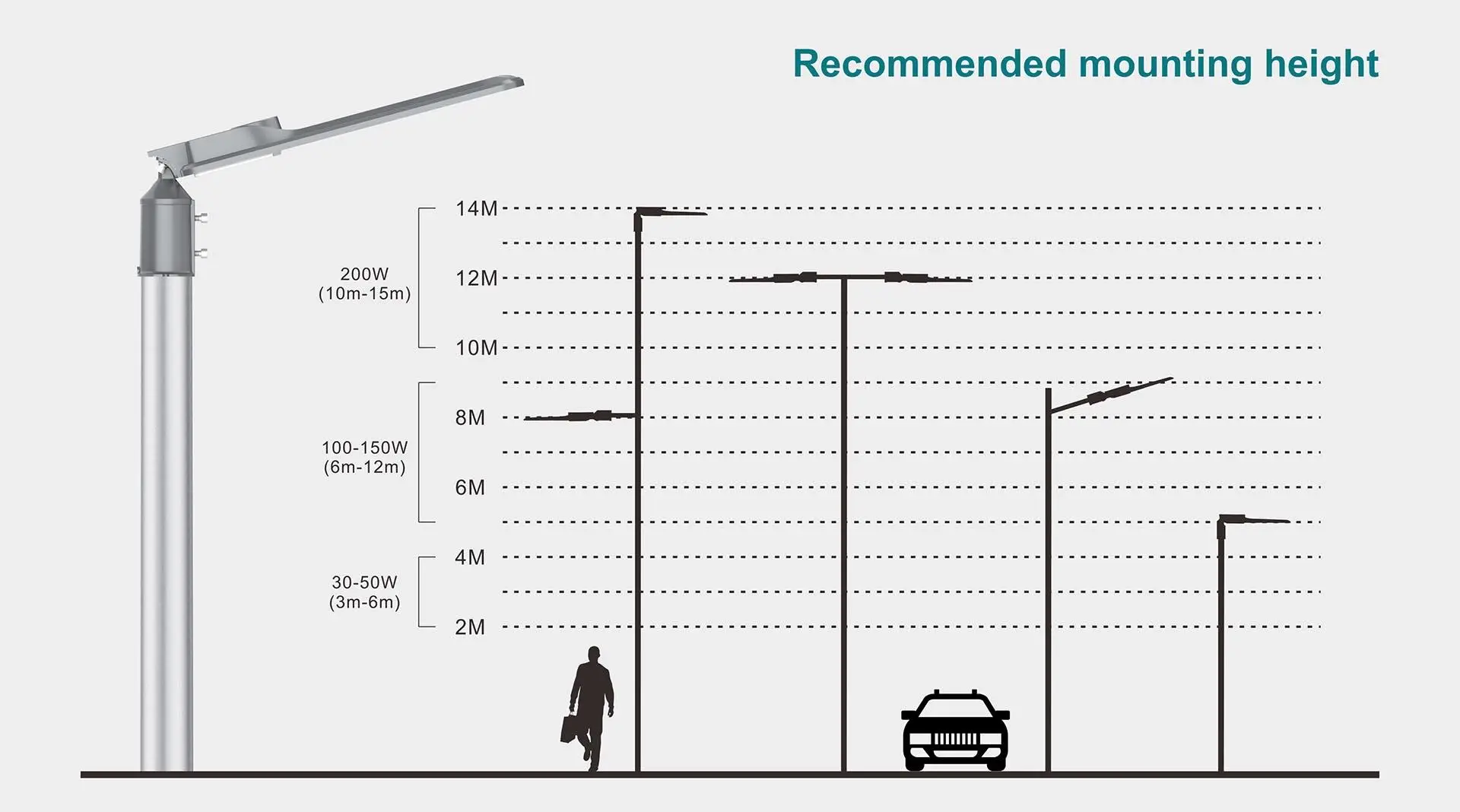
| Pedestrian paths, cycleways, campus walkways | 20–50 W | 3–6 m | Narrow, low-glare; a wide optic at low height creates glare, not coverage |
| Car parks and forecourts | 30–100 W | 4–8 m | Square or wide asymmetric; uniformity matters more than peak lux |
| Access and estate roads | 60–150 W | 6–10 m | Forward-throw asymmetric along the carriageway |
| Collector roads inside a site | 100–200 W | 8–12 m | Type II or III, arranged single-sided or staggered |
| Logistics yards, ports, industrial hardstanding | 150–300 W | 10–15 m | Wide asymmetric or high-mast; check wind load, not just output |
The performance classes behind those targets are defined in EN 13201-2 for roads and in EN 12464-2 for outdoor work places such as car parks and yards.
Two things go wrong at this stage. The first is buying commercial LED street lights on a watt-for-watt basis from the old high-pressure sodium installation: a 150W LED head usually replaces a 250W sodium head, and matching 250W produces an over-lit site, higher bills and worse glare. The second is buying on lumens alone — a 100W fixture at 160 lm/W delivers more usable light on the ground than a 120W fixture at 125 lm/W, and it also costs less to run.
3. Mounting height, spacing and the geometry nobody checks
On commercial LED street lights, mounting height sets everything downstream: the optic, the spacing, the glare risk and the pole cost. The relationship is not linear — doubling the height roughly quadruples the illuminated area for the same optic, but halves the illuminance — which is why the wattage has to rise with the pole.
Spacing is usually expressed as a multiple of mounting height. For carriageway lighting a ratio of roughly 3:1 to 4:1 applies with a forward-throw optic; for car parks the ratio widens to 4:1 or 5:1 because the areas are open and the uniformity target is lower. Beyond 5:1 the pool of light between columns becomes visible and the site starts to read as badly lit even when the average lux is technically fine.
Two geometry details are routinely missed on commercial projects: the spigot diameter (60 mm and 76 mm are both common, and a head that does not fit the existing pole turns a one-day retrofit into a fabrication job), and the arm reach — the distance from the pole to the luminaire centre, which decides whether light lands on the carriageway or on the verge.
4. Optic distribution: where most commercial LED street lights go wrong
The optics on commercial LED street lights are described by type, and the type has to match the geometry of the area:
- Type I — narrow, along a path. Walkways and cycleways.
- Type II — asymmetric along one side of a carriageway. Single-sided road layouts.
- Type III — wider asymmetric, for staggered or opposite layouts on wider roads.
- Type IV — forward throw into an open area; the default for car parks and forecourts.
- Type V — rotationally symmetric, for square areas and roundabouts.
The common failure on commercial sites is installing a Type II carriageway optic over a car park because the fixture was cheaper or already in stock. The result is a bright strip down the middle of the bays and darkness at the far kerb, plus glare into the windscreens of parked cars. A Type IV or an asymmetric wide optic solves it for the same wattage.
Equally important is backlight control. Most modern commercial LED street lights offer a house-side or backlight shield as an accessory, and on a site boundary it is the difference between a planning condition being satisfied and a complaint being raised. Ask for it at quotation stage; retrofitting shields later costs more than the shields.
5. IP, IK and surge: the three ratings that decide survival
These three numbers separate industrial-grade commercial LED street lights from repackaged residential products, and they are where price differences usually hide:
| Rating | Why it matters on a commercial site | Minimum we would accept |
|---|---|---|
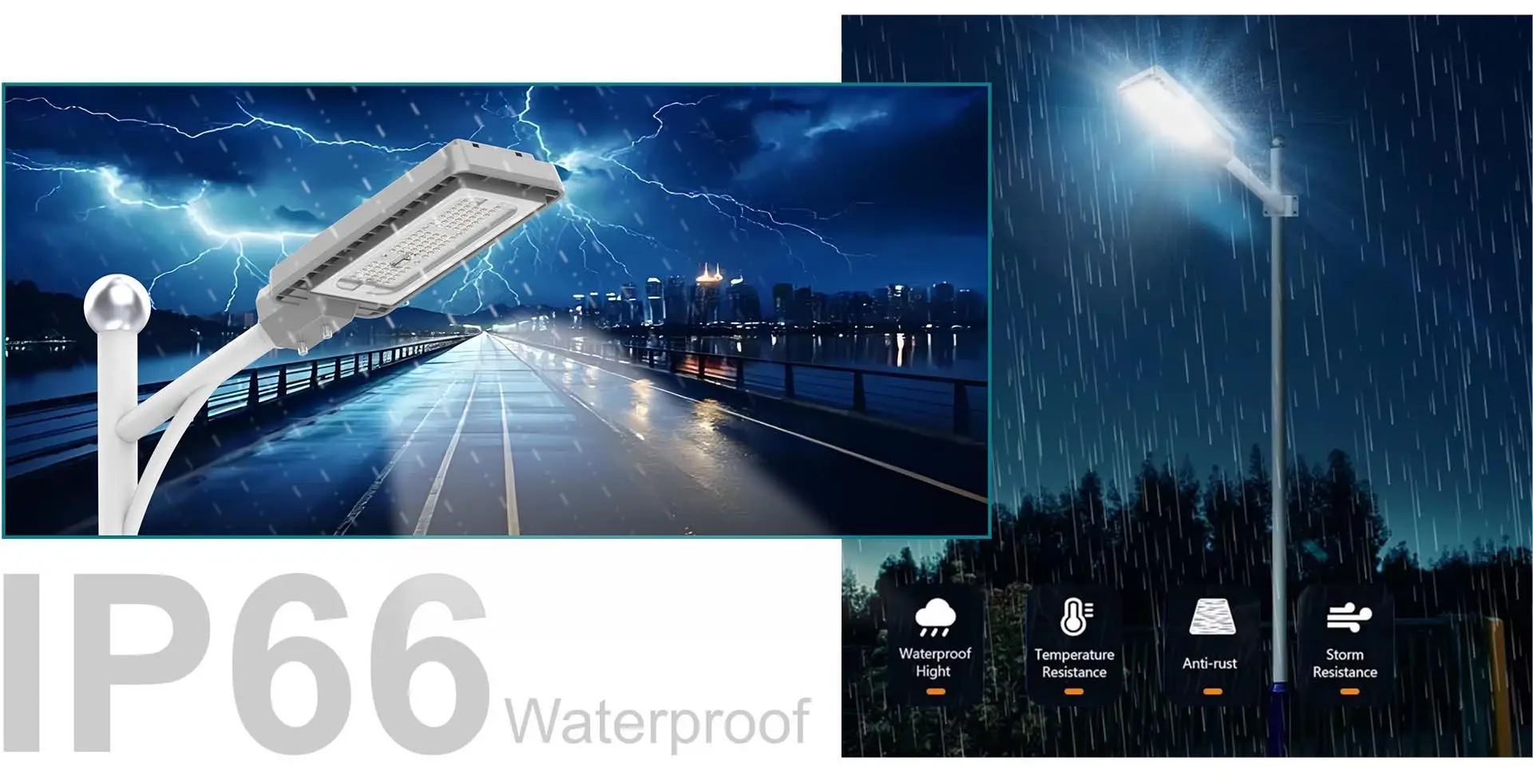
| IP66 | Pressure washing, driven rain, dust from yards and trucks | IP66 (IP65 is acceptable only under a canopy) |
| IK08 / IK09 | Vandalism, trolley impact, hail, yard machinery | IK08; IK09 in public car parks |
| Surge protection | Lightning-prone regions and sites with overhead distribution | 10 kV surge immunity at the driver input |
Add the ambient temperature to the same conversation. A commercial LED street light rated for full output at 25°C and derated 15% at 50°C will underperform its datasheet across the Gulf, South Asia and much of Africa — and the failure shows up as driver death in year three, not as a dimmer site.
6. Controls: where commercial sites get their money back
Public highways run all night because the road authority says so, and that is why commercial LED street lights are usually the first place a controls budget gets cut. A business park does not have to. This is the single largest operating-cost lever available to a commercial buyer, and it is usually ignored because the tender was copied from a municipal one.
- Photocell — dusk-to-dawn switching. The baseline, and it should be built in or socketed, not added as an external box.
- Time-based dimming — 100% until the site closes, 30–50% afterwards. On a retail car park this alone can cut energy by a third.
- 0–10V or DALI dimming — required if the site will ever be sub-metered per tenant or tied to a building management system.
- Zhaga or NEMA 7-pin socket — lets a controller be added later without replacing the luminaire, which is how most commercial estates eventually adopt central management.
- Central management (CMS) — fault reporting per pole. On a 200-pole estate, knowing which eight are dark without a site walk is the real return.
The specification trap here is buying commercial LED street lights with a proprietary controller built into the driver. When the platform is discontinued — and they are, on a five to seven year cycle — the fixtures become dumb, and the site is back to photocells.
7. Corrosion, coastal sites and industrial atmospheres
A car park inland and a port terminal are not the same product. Salt-laden air attacks aluminium housings, hinges, screws and cable glands, and galvanic corrosion between dissimilar metals is the usual failure point rather than the coating itself. For coastal and industrial sites, look for:
- Corrosion-resistant housing and a coating system rated for C4 or C5 atmospheres
- Stainless steel fasteners throughout, not just on the visible cover
- IP68 cable glands and breathing valves rather than sealed-but-condensing enclosures
- Marine-grade paint on the pole interface, since that joint is where water sits
Our G27 corrosion-resistant street light exists for exactly this case, and it is worth knowing that the difference is in the hardware, not the LED.
8. What to demand in the quotation
A quotation for commercial LED street lights should contain all seven items below. Missing any of them transfers risk to you at handover.
| Item | Why it decides the outcome |
|---|---|
| LM-79 report for the complete luminaire | Confirms delivered flux, efficacy, CCT and CRI at the stated wattage |
| IES or LDT photometric file | Without it, nobody can verify the lux or uniformity you are being promised |
| Lighting calculation for your layout | Grid, spacing and uniformity values — the only real proof of coverage |
| Driver brand and model | Determines replaceability and realistic life; a no-name driver is a five-year liability |
| Weight and EPA per fixture | Existing poles have limits; a heavier head may require new poles |
| Warranty terms in writing | What counts as failure, and who pays freight — the part that is always omitted |
| Spares and lead time | A 200-fixture site needs matching spares in year one, not a new product generation |
If you want an independent check on whether a fixture has actually been tested rather than simply described, the DesignLights Consortium qualified products list is a reasonable place to start, particularly when comparing suppliers.
9. Retrofit or new build
Most projects that buy commercial LED street lights are retrofits: the poles exist, the civil work is done, and only the heads are being replaced. That is the cheaper route and usually the right one, but three checks belong before the order:
- Spigot and arm compatibility — diameter, arm reach and tilt range.
- Head load and wind loading — a modern LED head may be lighter than the old sodium unit, but its projected area is often larger.
- Circuit capacity — LED retrofit reduces load, which occasionally means the existing contactor and cabling can serve more poles than before. That is an opportunity, not an obstacle.
When the poles are being replaced anyway, the layout should be recalculated rather than copied — this is the one moment where spacing, height and optic can be fixed at no extra cost.
10. Five mistakes that show up on almost every commercial site
- Replacing watt for watt from high-pressure sodium, which over-lights the site and raises the bill.
- Using carriageway optics in car parks, producing glare between parked cars and dark kerbs.
- Ignoring backlight and spill until a neighbour complains or a planning condition is refused.
- Buying commercial LED street lights with sealed, non-replaceable drivers — one failure means one new luminaire.
- Skipping surge protection on sites with overhead distribution, then blaming the fixture when a storm takes out a third of the poles.
11. Bottom line
For a commercial site, the right specification is not the highest wattage or the cheapest head. It is a fixture whose optic matches the area, whose height and spacing were calculated rather than inherited, whose IP, IK and surge ratings survive the site, and whose driver can be replaced in year seven. Get those four right and the procurement decision becomes simple, because the remaining differences between suppliers are mostly paperwork.
Our LED street light range covers 30W to 300W across the G7 multi-optic, G9 high-efficiency, G10 flip-top, G22 high-power and G24 multi-optic platforms, all with replaceable drivers and Zhaga-ready sockets. For layout and spacing method, read the street lighting design guide; for the standards that govern the targets, see street lighting solutions.
Related Posts