
Most gas station canopy projects fail on one of two things: they are lit far…
LED High Bay Lights for Warehouse Applications
LED high bay lights are the backbone of warehouse illumination, but a warehouse is not one uniform space. Receiving docks, bulk storage, narrow rack aisles, picking modules and loading yards impose different lighting demands. Specifying one fixture and one output for the whole building usually over-lights some zones and under-lights others.
This guide walks through warehouse zones one by one and explains how mounting height, aisle geometry, target illuminance and controls shape the high bay selection for each. The goal is a design that meets task requirements where they exist and saves energy everywhere else.
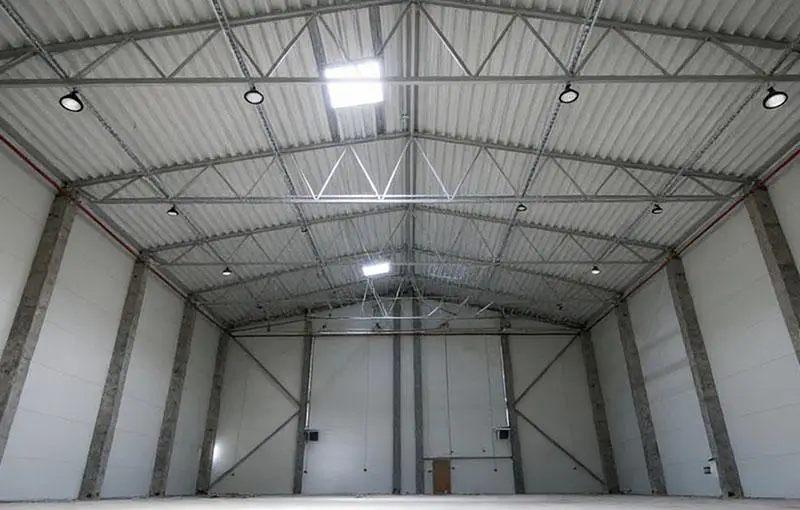
Why Warehouses Depend on LED High Bay Lights
Warehouse racks concentrate obstruction, not just height. High bays must throw light down narrow aisles, avoid shadows cast by pallets, and hold uniformity across tall mounting distances. LEDs made this practical: high optical efficiency, instant restrike, dimming capability and long maintenance intervals suit facilities that operate in shifts around the clock. Selecting LED high bay lights per zone, rather than per building, is what turns these advantages into measurable savings.
Compared with metal halide, LED high bay lights also hold maintained illuminance better. Lumen depreciation is gradual and predictable, so a design that starts slightly above target stays compliant for years instead of dropping below it between relamping cycles.
Match Output to Mounting Height and Aisle Geometry
Mounting height sets the optical starting point. At 8 to 10 meters, wider distributions spread light across open areas; at 12 meters and above, narrower beams keep intensity on the floor without excessive fixture count. Aisle-oriented racks invert the logic: linear distributions running parallel to the aisle put light between racks, while round UFO optics may waste output against rack faces.
Practical rules the design should confirm through calculation:
- align linear high bay orientation with aisle direction;
- use narrower beams as mounting height rises;
- keep fixture rows coordinated with rack rows, not the building grid alone;
- check uniformity on the floor and at mid-height rack faces where picking occurs.
Zone-by-Zone Warehouse Requirements
Receiving and dispatch docks
Dock areas handle paperwork, forklift traffic and truck interiors. Moderate illuminance with good vertical light on faces and door thresholds matters. Fixtures near doors should tolerate drafts and temperature swings; wall packs and linear fixtures complement high bays here. Where powered equipment operates, align the lighting layout with OSHA’s warehousing safety guidance on visibility and pedestrian separation.
Bulk storage and open floor
UFO high bay lights suit these zones: high output, compact wind area, and optics chosen for the mounting height. The layout prioritizes even coverage and forklift safety rather than rack-face lighting. Open zones are also where energy savings concentrate, because LED high bay lights there can dim when occupancy sensors detect no activity.
Narrow and very narrow aisles
Order-picking aisles often leave little room for fixture rows. Linear high bays with aisle optics, or narrower UFO beams at closer row spacing, keep light between racks. Glare control matters because operators face upward while handling loads.
Picking modules and mezzanines
Lower mounting heights move tasks into the low-bay range. Continuous linear fixtures with diffusers reduce LED image glare on labels and screens. Emergency lighting integration is typical on escape routes in these areas.
Cold storage
Freezer rooms need drivers and fixtures rated for low-temperature starts, sealed housings rated against condensation, and surfaces that resist icing. Verify the rated temperature range rather than assuming standard high bays will start reliably.
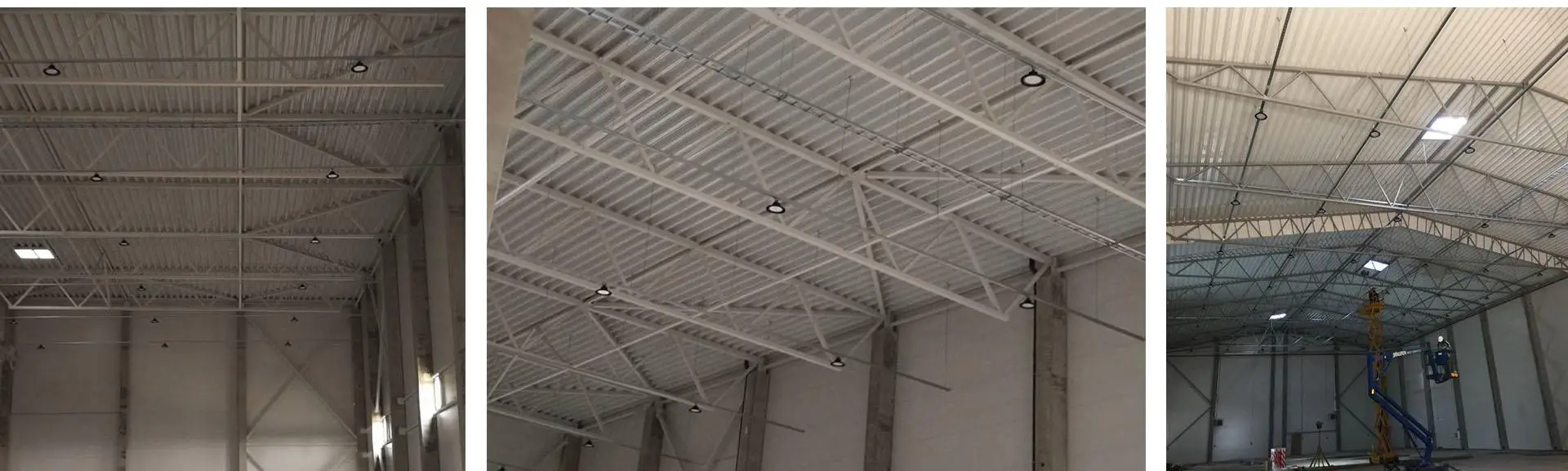
Optics, Glare and Controls
Optics determine efficiency at the working plane. Request IES or LDT files and a dialux or AGi32 calculation that models racks and tasks, not an empty-box estimate. Glare control accessories, reflector choices and mounting position relative to aisle centerlines all affect comfort for forklift and picking staff. Verify that the LED high bay lights quoted can deliver the calculated result with dimming, because output and control behavior are specified together.
Controls multiply savings because warehouses often hold light at full output for hours with no occupancy. Standard packages include occupancy sensing per aisle, daylight harvesting near skylights, and scheduled scene levels for cleaning versus operation. Pair controls with dimmable drivers specified at quotation time. Our warehouse LED high bay selection guide covers the fixture-level criteria in more depth.
Energy and Maintenance Planning
Estimate annual energy from connected load, operating hours and control schedules; the U.S. Department of Energy’s solid-state lighting resources provide benchmarks for efficiency comparisons. Plan maintenance access from the start: aisle layouts that block lift access make even reliable fixtures expensive to service. Keep records of fixture locations and driver batches so future service of LED high bay lights can draw on the same parts without relamping entire zones.
For a full design workflow, including lux targets and calculation assumptions, see the warehouse lighting design guide.
Specify High Bays for Your Warehouse
ROKEE manufactures UFO and linear LED high bay lights with application-specific optics and control options. Send your warehouse layout, rack heights and operating hours through the contact page for a zone-by-zone photometric design and quotation.
Frequently Asked Questions
How many lumens should warehouse high bays produce?
There is no single answer. Required fixture output follows from mounting height, aisle geometry and target illuminance, established through a photometric calculation for the actual layout rather than a generic lumen rule.
UFO or linear high bay for a warehouse?
UFO fixtures suit open storage and higher mounts; linear fixtures suit rack aisles and lower mounts where an elongated distribution reduces glare and wasted light. Most warehouses use both.
Can LED high bays handle freezer conditions?
Models rated for low-temperature operation can. Confirm the rated temperature range, sealing class and condensation behavior before ordering for cold storage zones.
Related Posts