Commercial sites buy street lighting for a different reason than a highway authority does. A municipality…
LED Gas Station Canopy Lights: Requirements, Wattage and Installation
Most gas station canopy projects fail on one of two things: they are lit far above the level anyone needed, or the installer spends weeks chasing an explosion proof certificate that the fixture never required. Both mistakes come from the same place — treating a forecourt like a generic outdoor area instead of reading the rules that actually apply to it.
This guide covers the four decisions that determine the result: how much light the pump island needs, which electrical classification applies at canopy height, how many fixtures that translates into, and what the installation itself has to survive.
1. What the pump island actually needs
LED gas station canopy lights are specified in foot-candles or lux on the horizontal plane at nozzle height, not at the ceiling. The reference most designers work from is IES RP-33, which puts fuel dispensing areas in the same family as other high-activity exterior tasks:
| Zone | Recommended | Minimum | Notes |
|---|---|---|---|
| Under canopy, pump island | 20–50 fc (215–540 lux) | 10 fc (108 lux) | Branded stations usually sit at the top of the range |
| Canopy drive lane | 10–20 fc (108–215 lux) | 5 fc | Transition between canopy and forecourt |
| Forecourt and parking | 2–5 fc (20–54 lux) | 1 fc | Security level, not task level |
| Shop entrance and ATM | 30 fc and up | 15 fc | Vertical illuminance matters more than horizontal |
Two constraints sit on top of that table for any set of LED gas station canopy lights. Uniformity across the canopy should stay within about 4:1 (maximum to minimum), because a bright pool over one island and a dark one over the next reads as a badly lit station even when the average is fine. And in many jurisdictions the upper limit is set by light trespass rules rather than by lighting need — some municipalities cap canopy illuminance specifically to protect nearby housing.
2. The classification question that wastes the most time
This is where LED gas station canopy lights get over-specified more than anywhere else. The classified area at a fuel dispensing facility is defined by NEC Article 514, and it is smaller than most people assume: roughly the space up to 18 inches above grade within about 20 feet horizontally of the dispenser enclosure, plus the interior of the dispenser and its connected piping.
A canopy fixture mounted 14 to 17 feet above grade is well outside that envelope. It sits in unclassified space, which means it needs to be listed for wet locations and built for the environment — but it does not need a hazardous location listing. Asking a supplier for an explosion proof canopy light usually buys a heavier, more expensive fixture with worse photometrics for no compliance benefit.
There are two exceptions worth knowing. Fixtures mounted inside the classified envelope — bollard lights, low wall packs, dispensers themselves — do need the appropriate rating. And in some jurisdictions the local authority having jurisdiction applies a more conservative interpretation than the code text, so the answer is always confirmed with them in writing before the order is placed, not after.
3. Wattage and fixture count
Sizing LED gas station canopy lights from a lumen target is more reliable than working from a wattage. A practical starting point for a forecourt is 70 to 100 lumens per square foot of canopy, which is roughly 750 to 1,080 lux-equivalent of installed flux before optical and maintenance losses are applied:
| Canopy size | Typical fixture count | Wattage each | Result |
|---|---|---|---|
| 2,000 sq ft (185 m²), 2–4 pumps | 4–6 | 100–150 W | 20–30 fc at island level |
| 3,000–4,000 sq ft (280–370 m²) | 6–10 | 150–200 W | 25–35 fc |
| 5,000 sq ft and above (465 m²+) | 10–15 | 200–300 W | 30–50 fc, branded standard |
A 150W fixture at 130 to 150 lumens per watt produces 19,500 to 22,500 lumens, which is the direct replacement band for a 400W metal halide canopy light. That ratio — roughly one to 2.7 on wattage — is the number that makes the retrofit pay: a station running 12 canopy fixtures for 12 hours a night removes about 30,000 kWh a year by moving from 400W metal halide to 150W LED, before any dimming is applied.
4. Layout, spacing and the edge setback
At the mounting heights used on forecourts — 12 to 16 feet — most LED gas station canopy lights are laid out in a grid at 8 to 12 feet between fixture centres, which gives even coverage with most asymmetric canopy optics. The spacing tightens or widens with the beam angle, so it should come out of a photometric layout rather than a rule of thumb.
What the layout must guarantee is that every pump position, at nozzle height, clears the minimum. Columns and downstands are the usual cause of a dark island, because the fixture grid gets pushed around them and nobody re-checks the cells underneath. Edge fixtures should also be set back 3 to 5 feet from the canopy perimeter; the light that spills past the fascia is the light that generates complaints.
5. Colour temperature, CRI and camera performance
For LED gas station canopy lights, 4000K and 5000K are both standard. 5000K reads brighter and photographs better; 4000K is easier on the eye at a station with a convenience store attached. In dark-sky jurisdictions the limit may be 3000K, and major oil brands often dictate colour temperature in their own image standards — check that before specifying, because repainting a canopy is not an option after installation.
CRI matters more here than in most outdoor applications. Staff and customers read fuel grade labels, price displays and payment screens under this light, and CCTV footage taken under a low-CRI source is noticeably harder to use. A CRI of 80 is the sensible floor; there is no reason to accept less on a fixture at this price point.
6. What the environment does to LED gas station canopy lights
A forecourt is not a normal outdoor location for LED gas station canopy lights. The fixture sits above a source of petrol vapour, under a steel canopy that radiates heat in summer, and it is expected to run for a decade with almost no maintenance access. Four specifications carry most of that burden:
- IP65 as a minimum, IP66 for monsoon and pressure-wash climates. The gasket is the failure point, not the LED.
- IK08 or better. Hoses, ladders and delivery equipment all reach the canopy line eventually.
- UV-stable lens and a corrosion-resistant housing. Petrol vapour plus sunlight attacks polycarbonate and paint; a lens that yellows shifts colour temperature and cuts output.
- Driver accessible from below. The single biggest maintenance cost on a forecourt is closing a lane to reach a driver mounted above the ceiling.
None of these show up on a quotation. All four decide whether the installation is still performing in year six.
7. Installation realities: recessed versus surface
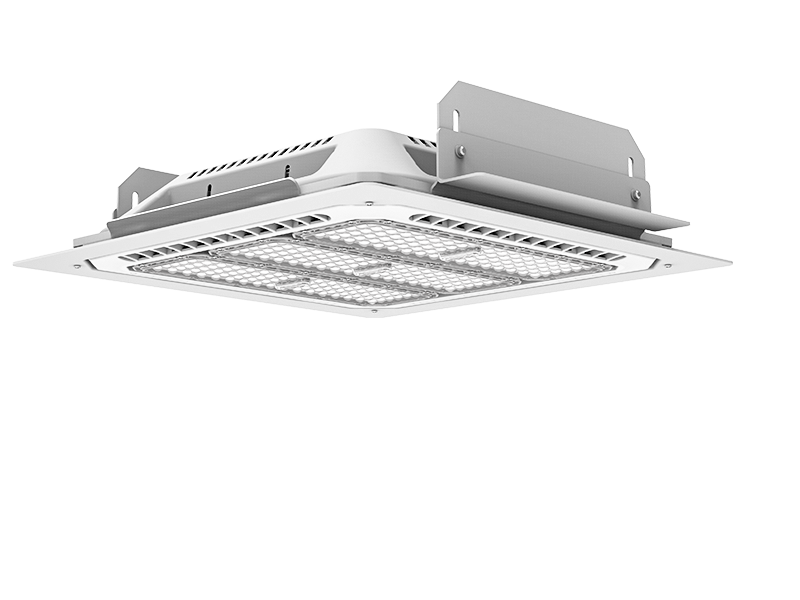
Recessed LED gas station canopy lights suit new canopies and clean retrofits where the ceiling void is accessible and deep enough for the heatsink. Surface-mounted fixtures are the practical answer for existing canopies with shallow voids or no access above, because the work happens entirely from below and does not disturb the canopy membrane.
Whichever route is taken, three things need checking before the first box is opened: the weight per fixture against the canopy structural capacity, the fixing pattern against the existing frame (a different bolt spacing means fabrication), and the conduit entry position relative to the ceiling structure. On a live station, the sequence also matters — a phased replacement by island, done overnight, avoids closing the forecourt at all.
8. Controls worth having
LED gas station canopy lights usually run at full output from dusk until dawn because that is how the old installation worked. With LED gas station canopy lights there is no technical reason for it: a photocell handles switching, 0-10V dimming handles the quiet hours, and a modest drop to 50 or 60 percent between midnight and 5 a.m. is invisible to customers while taking a further slice off the bill. Keep the dimming curve in mind when comparing drivers — a cheap driver that dims to 20 percent and flickers is worse than no dimming at all.
9. Checklist before you order
- Horizontal illuminance target confirmed at nozzle height, with the local authority’s light trespass limit checked as well.
- Written confirmation that the canopy mounting height falls outside the classified envelope, or a hazardous-location fixture where it does not.
- Photometric layout for the LED gas station canopy lights, showing uniformity across every island rather than just the average.
- LM-79 report and IES file so the layout can be verified independently.
- IP, IK and lens material stated in writing, plus the corrosion class if the site is coastal.
- Driver replacement procedure — from below, and how long a lane has to close.
- Weight per fixture and fixing pattern matched to the existing canopy frame.
10. Choosing the fixture
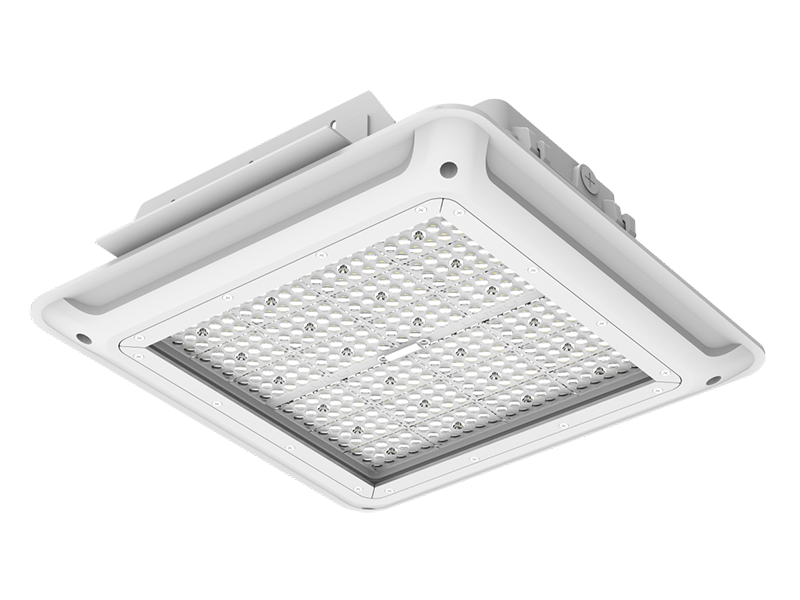
ROKEE builds LED gas station lights in three canopy formats: the G1 recessed canopy light, the G6 from 60W to 200W, and the G7 surface-mounted canopy light. All three use the same optical approach — a downward array with a wide asymmetric distribution — so the choice comes down to ceiling depth, mounting method and the output the layout calls for.
If the project also includes the rest of the site and the LED gas station canopy lights are only one part of it, the wall pack range covers building perimeters and the street lighting solutions page covers the access road. For the compliance framework behind the numbers in section 1 and 2, see NFPA 30A, which governs motor fuel dispensing facilities.
Related Posts