
Zone-by-zone hazardous area lighting selection with ATEX-certified LED luminaires for petrochemical plants, shipyards, paint booths and dust-hazard sites.
Street lighting is a fundamental public facility for urban roads. Its core functions are to ensure nighttime traffic safety, improve road efficiency, prevent crime and create a comfortable nighttime environment. Modern street lighting is no longer just a lighting tool, but a technical system integrating optical design, power control, structural safety and intelligent management.
A high-quality street light should provide sufficient, uniform and glare-free visual conditions for drivers and pedestrians with reasonable energy consumption. The G10 series 240 W LED street light is a representative example, delivering 190 lm/W with IK10 protection and a flip-top design.
Five Factors That Decide Road Lighting Quality
1. Brightness and illuminance. Comply with the specified average luminance (cd/m²) or average illuminance (lx) for the road class — expressway, main road, secondary road or branch road. Too low leads to poor visibility; too high wastes energy and creates light pollution.
2. Uniformity. Both overall uniformity and longitudinal uniformity matter. Poor uniformity produces the “zebra effect”, which causes visual fatigue for drivers and hides obstacles between bright pools of light.
3. Glare control. Installation angle, mounting height and light distribution must control glare effectively. Glare temporarily impairs vision and is a major accident risk; threshold increment is typically required to stay at TI ≤ 15%.
4. Surround ratio. The ratio of average illuminance in the 5 m strip outside the carriageway to that inside the lane. A proper surround ratio improves safety by revealing roadside obstacles, cyclists and pedestrians.
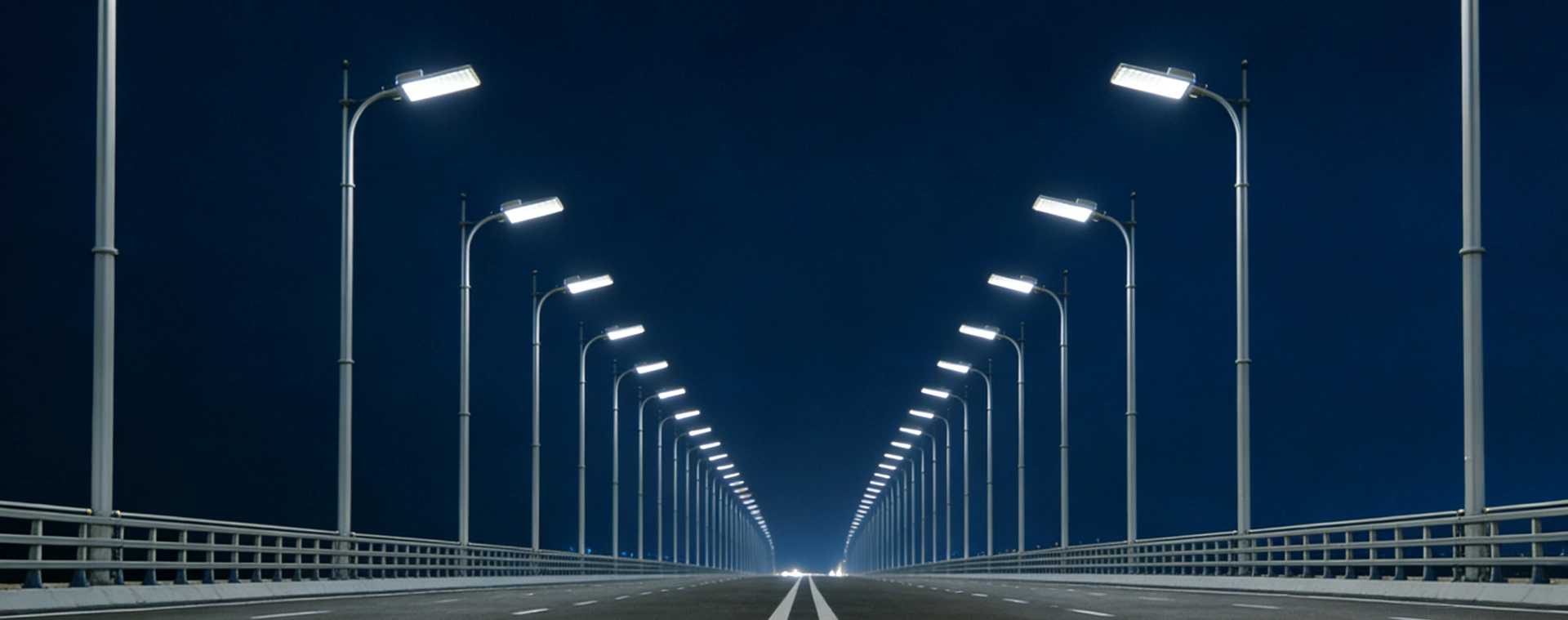
5. Pole arrangement. Single-sided, double-sided staggered, double-sided symmetric or central double-overhang — the choice depends on road width, median barriers and available space.
Pole Height, Spacing and Layout by Road Type
Recommended values for LED street lighting, based on CIE standards for LED street lights (mounting height = H):
| Road type | Lanes | Layout | Height H | Spacing S | Overhang | Notes |
|---|---|---|---|---|---|---|
| 1–2 lanes | 1–2 | Single-sided | 6–8 m | 20–30 m (S≤3H) | ≤1 m | Moderate illumination, cost-effective; increase fixture density at curves |
| 2 lanes | 2 | Double-sided staggered | 8–10 m | 25–35 m (S≤3.5H) | ≤1.5 m | Staggered arrangement avoids oncoming glare and improves uniformity |
| 4 lanes (with median) | 4 | Double-sided symmetric / central double-overhang | 10–12 m | 30–40 m (S≤3.5H) | ≤2 m | Or use dual-arm central mounting on the median, lighting both sides |
| 2 lanes + sidewalks | 2 + sidewalks | Double-sided symmetric | 8–10 m | 25–30 m (S≤3H) | 1.5–2 m | Sidewalk illuminance ≥50% of the lane value |
| Main road / expressway | 6+ | Double-sided symmetric / central double-overhang | 12–15 m | 35–45 m (S≤3.5H) | ≤2.5 m | Full cutoff or semi-cutoff; strict glare control |
Core principle: spacing (S) is usually 3–4 times mounting height (H). Shorten spacing or increase output at intersections, curves and crosswalks.
CIE 115:2010 Classes for Motorized Roads (M1–M6)
For road lighting projects and tender documents, the corresponding M-class (motorized) and P-class (pedestrian) lighting classes are selected according to CIE 115:2010. The table below covers luminance, uniformity and glare limits:
| Class | Application | Lav (cd/m²) | Uo (dry) | UI (dry) | Uo (wet) | TI (%) | SR |
|---|---|---|---|---|---|---|---|
| M1 | Expressway / urban expressway | 2 | 0.4 | 0.7 | 0.15 | 10 | 0.5 |
| M2 | Urban arterial / Class-I highway | 1.5 | 0.4 | 0.7 | 0.15 | 10 | 0.5 |
| M3 | Urban secondary / Class-II highway | 1 | 0.4 | 0.6 | 0.15 | 10 | 0.5 |
| M4 | Urban branch / Class-III highway | 0.75 | 0.4 | 0.6 | 0.15 | 15 | 0.5 |
| M5 | Low-volume / industrial roads | 0.5 | 0.35 | 0.4 | 0.15 | 15 | 0.5 |
| M6 | Rural roads / very low traffic | 0.3 | 0.35 | 0.4 | 0.15 | 20 | 0.5 |
CIE 115:2010 Classes for Pedestrian Areas (P1–P6)
| Class | Application | Eav (lx) | Emin (lx) | TI (%) | Ev,min (lx) | Esc,min (lx) |
|---|---|---|---|---|---|---|
| P1 | Commercial pedestrian street / high-flow square | 15 | 3 | 20 | 5 | 3 |
| P2 | Urban sidewalk / station square | 10 | 2 | 25 | 3 | 2 |
| P3 | Community path / park main road | 7.5 | 1.5 | 25 | 2.5 | 1.5 |
| P4 | Bike lane / community lane | 5 | 1 | 30 | 1.5 | 1 |
| P5 | Low-flow path / yard path | 3 | 0.6 | 30 | 1 | 0.6 |
| P6 | Remote path / landscape lighting | 2 | 0.4 | 35 | 0.6 | 0.4 |
The parameters are consistent with EN 13201-2:2015 and can be used directly for scheme selection, luminaire performance verification and tender document preparation. Most projects also impose additional requirements on ingress protection (IP65/IP66) and lightning protection level — confirm these in the specification before ordering.
For the step-by-step design method behind these values, see the street lighting design guide.
Why Choose ROKEE for Street Lighting
Founded in 2008, ROKEE serves customers in more than 120 countries with street lighting projects worldwide.
- Optical performance — high-efficiency LED chips at ≥190 lm/W with professional secondary lenses. Types I, II and III distributions give precise road coverage; energy saving is typically 50% or more against legacy HID. A representative model is the G9 series 300 W LED shoebox street light at 190 lm/W with a Type II-M beam.
- Heat dissipation and lifetime — modular dissipation (phase change or die-cast aluminium fins) keeps junction temperature at ≤85 °C, supporting a lifetime of ≥100,000 hours with lumen decay ≤30%.
- Robustness — IP66 or higher, 17-typhoon wind resistance and 1,000-hour salt spray testing, suitable for coastal and heavy industrial areas.
- Smart control — NEMA and Zhaga sockets with ZigBee, LoRa or NB-IoT options for remote dimming, energy monitoring, fault alarms and smart city integration.
- Installation and maintenance — tool-free electrical compartment and modular design allow on-site replacement in about five minutes, keeping operation and maintenance cost low.
Street Light Series
| Series | Power range | Key feature |
|---|---|---|
| G10 | 50–240 W | Flip-top shoebox, 170 lm/W or 190 lm/W |
| G9 | 50–300 W | Lens design reduces light decay, over 190 lm/W, Type II-M |
| G7 | 30–240 W | Five beam angles: Type II-S, II-M, III-M, IV-M, Type V |
| G22 | 60–300 W | Flip-top design with 10 kV / 20 kV surge protection |
| G24 | 60–240 W | Five optical beam angles, flip-top design |
| G27 | 30–200 W | Stronger corrosion resistance for harsh outdoor environments |
Solar versions of the same platforms are available for off-grid roads; see the LED street light range and solar LED lights.
Street Lighting Projects
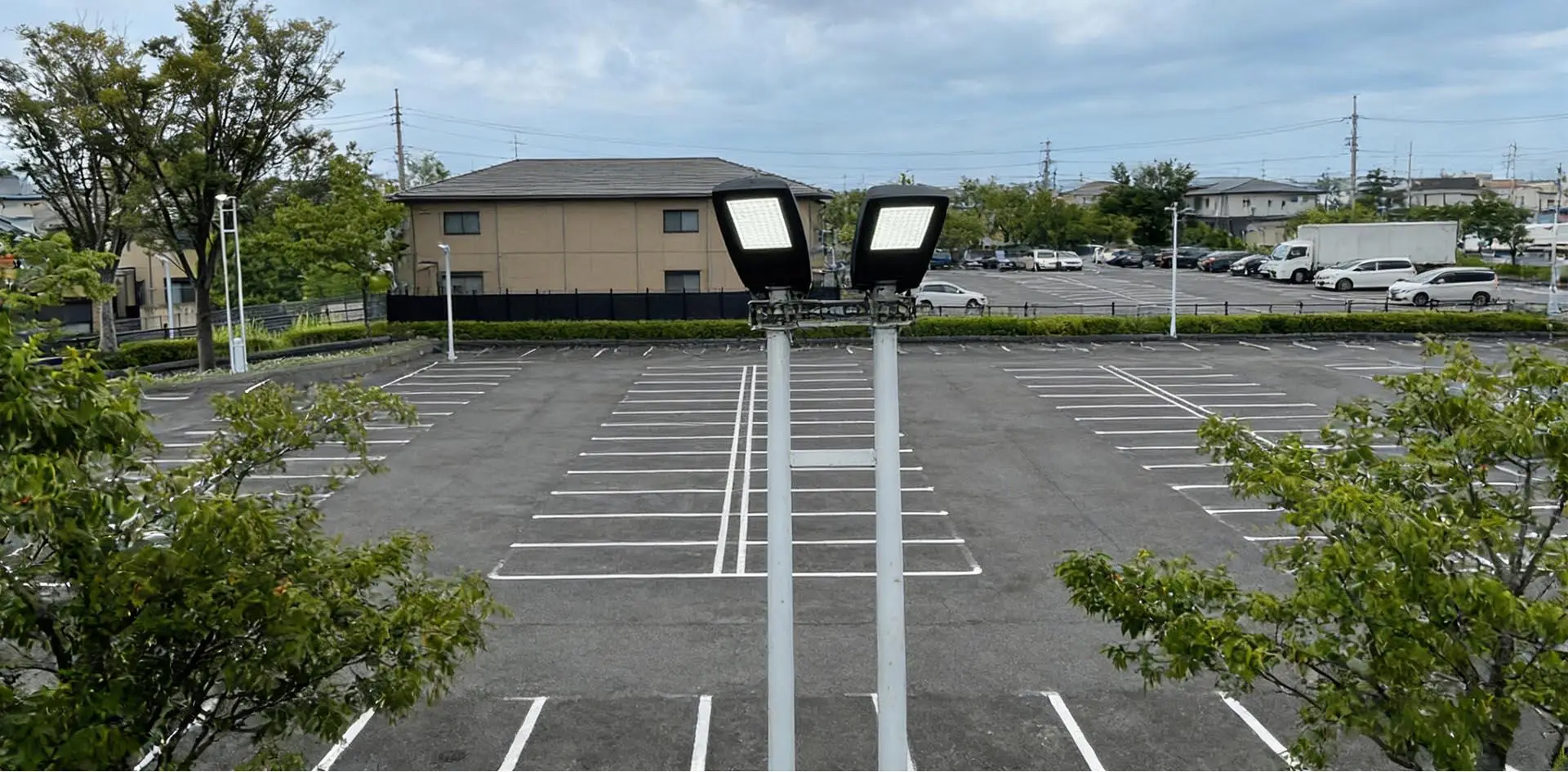
Selected installations include the LED parking lot lighting project in Japan and the delivery of 7,000 solar street lights put into application. More are listed under street lighting projects.
Frequently Asked Questions
Which lighting class should a project adopt?
Start from the road type and traffic volume, then confirm with the local authority or tender document. Motorized roads use M1–M6, pedestrian areas use P1–P6, and many projects specify a different class for intersections and crosswalks.
What pole spacing should street lighting use?
Spacing is normally 3–4 times the mounting height, then verified in a photometric calculation. Curves, intersections and pedestrian crossings need shorter spacing or higher output.
Is 190 lm/W realistic in a real installation?
Fixture efficacy is measured under test conditions. Real road performance depends on optical efficiency, maintenance factor, dirt depreciation and the control schedule — which is why a photometric layout matters more than the datasheet number alone.
Request a Street Lighting Design
Send your road drawings, pole schedule and target class through the contact page for a free lighting layout and configuration proposal tailored to your road type and traffic volume.