
ATEX is EU law. IECEx is a voluntary international certificate built on the same IEC…
LED Sports Field Lighting: The Complete Buyer’s Guide
Almost every sports field lighting decision comes down to four questions: how much light the sport actually needs, how evenly it has to be spread, how much glare the neighbours will tolerate, and who is going to maintain the installation in ten years. Answer those four properly and the product selection becomes straightforward, because LED sports field lighting is a mature category — the difference between a good and a bad installation is almost never the LED itself.
This page is the overview of LED sports field lighting: it gives you the targets, the fixture families, the layout logic and the procurement questions in one place, then points to the detailed guides for each topic. If you are preparing a tender, a budget or a supplier enquiry, start here and follow the links that match your situation.
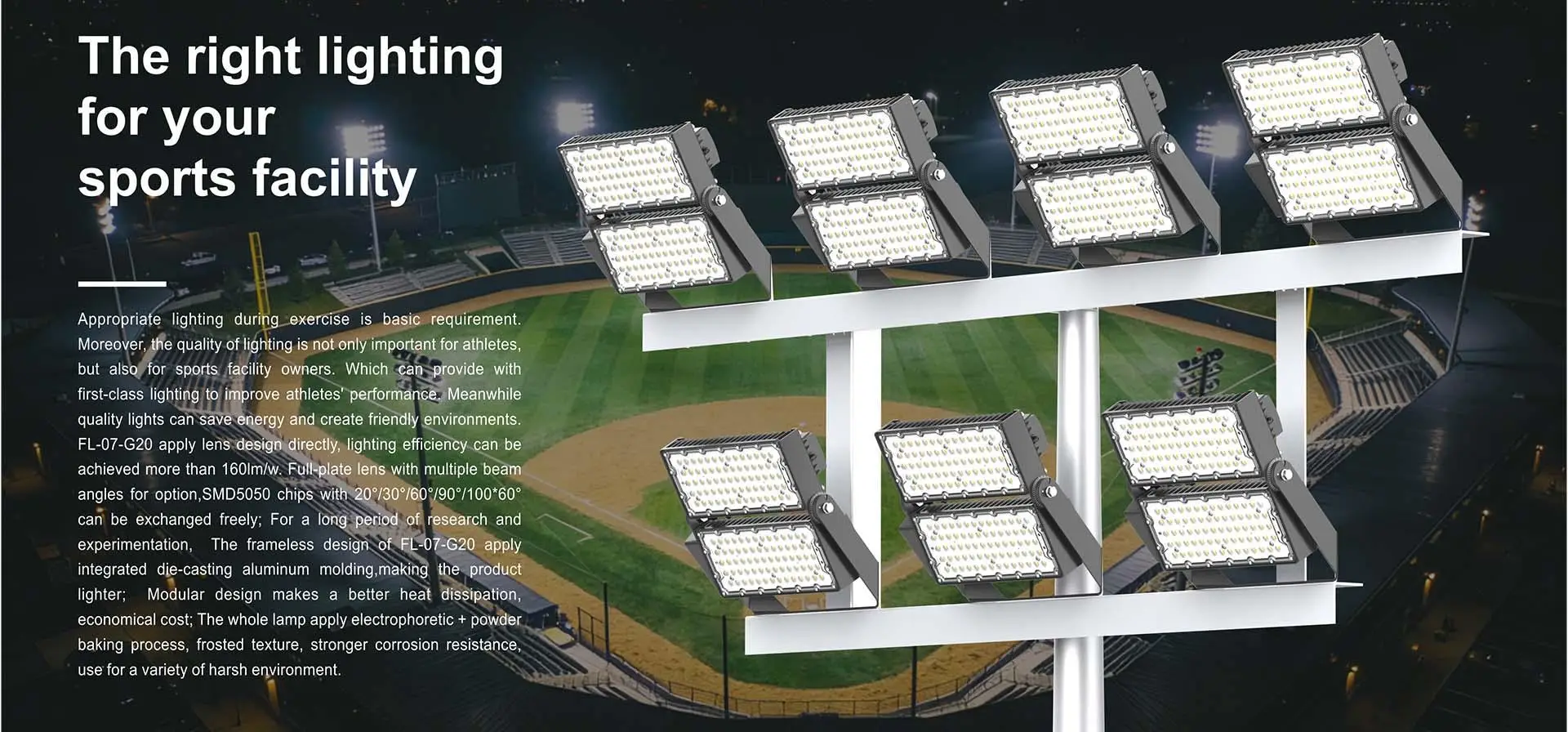
1. What counts as an LED sports field lighting project
LED sports field lighting covers a wide range of jobs, and they do not share a specification. Before comparing products, identify which of these you are actually buying:
- Training and community fields — the largest volume of projects worldwide, and the most price-sensitive.
- Competition venues — regional and national leagues, where uniformity and glare control start to matter as much as average lux.
- Televised stadiums — broadcast adds vertical illuminance, colour fidelity and flicker requirements that dominate the design.
- Multi-use facilities — one installation serving football, athletics and community events, usually with preset lighting scenes.
- Small-sided and racket courts — padel, tennis, basketball and five-a-side, where pole height is limited and glare control is the main challenge.
Each category has a different budget, a different approval authority and a different maintenance expectation. A community field and a televised stadium can use the same fixture family and still be completely different projects.
2. Illuminance targets by sport
Targets for LED sports field lighting are set by the governing body for the sport and level, and they are always quoted as maintained values on a defined grid. The table below shows the ranges that appear most often in tender documents; treat it as orientation, not as a substitute for the project standard.
| Sport / level | Typical horizontal illuminance | Uniformity focus | Detail |
|---|---|---|---|
| Football / soccer — training | 75–200 lux | U2 ≥ 0.5 | Football field lighting requirements |
| Football / soccer — competition | 200–500 lux | U2 ≥ 0.6–0.7 | Lux levels explained |
| Football / soccer — televised | 750–2,000+ lux vertical and horizontal | U1 and U2 both specified | Lux levels explained |
| Baseball / softball infield | 300–1,000 lux | Infield-to-outfield ratios | Baseball field lighting design |
| Tennis and padel courts | 200–500 lux | Very high uniformity, low glare | Sports light range |
| Athletics track | 100–500 lux | Even coverage across lanes | Standards guide |
Two rules apply across every sport, and they matter more than the wattage of the fixtures you buy. First, the target is a maintained value, so the calculation must include a maintenance factor for dirt and lumen depreciation. Second, the level is meaningless without uniformity — a field averaging 300 lux with dark corners fails the same way a 150 lux field does. Both are covered in our guide to sports field lighting standards.
3. Uniformity and glare: the two numbers that decide playability
Uniformity is the first thing that separates good LED sports field lighting from a bright but unusable installation. It is expressed as U1 (minimum ÷ maximum) or U2 (minimum ÷ average). A high average with poor uniformity produces bright patches and dark pockets, which is worse for players than a lower but even level, because the eye keeps re-adapting as the ball moves.
Glare is the other half. Athletes look up while tracking a high ball, and a fixture aimed toward the play area can be visually disabling even when the illuminance values are correct. Three design levers control it: mounting height, aiming angle and the optical distribution of the fixture. Raising poles and aiming luminaires more steeply reduces glare but costs more in steel — which is exactly why glare should be fixed at design stage, not after players complain.
For residential boundaries, add a third constraint to any LED sports field lighting design: spill light and light trespass onto neighbouring properties. Spill limits are usually imposed by the planning authority rather than the sports federation, and they can force shields or reduce aiming angles after the layout appears settled.
4. The three fixture families used on sports fields
Almost all LED sports field lighting is delivered by one of three families, and the choice follows pole height and competition level rather than brand preference.
| Family | Where it belongs | Typical output | Design note |
|---|---|---|---|
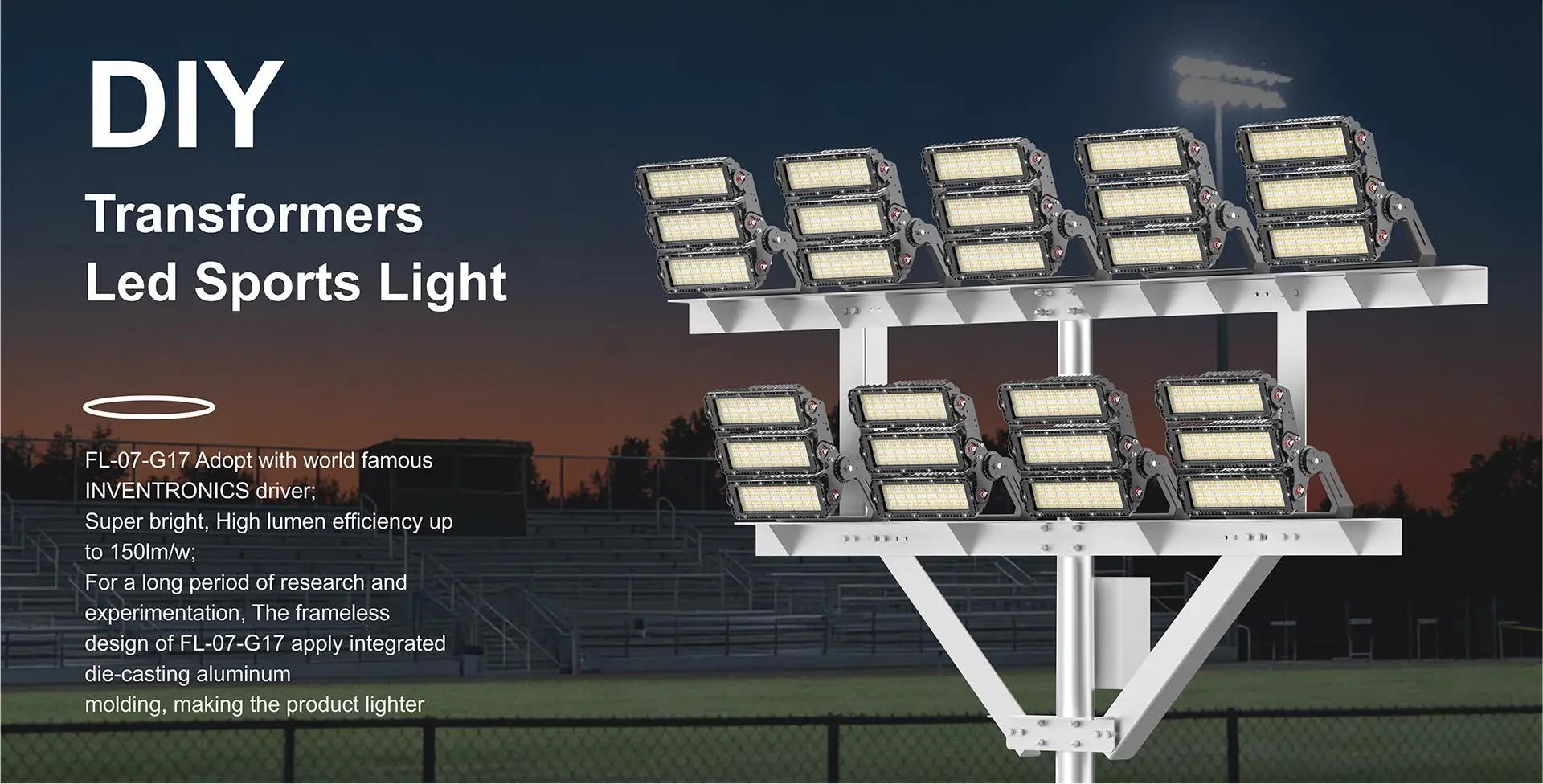
| Modular stadium floodlight | Competition and televised fields, large masts | 600–1,500 W per luminaire | Multiple modules allow tight beams and future output changes |
| High mast floodlight | Fields with 20–50 m masts | 400–1,200 W | Aiming accuracy and maintenance access dominate the design |
| Compact sports floodlight | Training fields, courts, small-sided pitches | 100–400 W | Lower pole heights make glare control the main constraint |
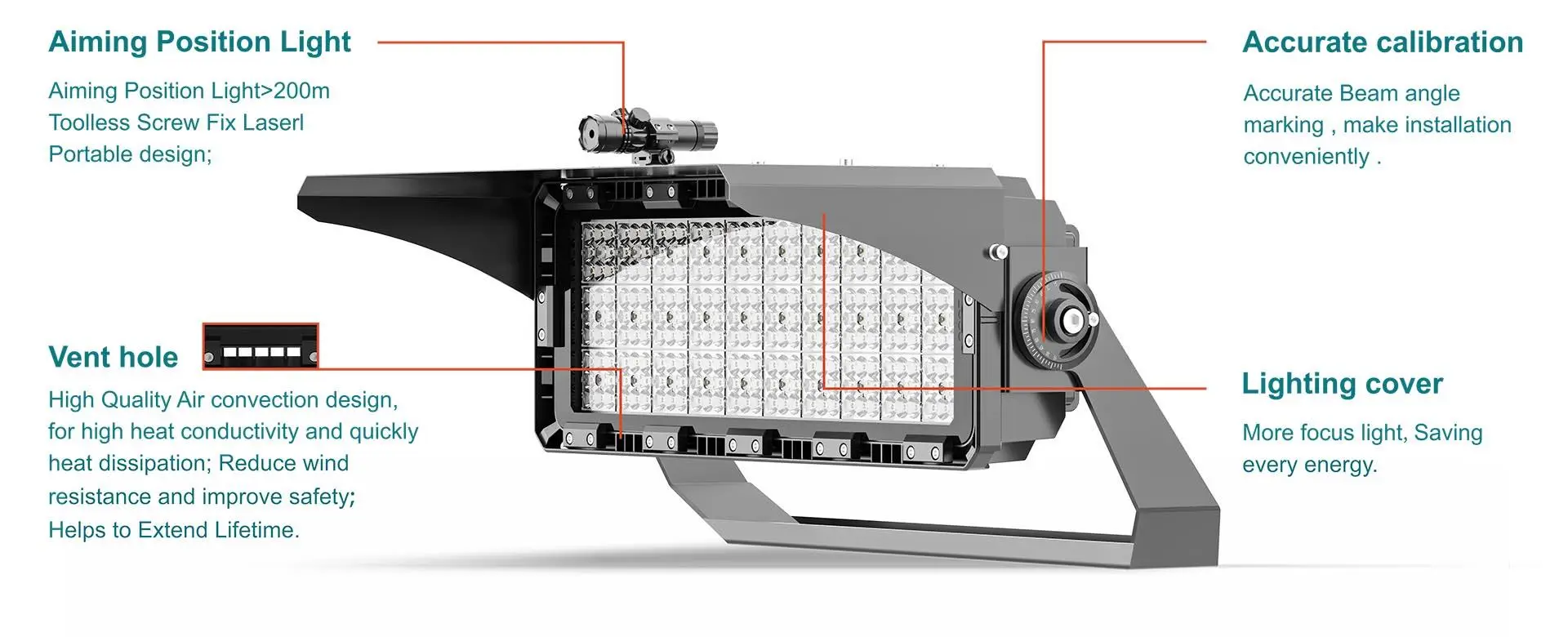
Two mechanical details are worth insisting on whatever the family. A built-in aiming device cuts commissioning time and makes later re-aiming repeatable. Visible angle markings on the bracket let a maintenance team restore the design aim after a pole inspection, instead of guessing. Our high mast LED lights guide explains how pole height and aiming interact on tall installations.
5. Pole layout and the photometric calculation
The layout is where LED sports field lighting projects are usually won or lost. Layouts follow one of four patterns: four corner poles, six or eight poles along the sides, a single side mast arrangement, or a full perimeter. Each produces a different uniformity profile and a different glare risk. Corner poles are the most common solution for rectangular fields; side poles give better vertical illuminance for cameras; perimeter layouts suit multi-use venues but cost more in steel and cable.
None of this can be settled by rule of thumb. The layout has to be verified in a calculation that uses the actual photometric files of the offered luminaires, on the grid required by the standard, with the maintenance factor applied. Ask for the calculation as a deliverable, along with the pole coordinates and aiming schedule — our stadium lighting design guide walks through the ten inputs that feed it.
If you are choosing fixtures rather than poles, the practical differences between beam angles and wattages are covered in how to choose LED flood lights for sports fields.
6. Replacing metal halide with LED sports field lighting
Most retrofit projects start with a simple ambition — keep the poles, change the lights — and hit four constraints in sequence.
- Pole loading. LED luminaires are usually lighter, but not always, and the wind area of a large modular fixture can exceed the old floodlight it replaces. The structural check comes first.
- Electrical capacity. Lower wattage usually leaves headroom, but inrush current and driver harmonics can trip protection that was sized for discharge lamps.
- Aiming and uniformity. A one-for-one swap keeps the old aiming pattern, which was designed for a different distribution. The result is higher lux on the centre and worse uniformity at the edges.
- Controls. Retrofit is the moment to add scene control for training, competition and cleaning modes, because the wiring is already open.
Done properly, retrofitting LED sports field lighting means a new calculation against the existing geometry, not a lamp substitution. That is also why the savings case is usually stronger than the supplier’s wattage table suggests: stadium lighting cost is dominated by mobilisation and maintenance access, not by electricity alone.
7. What to ask a supplier of LED sports field lighting
Eight questions separate a supplier of LED sports field lighting who can engineer a field from one who can only ship boxes.
- Can you provide IES and LDT photometric files for the exact model and optic you are quoting?
- Will you run the calculation on our field drawing, and will you show uniformity and glare, not just average lux?
- What is the delivered luminaire efficacy, measured at the luminaire rather than at the LED?
- Which driver is fitted, what is its surge rating, and can it be replaced without removing the fixture?
- What IP and IK ratings apply, and what corrosion protection is used for coastal or humid sites?
- How is the fixture aimed, and is there a repeatable angle reference on the bracket?
- What does the warranty cover — parts only, or labour and access equipment as well?
- Can we have a sample and a pre-production photometric test before the full order?
A supplier who answers all eight without hesitation is worth a longer conversation. The procurement side — samples, batch consistency, certification and shipping — is covered in custom LED stadium lights supplier.
8. Read the deep dives
Each of these covers one part of the LED sports field lighting picture in detail. If you already know which decision you are stuck on, go straight there.
| If your question is… | Read |
|---|---|
| Which standard applies to my field? | Sports field lighting standards |
| How many lux does each level of play need? | Football field lighting lux levels |
| What does a full football field specification include? | Football field lighting requirements |
| How do I light a baseball or softball field? | Baseball field lighting design |
| How tall should poles be, and how are they aimed? | High mast LED lights for sports fields |
| Which floodlight and beam angle should I pick? | How to choose LED flood lights for sports fields |
| How is a stadium design actually put together? | Stadium lighting design guide |
| What should this cost? | Stadium lighting cost guide |
| What changes for a stadium rather than a field? | LED sports lighting for outdoor stadiums |
Explore LED sports field lighting from ROKEE
ROKEE manufactures modular LED stadium floodlights, high mast luminaires and compact sports floodlights for fields, courts and arenas, with photometric files, DIALux and AGi32 support and configuration control from prototype to shipment. Browse the LED sports light range, see the sports lighting applications we support, or send your field drawing and target standard for a layout and calculation.
Frequently asked questions
How many lux does a sports field need?
For LED sports field lighting, training fields typically need 75–200 lux, competition fields 200–500 lux, and televised venues 750 lux or more with vertical illuminance specified separately. The exact figure comes from the governing body for that sport and level, and must be a maintained value on the required measurement grid.
How many poles does a sports field lighting installation need?
Four corner poles suit most rectangular fields. Six or eight side poles give better vertical illuminance for cameras and can improve uniformity on larger pitches. The layout must be confirmed by a photometric calculation, because pole height, setback and beam angle interact.
Can I keep my existing poles when switching to LED?
Often yes, but it must be checked. The structural assessment compares luminaire weight and wind area, and the electrical assessment looks at inrush current and protection settings. The lighting itself also needs a new calculation, because a one-for-one swap keeps an aiming pattern designed for a different distribution.
What is the difference between U1 and U2 uniformity?
U1 is minimum illuminance divided by maximum; U2 is minimum divided by average. U1 is a stricter measure of hotspots, while U2 describes overall evenness. Sports standards specify which one applies, and often both.
How long do LED sports field lights last?
LED packages are usually rated to L70 at 50,000–100,000 hours, but on a sports field the practical life is set by the driver and the environment. In hot, humid or coastal locations, planning for driver replacement within the first ten years is realistic, which is why driver accessibility should be part of the specification.
Authoritative references
Related Posts