
ATEX is EU law. IECEx is a voluntary international certificate built on the same IEC…
Football Field Lighting Requirements: Complete Guide
Football field lighting requirements begin with the level of play and finish with measured proof that the installed system performs as designed. Between those points, the project team must coordinate illuminance, uniformity, glare, pole geometry, optical distributions, colour, flicker, electrical capacity, spill light, controls and maintenance.
A requirements list is not the same as a specification. Football field lighting requirements describe what the venue must achieve; the specification describes the equipment and installation that will achieve it.
This guide focuses on what owners, engineers, contractors and buyers need to define before requesting a football floodlighting quotation. For a detailed comparison of numeric light levels, see our companion guide to football field lighting lux levels.
1. Competition and broadcast requirements
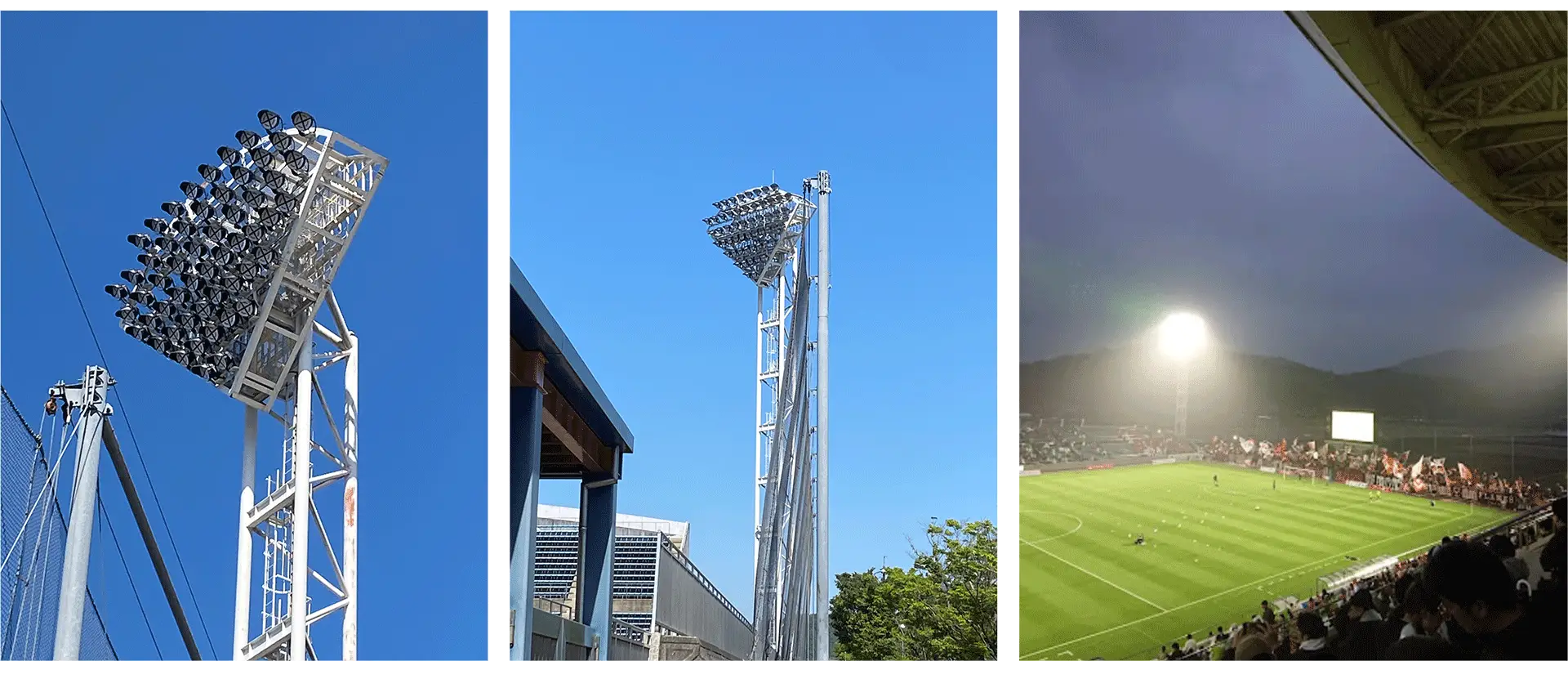
Football field lighting requirements change with the level of play. A training pitch does not need the same system as a televised stadium, so start by confirming the highest event the venue will host during the expected life of the installation. The brief should distinguish among community training, match practice, non-televised competition, televised competition and elite international broadcast.
Broadcast changes the design because cameras need light on vertical planes. FIFA’s stadium guidance identifies vertical illuminance, horizontal illuminance, flicker, glare, colour rendering, correlated colour temperature and uniformity as relevant for televised standards. A non-televised venue can use a simpler performance set focused on horizontal light, glare, colour and uniformity.
If future broadcast is only a possibility, decide whether to install the full system now or prepare poles, power and controls for a later upgrade. “Broadcast ready” should never be used without stating the target standard and camera requirement.
2. The standard that sets football field lighting requirements
The contract must identify which football field lighting requirements and document edition govern the work. Common references include FIFA requirements, EN 12193 for European sports lighting, ANSI/IES RP-6 for North American sports facilities, and national-association or league rules.
The project may also need local requirements covering electrical safety, structural design, planning permission, property-boundary light, road safety and environmental protection. Where documents overlap, a design responsibility matrix should state which requirement controls each metric.
3. Football pitch dimensions and calculation area
Photometric calculations require an accurate scaled drawing. Do not begin with a generic field template if the real pitch, runoff zones or pole setbacks differ. FIFA notes that a normal pitch used in its stadium test procedure measures 105 m by 68 m, but actual projects must use approved site dimensions.
Include the playing surface, runoff area, team areas, spectator zones, paths and any adjacent practice areas that need illumination. Show north orientation, property boundaries, roads, stands, roofs, scoreboards and other obstructions. These objects affect pole positioning, aiming and spill-light calculations.
4. Football field lighting requirements: horizontal and vertical illuminance
Horizontal illuminance, Eh, represents light incident on the pitch. It supports player movement, ball tracking and spectator visibility. Vertical illuminance, Ev, represents light reaching vertical planes. It affects facial visibility, player modelling and camera images.
FIFA’s training-pitch guidance uses three grades with average horizontal targets above 300, 500 and 750 lux respectively. Its televised stadium classes can require much higher horizontal and vertical performance. These numbers are not interchangeable: the correct target comes from the selected standard, event and measurement procedure.
5. Uniformity across the pitch in football field lighting requirements
Football is continuous and fast. Players, officials and cameras move through the full field, so abrupt changes in brightness are undesirable. A compliant calculation normally reports average, minimum and maximum values together with uniformity ratios.
- U1 is minimum divided by maximum illuminance.
- U2 is minimum divided by average illuminance.
FIFA’s cited training-pitch table requires horizontal U1 above 0.40 and U2 above 0.60 for all three grades. Other standards and competition organisers may use different ratios or definitions. Always state the formula as well as the limit.
6. Glare control for players and goalkeepers
Goalkeepers frequently look upward and across the pitch, making them sensitive to poorly located or steeply aimed floodlights. Glare must be checked from defined observer positions and directions, not judged from a single rendering.
Design measures include adequate mounting height, controlled optical distributions, sensible aiming angles, shielding and avoidance of critical sightlines. FIFA’s training-pitch table uses a glare rating below 50. A project using another standard should apply its own calculation method and limit.
7. Pole quantity, position and height
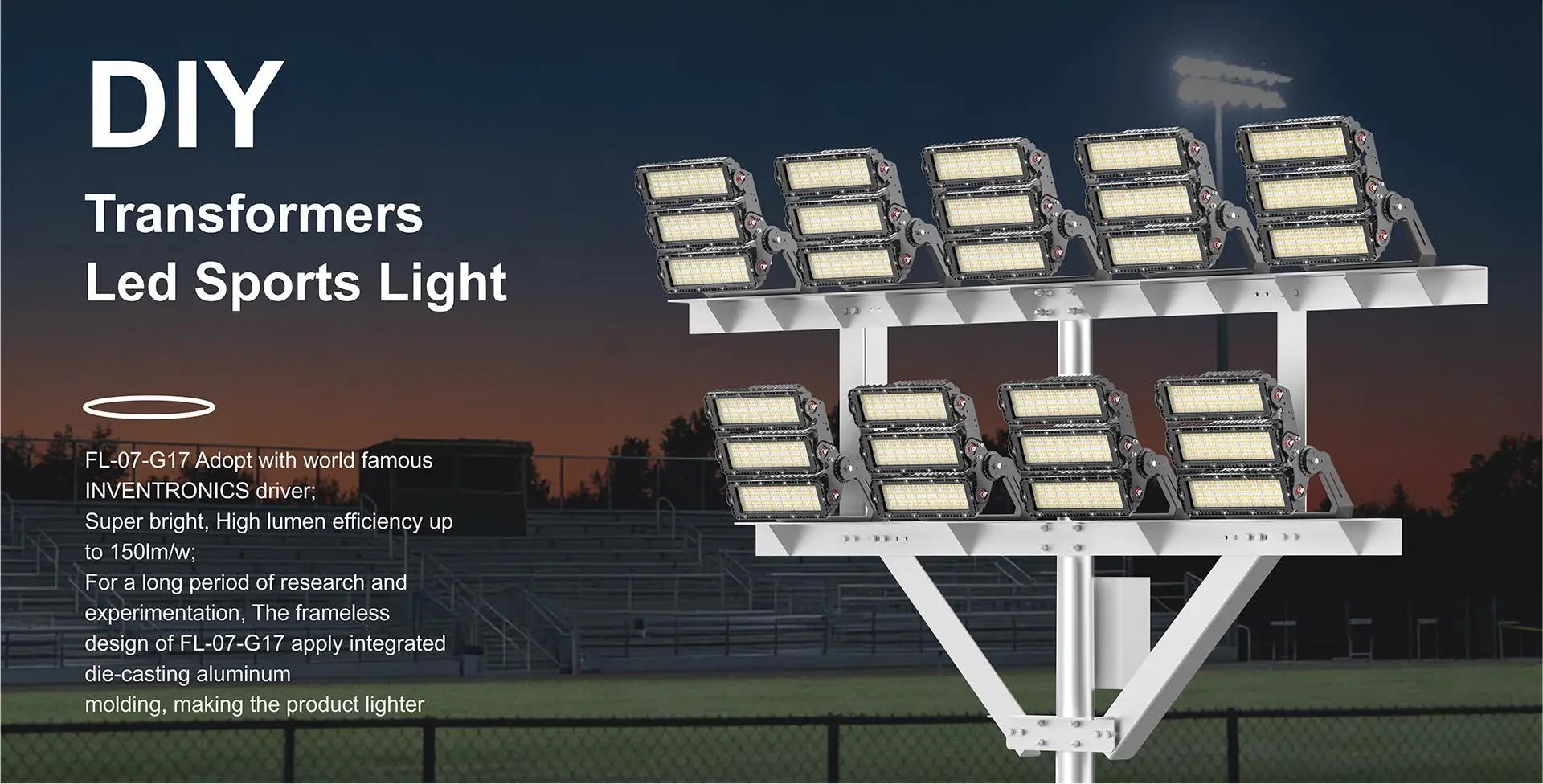
Pole layout determines whether the design can achieve long throws, good uniformity and low glare. Four-pole corner arrangements are common for training fields, while larger or higher-level venues may use six or eight poles, side arrays or roof-mounted lighting.
FIFA’s design examples for training pitches show mounting heights from approximately 16 m to 25 m depending on grade and pole arrangement. FIFA also notes that 15 m is considered the minimum height that allows the required conditions for a FIFA training pitch. These are FIFA examples, not universal construction rules.
Final heights and foundations must be verified for the actual setback, wind zone, soil, pole loading, luminaire projected area and local structural code.
8. Optics and aiming
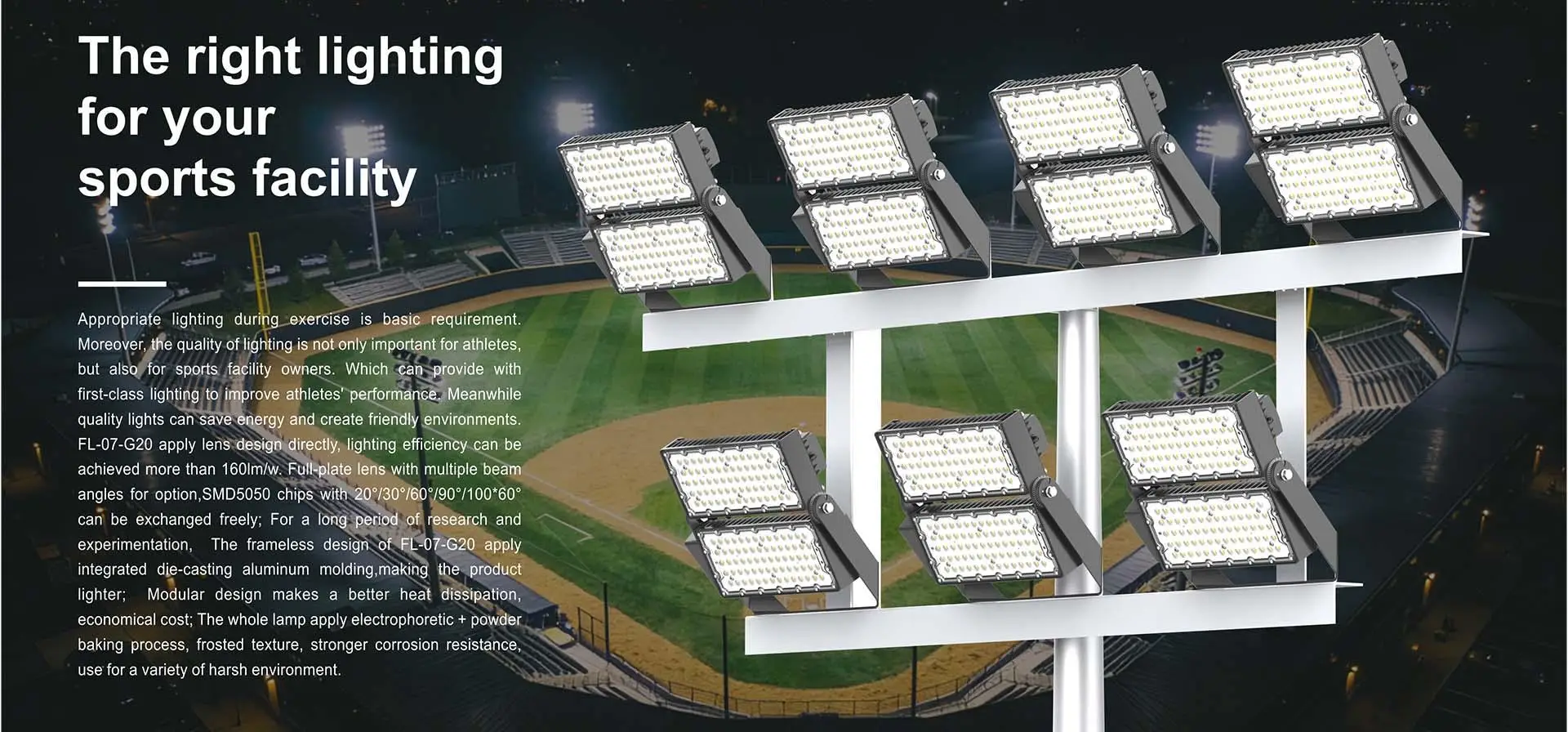
A football field normally needs a combination of distributions. Luminaires closer to the target zone may use medium or asymmetric optics, while long throws toward the centre can require narrower beams. Every luminaire should have an aiming point or horizontal and vertical angle in the installation schedule.
The design calculation must use the photometric file for the exact product, wattage, lens and accessory. Changing a visor, lens or drive current after approval can change the field result and should trigger a design review.
9. Colour rendering and colour temperature
Colour quality helps players distinguish the ball, field markings and uniforms. It also affects how the pitch and skin tones appear on camera. FIFA’s training-pitch table cited in its Lighting Guide requires at least Ra 70 for standard training and match practice, and at least Ra 80 for World Cup training. It gives CCT ranges that become more restrictive at higher grades.
Do not choose CCT only by perceived brightness. The project should balance visual performance, broadcast needs, environmental impact and regional preference.
10. Flicker and high-speed cameras
LED drivers can modulate output at frequencies that are invisible to the eye but visible to cameras. The result may appear as banding or changing brightness, especially in slow motion. FIFA’s World Cup training grade specifies a flicker factor below 1%, while its lower training grades list flicker as not applicable in that table.
Ask for test data for the complete luminaire and driver at the intended output and dimming levels. A “flicker-free” marketing statement without a test method and operating condition is not enough for broadcast design.
11. Spill light and neighbourhood impact in football field lighting requirements
Football fields are often close to homes and roads. The design should evaluate vertical illuminance and luminous intensity at sensitive positions, not just horizontal spill on the ground. Upward light and operating hours may also be limited by planning conditions.
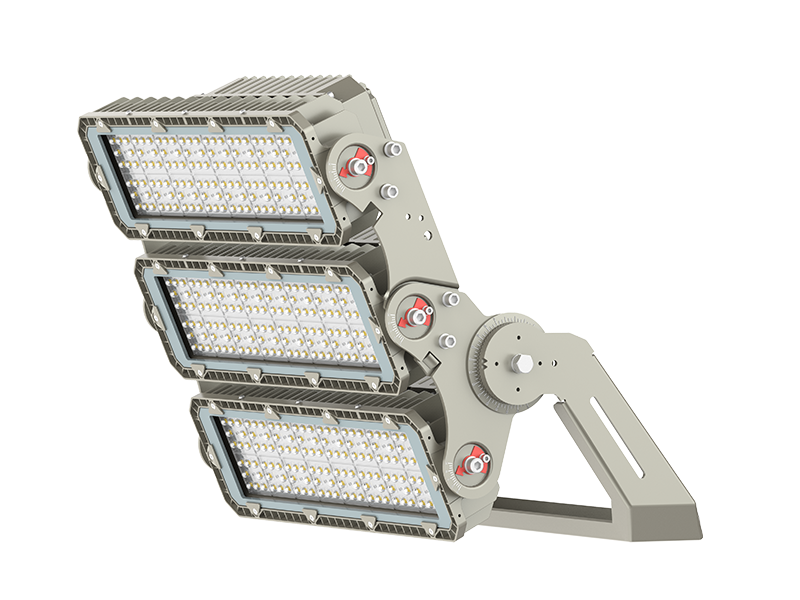
Asymmetric optics, visors, better pole geometry, accurate aiming and reduced-output training modes can limit impact. Simply lowering poles or tilting fixtures higher can make glare and spill worse.
Neighbourhood limits belong in football field lighting requirements before tendering, because retrofitting visors after a complaint costs far more than specifying them.
12. Electrical and control requirements
The electrical design should include connected load, inrush current, power factor, harmonic performance, cable sizing, voltage drop, surge protection, earthing and protective devices. High-power sports lights can place demanding transient loads on circuits.
Controls should provide the required scenes, such as maintenance, training, match and event modes. Broadcast or entertainment venues may use DALI, DMX or another suitable architecture. Emergency and match-continuity requirements must be coordinated with the governing body and the site’s backup-power strategy.
Product durability is where football field lighting requirements meet procurement: a compliant design delivered with unverifiable hardware still fails at handover.
13. Product durability in football field lighting requirements
Outdoor football luminaires need a suitable ingress-protection rating, impact resistance, corrosion protection and operating-temperature range. Coastal or industrial sites may require enhanced materials and coatings. Product declarations should identify the test standard and exact configuration.
The support structure, fasteners, brackets and external controls need the same environmental review. A durable luminaire on an unsuitable bracket does not create a durable system.
14. Commissioning and acceptance testing
Before measurement, verify fixture locations, mounting heights, tilt angles, control output and supply voltage. The acceptance plan should map every football field lighting requirement to a calculation result or site measurement. Field testing must follow the chosen standard’s grid, sensor height, orientation and environmental conditions.
FIFA’s televised stadium procedure uses 96 pitch points and measures horizontal illuminance plus four vertical directions at each point. FIFA training grades use their own procedure. This distinction is important: a test completed on the wrong grid cannot demonstrate compliance with the specified class.
Football field lighting requirements checklist
| Requirement | Project input to confirm |
|---|---|
| Use | Training, competition, broadcast and event modes |
| Standard | Document, edition, class and governing authority |
| Geometry | Pitch, runoff, poles, stands, cameras and sensitive boundaries |
| Lighting | Eh, Ev, minimum, average, uniformity, glare, CCT, CRI and flicker |
| Equipment | Luminaire, optics, driver, visor, bracket, pole and controls |
| Infrastructure | Power capacity, circuits, backup, surge protection and earthing |
| Environment | Spill, upward light, operating hours, wind and corrosion |
| Acceptance | Approved calculation, aiming record and field measurement report |
Prepare a football field lighting requirements brief
ROKEE provides LED sports lights and project support for football field lighting requirements, including photometric data, DIALux simulation, optical selection and aiming information. Send us the pitch drawing, pole details, target standard and operating modes to prepare a technical proposal.
Authoritative references
Frequently asked questions
How many floodlights are required for a football field?
The quantity depends on field dimensions, pole positions, mounting height, fixture output, optics and the required class. Only a calculation using the exact photometric files can confirm the number.
What is a typical football lighting pole height?
Training-field examples can range from the mid-teens to approximately 25 m, but actual height depends on setback, glare, optics, wind and structural design. It is not a universal fixed value.
Are 500 lux enough for a football field?
Five hundred average horizontal lux is a FIFA match-practice training target in the cited guide, but it does not automatically satisfy competition or broadcast requirements. Check the governing class and all other metrics.
Do football fields need vertical illuminance?
Vertical illuminance is essential for broadcast and may also be specified for higher-level training or competition. Non-televised community fields are often evaluated primarily on horizontal illuminance.
What causes glare on a football field?
Glare is influenced by source intensity, mounting height, pole position, aiming, optical distribution and observer direction. It must be controlled through the complete layout, not only fixture wattage.
Related Posts