
ATEX is EU law. IECEx is a voluntary international certificate built on the same IEC…
Best LED Tunnel Lighting Fixtures for Road Projects: Selection Guide
Tunnel lighting is the only branch of road lighting where the driver’s own eyes are the primary design constraint. Outside, the eye adapts to daylight in minutes; entering a tunnel, it needs several seconds to adapt to a much lower level, and those seconds happen at highway speed. LED tunnel lighting fixtures are therefore not chosen for brightness but for how precisely they manage a transition.
This guide explains how road tunnels are divided into lighting zones, why luminance rather than illuminance governs the design, which optical and mechanical features a tunnel luminaire must have, and how adaptive control and maintenance access change the total cost of a project. Every section assumes that LED tunnel lighting fixtures are selected against a calculation, not against a wattage list. It is written for road authorities, consultants, tunnel MEP contractors and distributors preparing a new bore, a refurbishment or an LED conversion of a sodium installation.
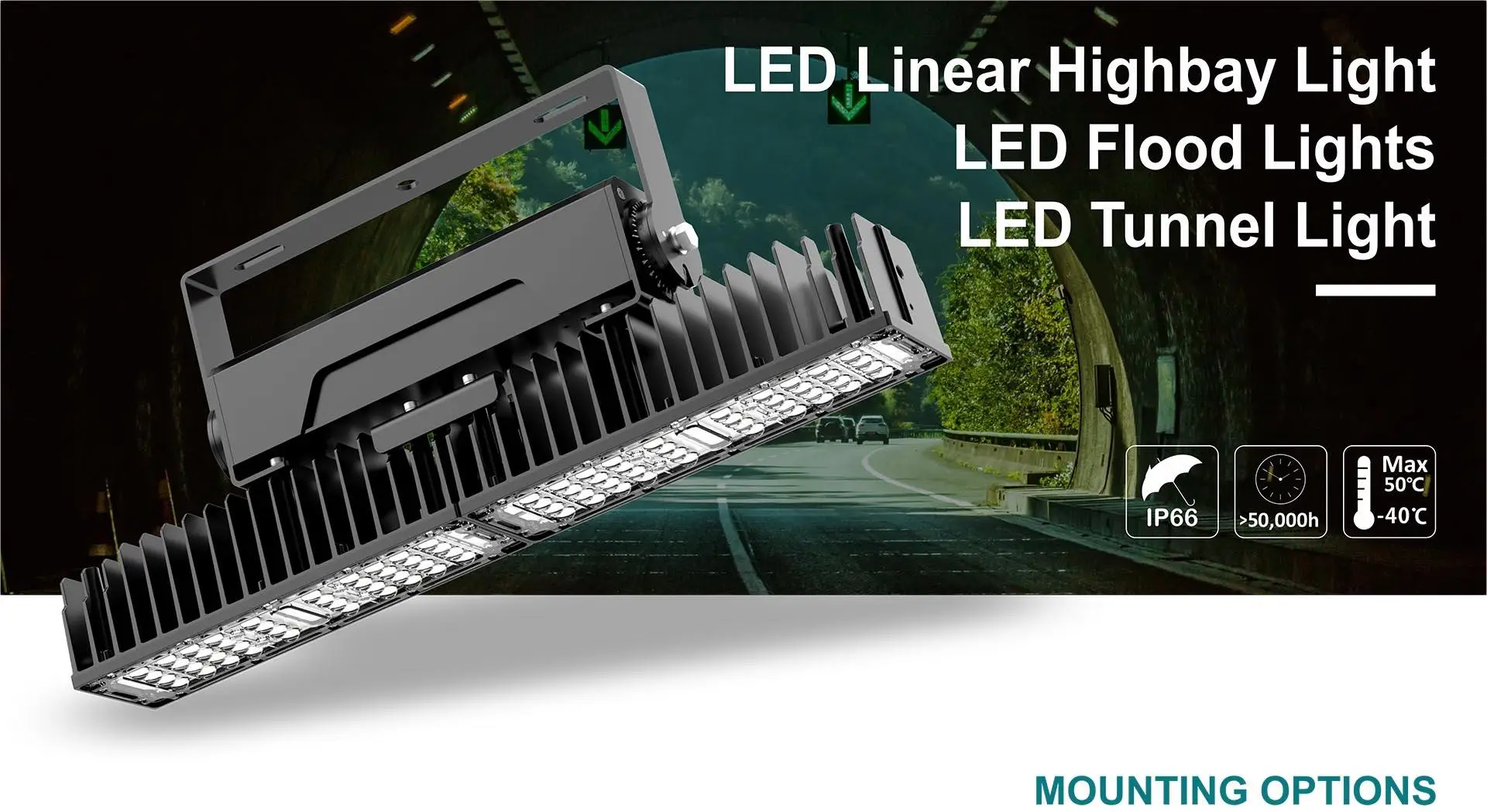
1. Why tunnel lighting is a different discipline
On an open road, the lighting task is to reveal obstacles and the road geometry. In a tunnel, the task is to keep the driver’s adaptation state continuous. Three effects drive every decision.
- The black hole effect. From bright daylight, an unlit or under-lit portal appears as a dark rectangle. Drivers slow abruptly or drift, and the stopping distance inside the entrance becomes unsafe.
- The adaptation lag. The eye takes seconds to adapt from daylight to tunnel levels. In that window the driver is effectively night-blind, so the threshold zone must be lit far above interior levels.
- The exit flare. Leaving the tunnel, the eye is again exposed to bright light, and the interior level can be stepped down before the portal because adaptation in that direction is faster.
Every one of these effects is a luminance problem measured against the surrounding access road, not an illuminance problem measured on the road surface. That distinction shapes the entire fixture specification.
2. The lighting zones and how their levels relate
A road tunnel is designed as a sequence of zones, each with its own luminance target expressed as a fraction of the access-zone luminance. The LED tunnel lighting fixtures are then distributed across those zones, and the same luminaire rarely appears in all of them.
| Zone | Location | Design intent | Typical relative level |
|---|---|---|---|
| Access zone | Approach road before the portal | Reference luminance L20 for the whole design | Defines the baseline |
| Threshold zone | First section inside the portal | Allow adaptation without hiding obstacles | Highest in the tunnel; often several times the interior level |
| Transition zone | After the threshold | Reduce level in steps as the eye adapts | Falls progressively toward interior |
| Interior zone | Central length of the bore | Maintain visibility at a stable level | Lowest daytime level, sometimes reduced at night |
| Exit zone | Last section before the far portal | Prepare the eye for daylight; boost wall visibility | Rises again during daytime |
The relative levels shown above are indicative only, and they are the reason no catalogue of LED tunnel lighting fixtures can replace a project calculation. The actual values come from the design method in the applicable standard and from the measured or calculated L20 value for the specific approach. Never transplant zone ratios from one project to another: traffic speed, portal orientation, access-road surface and the proportion of sky visible all change the result.
Short tunnels and underpasses are a special case. Where the bore is short enough for the far portal to be visible from the entrance, the design is often driven by the silhouette effect rather than by adaptation, and the whole tunnel may be treated as a single threshold-like zone. This is common in urban underpasses, and it is where many LED tunnel lighting fixtures are wrongly specified as if the tunnel were long.
3. Luminance, uniformity and glare: the three numbers that matter
Tunnel design works in luminance, measured in candelas per square metre on the road surface and on the walls, which is the reason LED tunnel lighting fixtures are compared on intensity distribution rather than on lumens. Three parameters are checked on every project.
Road surface luminance is the primary design value. It depends on the luminaire’s intensity distribution and on the reflectance of the pavement, which is why the same fixture delivers different luminance on a new asphalt and on a polished concrete surface.
Overall uniformity (Uo) is the ratio of minimum to average luminance. Poor uniformity creates dark patches that hide obstacles and make the surface appear wet or patchy. Longitudinal uniformity along the driving line matters as much as the overall figure, because the driver moves through the pattern.
Threshold increment (TI) quantifies disability glare from the installation itself. A tunnel lined with high-output fixtures aimed badly can meet its luminance target and still be uncomfortable, especially where the luminaire is mounted low or the optic is symmetric.
Wall luminance is the fourth value that separates a professional design from a basic one, and it is usually where low-cost LED tunnel lighting fixtures fall short. Bright walls and a visible upper half of the tunnel cross-section improve the perception of the tunnel’s shape and reduce the “tunnel within a tunnel” effect that makes drivers feel confined.
4. The standards behind the design
Tunnel lighting is covered by a small group of documents that should be quoted by name in the specification.
- CIE guidance on tunnel and underpass lighting, which sets out the zone method and the L20 approach.
- CEN/TR 14380, the European technical report on tunnel lighting applications.
- BS 5489-2, the UK code of practice for the design of road lighting in tunnels.
- EN 13201-2 for the access road and for the performance classes used outside the bore.
- EN 16276 for evacuation lighting in road tunnels, which is a separate system with its own fixtures and autonomy requirements.
Our street lighting design guide covers the access-road side of the calculation, including the luminance classes that feed the tunnel design and set the baseline against which LED tunnel lighting fixtures are then specified.
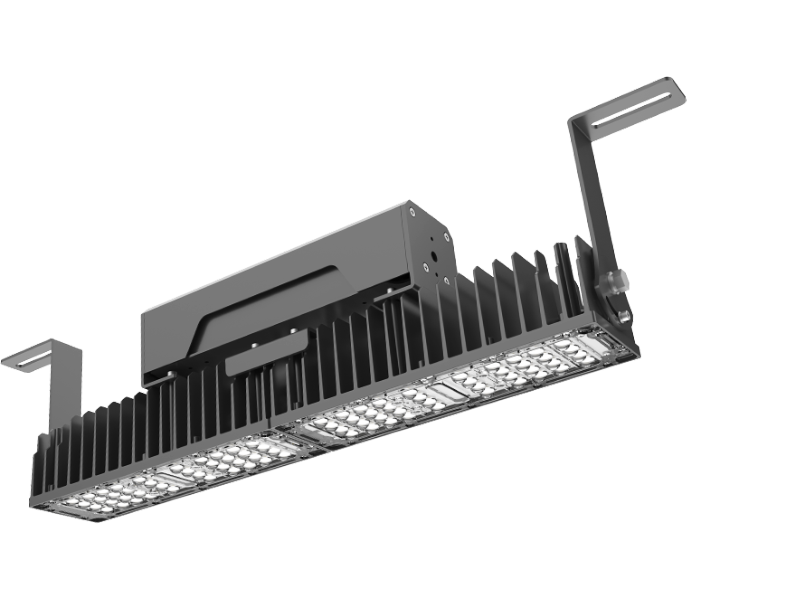
5. What a tunnel luminaire must have that a floodlight does not
Many projects attempt to use general floodlights in tunnels to save cost, which is why unsuitable LED tunnel lighting fixtures keep appearing in refurbishments. The specification usually fails on four points.
| Requirement | Reason | Typical value |
|---|---|---|
| Sealed housing | Exhaust soot, wash water and dust are continuous | IP66 minimum, IP67 for wash-down tunnels |
| Vibration resistance | Traffic-induced vibration loosens brackets and fatigues solder joints | Locked aim adjustment, tested fixings |
| Corrosion resistance | De-icing salt, exhaust condensate and cleaning chemicals | Corrosion-resistant body, stainless fasteners |
| Optical control | Longitudinal uniformity and glare cannot be achieved with a wide flood beam | Asymmetric or counter-beam distribution |
| High ambient capability | Bore temperature plus luminaire heat in still air | Ambient rating stated for the installed condition |
| Replaceable driver | Every failure costs a lane closure | Driver accessible from below without removing the body |
The adjustable bracket deserves its own line in the specification. Tunnel luminaires are aimed against a calculated grid, and an aim that drifts by a few degrees over a year will show up as a uniformity failure at the next inspection. Look for a bracket with a positive locking mechanism and a visible angle reference rather than a friction joint.
6. Optics: symmetric, asymmetric and counter-beam
Three optic families appear in tunnel projects, and each belongs to a different location — the right choice is what separates usable LED tunnel lighting fixtures from a sealed box with LEDs inside.
Symmetric distribution spreads light evenly left and right and is used where the luminaire sits centrally over the carriageway in a narrow bore, or where the ceiling height is low enough that the pattern does not need longitudinal control.
Asymmetric distribution throws light forward along the tunnel axis and is the most common choice for ceiling-mounted luminaires in one-way bores, because it produces the longitudinal uniformity that the design requires while limiting glare toward oncoming traffic.
Counter-beam distribution aims light against the direction of travel, illuminating the road surface ahead of the vehicle in the direction the driver is looking. It gives high luminance contrast on obstacles with comparatively low installed power, but it depends on correct mounting height, spacing and one-way traffic. In a bidirectional bore it is generally unsuitable.
Whatever the family, ask for the intensity distribution in IES or LDT format and check that the design calculation used the same file. This is where most LED tunnel lighting fixtures end up misapplied: the module is capable, but the optic shipped is a flood optic from the general range.
7. Adaptive control is not optional
The threshold zone must be sized for a bright summer day and a wet road, and the same LED tunnel lighting fixtures then run all night. Without adaptive control, the tunnel is either under-lit at noon or wastefully over-lit at midnight.
A typical control scheme measures the access-zone luminance with an L20 camera or luminance meter, feeds the value to a controller, and steps the threshold and transition zones through several predefined levels. Steps are used rather than continuous dimming because drivers should not see the lighting change.
- Day, overcast, night and wet-road levels defined in advance and validated in commissioning.
- Luminance measurement positioned to see the same sky and road area the driver sees.
- Fail-safe behaviour that defaults to a safe level if the sensor or controller fails.
- Manual override for maintenance and emergency operation.
- Dimming interface that performs reliably across the whole range — DALI-2 is now the usual choice for new projects.
Control also determines driver selection, and it is the part of LED tunnel lighting fixtures that is easiest to under-specify. A driver that dims poorly, or that loses efficiency at low output, can erase the savings the control system was bought for. Specify the dimming range and confirm it in a sample test.
8. Maintenance defines the real cost
Every maintenance intervention in a tunnel costs more than the luminaire, and the same logic applies to LED tunnel lighting fixtures that are bought on unit price alone. Lane closures, night shifts, access platforms and traffic management usually dwarf the hardware price, which changes how LED tunnel lighting fixtures should be evaluated.
- Group re-lamping is replaced by individual replacement. With LEDs, failures are sporadic, so each one carries a full mobilisation cost — driver reliability is therefore an economic parameter, not a technical detail.
- Cleaning cycles stay. Soot and dust reduce output even on a sealed fixture. Design the schedule from the measured depreciation, and specify a flat glass surface that can be wiped rather than a finned one that traps dirt.
- Tool-free access matters. A gear tray that opens without removing the luminaire from the bracket can halve the time on a platform.
- Spares for the whole life. Tunnels are often specified with a 15–20 year horizon. Confirm that drivers and LED modules remain available, or stock a lifetime quantity at handover.
Our G13B adjustable LED tunnel light is built around this maintenance logic: sealed linear body, replaceable driver, adjustable locking bracket and a choice of wattages from 100 W to 300 W within the same housing family, which keeps spare-part holdings small.
9. Selecting by tunnel type
| Tunnel type | Dominant design issue | Fixture priority |
|---|---|---|
| Urban underpass, under 100 m | Silhouette effect and short adaptation | Uniform asymmetric lighting, low glare, robust against vandalism |
| One-way road tunnel, medium length | Threshold and interior zones with adaptive steps | Asymmetric or counter-beam optics, sealed body, dimmable driver |
| Bidirectional tunnel | Both portals need threshold design | Symmetric or carefully aimed asymmetric distribution, no counter-beam |
| Long or subsea tunnel | Interior zone dominates energy use | High efficacy, advanced control, long-life drivers, planned spares |
| Refurbishment of sodium installation | Existing spacing, mounting height and wiring | Optics matched to the existing geometry, not to an ideal layout |
For a refurbishment, the constraint set is what matters, and it usually decides which LED tunnel lighting fixtures are even feasible. Reusing existing brackets and spacing limits the optical options, and the calculation has to be run against the geometry that exists. Replacing the complete installation usually gives better uniformity but requires civil and electrical works that are often outside the budget. Both routes are legitimate; only one of them can be designed properly at a time.
10. Procurement checklist for LED tunnel lighting fixtures
| Item | What to confirm |
|---|---|
| Design basis | Zone lengths, luminance levels, Uo, TI and wall luminance, with the L20 value and standard stated |
| Calculation | Per-zone calculation using the exact IES/LDT files of the offered optics |
| Optic | Distribution family and mounting orientation confirmed against the layout drawing |
| Ratings | IP66 or better, IK rating, ambient rating for installed conditions, corrosion class |
| Control | Dimming interface, step levels, fail-safe behaviour and sensor compatibility |
| Mechanics | Locking adjustable bracket, tool-free gear access, driver replaceable in situ |
| Evidence | LM-79 and LM-80 data, IP and IK test reports, CE/RoHS and market-specific approvals |
| Lifecycle | Warranty terms, spare-part availability, lifetime spare quantity agreed at handover |
Specify tunnel lighting with the design, not after it
ROKEE supplies LED tunnel lighting fixtures and road lighting luminaires for infrastructure projects, with photometric files, calculation support and configuration control from prototype to shipment. Review our linear and tunnel luminaire range, our LED street light range for the access road, or send your tunnel section drawing and design basis for a zone-by-zone proposal.
Frequently asked questions
Why is the threshold zone lit so much brighter than the rest of the tunnel?
Because the driver’s eye is still adapted to daylight when the vehicle enters the portal. The threshold zone has to provide enough luminance for obstacles to be visible during the seconds the eye needs to adapt. Its level is derived from the access-zone luminance, traffic speed and stopping distance, not from a fixed rule.
What is L20 in tunnel lighting?
L20 is the average luminance of the access zone over the area seen by a driver approaching the portal, weighted toward the sky and road in the central 20 degrees of the field of view. It is the reference value that drives the threshold zone design.
Can LED tunnel lighting fixtures replace sodium lamps one for one?
Usually not directly. Sodium produces a broad, low-contrast distribution and a monochromatic spectrum; LED tunnel lighting fixtures have different intensity distributions, colour rendering and glare profiles. The replacement must be designed as a new calculation against the existing geometry.
What colour temperature is used in road tunnels?
4000 K is the common choice for new LED tunnels because it supports obstacle detection and gives neutral images on CCTV. Warmer values are used where the tunnel connects to a lit urban area or where the design intent is to reduce perceived glare at the portal.
Is emergency lighting part of the tunnel lighting design?
It is a separate system with its own standard (EN 16276 for road tunnels), its own fixtures and its own autonomy requirements. It should be specified alongside the main lighting but must not be satisfied by the general lighting installation alone.
Authoritative references
Related Posts