
Most gas station canopy projects fail on one of two things: they are lit far…
Best LED Flood Lights for Large Outdoor Areas: Buyer’s Guide
The best LED flood lights for a large outdoor area are not necessarily the products with the highest wattage or lumen claim. Parking areas, ports, yards, building perimeters and public spaces have different geometry, visual tasks and environmental constraints. A successful system delivers the required light where it is useful while controlling glare, spill light, energy use and maintenance.
This guide explains how to compare commercial outdoor floodlighting and what information to provide for a photometric plan. Final light levels and installation details should be confirmed by qualified professionals according to the site, local rules and applicable standards.
Define What “Best” Means for the Site
Start with the activity: vehicle movement, security observation, loading, sports, façade lighting or general circulation. Record where the LED flood lights will be mounted, the operating schedule, target zones, nearby properties and dark areas that should remain unlit. A design brief should also identify camera requirements, emergency operation and control scenes.
Do not copy the light level from an unrelated project. More light is not always safer or better. Excessive contrast and glare can reduce visibility, while unnecessary light wastes energy and affects neighbors and the night environment.
Compare Delivered Lumens and Efficacy
Lumens describe emitted light and watts describe electrical power. Efficacy, expressed in lumens per watt, helps compare efficiency, but none of these numbers alone shows how much light reaches the target. Optical losses, aiming and distribution determine useful performance.
Ask for delivered lumens at the expected operating temperature, not only LED-chip values. Review lumen-maintenance data and driver lifetime. Quality LED flood lights should maintain performance over time rather than merely produce a strong initial reading.
Choose the Correct Beam Pattern for LED Flood Lights
Narrow-beam LED flood lights are useful for long-distance projection from tall poles. Medium and wide beams cover nearer areas, while asymmetric distributions can place light forward without wasting as much behind the pole. Large sites often need a combination.
The U.S. Department of Energy’s LED outdoor area lighting fact sheet discusses forward light, backlight and uplight and explains how directional LED optics can improve cutoff and distribution. Use the exact IES or LDT file in a project calculation before ordering fixtures.
Control Glare, Spill Light and Uplight
Glare from LED flood lights can make pedestrians, drivers and camera operators less able to see detail. It is influenced by source brightness, aiming angle, mounting height and background conditions. Fixtures aimed too close to horizontal can also send light beyond the property or into the sky.
DarkSky’s responsible outdoor lighting principles recommend using light only where and when needed, at no brighter a level than necessary. Use shields, asymmetric optics, sensible mounting heights and accurate aiming. Confirm boundary values in the photometric report.
Check Durability for the Environment
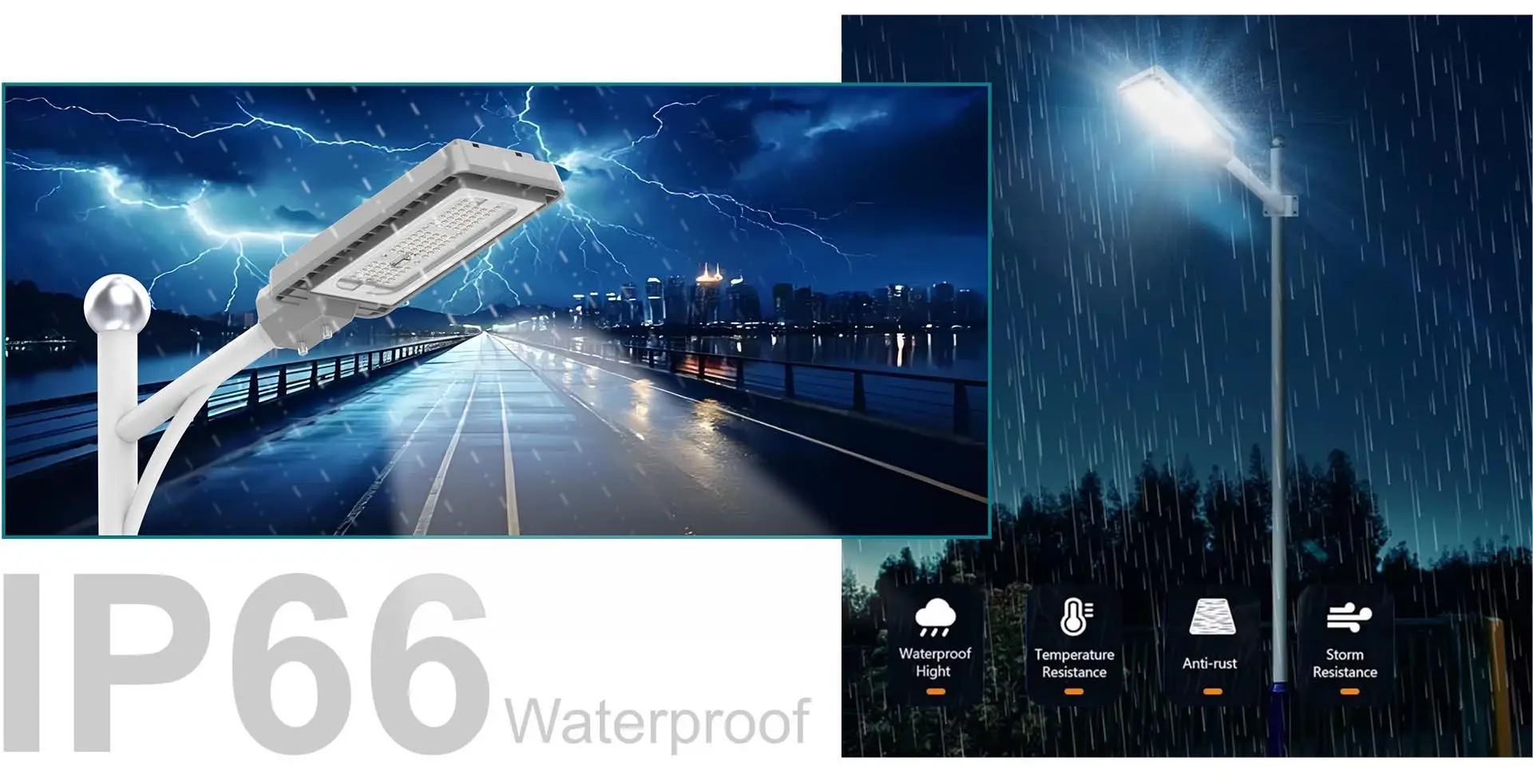
Outdoor LED flood lights should have suitable ingress protection, impact resistance and operating-temperature ratings. Coastal, marine and industrial sites also need appropriate corrosion protection. Review housing material, coating, fasteners, seals and cable-entry details.
Surge protection is particularly important on exposed poles and large outdoor electrical networks. Coordinate luminaire protection with the site’s wider grounding and surge strategy. For areas containing flammable gas or combustible dust, ordinary floodlights are not suitable; certified hazardous-location equipment may be required.
Consider Mounting Height and Wind Load
The mounting height of LED flood lights affects coverage, glare and the required beam angle. Tall poles can cover more area but increase wind and access considerations. Verify fixture weight, projected area, bracket strength, pole capacity and foundation design.
Adjustable brackets should provide secure, repeatable aiming. Record the final tilt and orientation of every luminaire so the design can be restored after maintenance.
Use a Photometric Plan
A calculation for LED flood lights should include accurate site dimensions, pole locations, mounting heights, obstacles and surface reflectance. Review average and minimum illuminance, uniformity, vertical light where relevant, glare and off-site spill. Visual renderings are useful, but point-by-point data is necessary for evaluation.
Browse ROKEE LED flood light products for available outputs and optical configurations, then use the selected model’s photometric file in the final design. Do not substitute another optic after approval without recalculating.
Add Controls for Real Operating Conditions
Photocells, timers, motion sensors and centralized controls can reduce unnecessary runtime. Large yards may use a low background level with higher output when activity is detected. Curfews and scheduled dimming are useful near residential areas.
Controls must be rated for the load, environment and mounting height. Define what happens after a communication failure and provide a safe local override. If cameras are present, test dimming and driver behavior for visible flicker.
Compare Lifetime Cost and Serviceability
Calculate energy from actual operating hours and control scenes. Include lift rental, cleaning, driver replacement and downtime. Long warranties are helpful only when the coverage, exclusions and replacement process are clear.
Modular components and accessible drivers may reduce maintenance cost. Ask whether replacement parts will be available and whether a component change affects photometric performance or certification.
Outdoor Flood Light Selection Checklist
- site plan, target areas and visual tasks;
- pole locations and mounting heights;
- required average, minimum and uniformity values;
- beam distributions and aiming coordinates;
- glare, boundary spill and uplight limits;
- temperature, water, impact and corrosion exposure;
- voltage, surge protection and control method;
- wind load, bracket and maintenance access;
- photometric files, warranty and spare parts.
Commission the Finished Installation
Verify model numbers, optics and mounting orientations before aiming. Measure representative locations after dark and compare the result with the approved design. Check controls, glare from roads and properties, security-camera images and any unintended dark or overlit zones.
Keep an as-built aiming schedule and maintenance plan. ROKEE’s outdoor lighting project portfolio provides application ideas, but commissioning must be based on the specific site.
Choose Flood Lights From the Lighting Plan
The best LED flood lights combine verified photometric performance, optical control, outdoor durability and practical maintenance. Define the site requirements first and compare complete systems instead of wattage alone.
Contact ROKEE Lighting with your site drawing, pole heights, target light levels and environmental conditions for a project-specific floodlighting recommendation.
Frequently Asked Questions
How many watts should an outdoor LED flood light use?
There is no universal wattage. The choice depends on mounting height, area, target light level, optic, efficacy and surrounding constraints. Use photometric results to compare options.
Are more lumens always better?
No. More lumens can increase glare and spill if the distribution is poorly matched. Useful light on the target and appropriate uniformity are more important than the largest lumen number.
What beam angle is best for a large area?
Narrow beams suit long throws, while wider or asymmetric beams suit nearer zones. Most large sites need multiple distributions selected through a calculation.
Related Posts