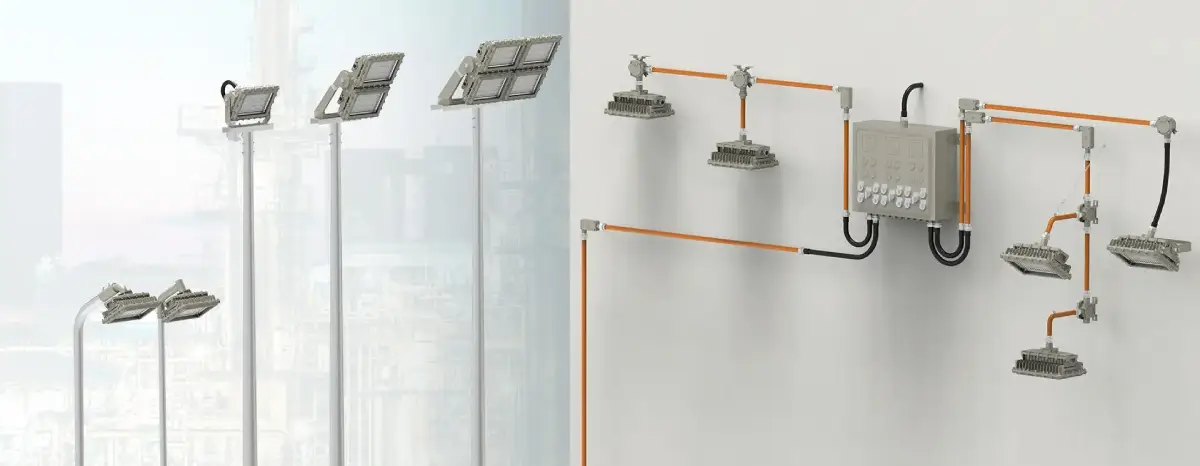
High mast LED lights allow a relatively small number of elevated mounting points to illuminate…
Explosion Proof LED Lights for Industrial Use: Selection Guide
Explosion proof LED lights are designed for hazardous areas where flammable gases, vapors, combustible dusts or fibers may be present. They are used in facilities such as oil and gas plants, chemical processing sites, marine environments, grain handling operations and paint shops. Choosing a fixture by appearance, wattage or an “explosion-proof” label alone is unsafe. The equipment must be suitable for the exact area classification and installation conditions.
This guide outlines the information a purchaser should collect before selecting hazardous-area lighting. Classification and installation must be performed by competent professionals under the codes and regulations applicable to the project location.
What Are Explosion Proof LED Lights?
The term refers to luminaires using recognized protection techniques to reduce the risk that electrical equipment will ignite a surrounding explosive atmosphere. It does not mean the fixture can survive every external explosion. Depending on the certification system, protection may involve flameproof enclosures, increased safety, encapsulation, intrinsic safety or other methods.
The IECEx system describes hazardous or “Ex” areas as places where flammable liquids, vapors, gases, combustible dusts or fibers may occur in quantities sufficient to cause a fire or explosion. Its official overview of IECEx explains the international framework for third-party conformity assessment of equipment used in explosive atmospheres.
Begin With the Hazardous-Area Classification
Before comparing explosion proof LED lights, obtain the approved area-classification document. It should identify the hazardous substance, how often an explosive atmosphere may occur and the boundaries of the classified area. Different regions use class/division or zone systems, and terminology must not be mixed casually.
In the United States, OSHA 29 CFR 1910.307 covers electrical equipment and wiring in hazardous classified locations. OSHA states that each room, section or area should be considered individually and lists Class I, II and III division designations as well as zone designations. Review the current OSHA hazardous-locations requirements with the responsible engineer and authority having jurisdiction.
Gas, Dust and Fiber Hazards Are Not Interchangeable
Explosion proof LED lights approved for a gas atmosphere are not automatically suitable for combustible dust. The classification must account for the material group and its ignition characteristics. Dust accumulation can also block heat dissipation, so the permitted surface temperature and housekeeping conditions matter.
Provide the manufacturer with the substance name and classification—not merely “oil plant” or “dusty factory.” The correct marking must cover the actual gas or dust group at the installation point.
Understand Temperature Class and Ambient Range
Electrical equipment can become an ignition source if its surface temperature is too high. The selected temperature class or maximum surface-temperature marking must be appropriate for the hazardous material. Ambient temperature is equally important because certification is valid only within the marked range.
Do not assume a fixture certified at normal room temperature remains compliant beside process equipment, under direct sun or in a cold outdoor location. Confirm the minimum and maximum site temperatures, including abnormal operating conditions identified by the risk assessment.
Verify Certification and the Exact Product Marking
Certification requirements for explosion proof LED lights vary by country and project. IECEx, ATEX, UL or other schemes may apply. A marketing statement is not a substitute for a valid certificate covering the exact model, protection concept, group, temperature class and ambient range.
Ask for the certificate, schedule, drawing references and any special conditions of use. Check the certificate in the issuing body’s database when possible. Browse ROKEE industrial LED lighting products and request the documentation applicable to your destination market.
Match the Fixture to the Industrial Environment
Hazardous classification is only one part of product selection. Explosion proof LED lights may also face salt spray, vibration, pressure washing, corrosive chemicals, high humidity or impact. Review enclosure material, coating, fasteners, seals, ingress protection and impact resistance.
For marine and coastal locations, corrosion resistance often determines long-term reliability. For food, grain or powder handling, consider dust accumulation and cleaning practices. In high-vibration areas, verify the mounting method and cable entries.
Design for Useful Light, Not Just Compliance
Certified explosion proof LED lights still need an effective lighting design. Determine the task, mounting height, target illuminance, uniformity and glare limits. Use photometric files for the exact optic and include obstructions such as pipe racks, vessels and machinery.
Emergency routes, stairs, gauges and maintenance zones may require different distributions or backup arrangements. Good design can reduce fixture count while improving visibility, but compliance and redundancy requirements must remain the priority.
Installation Details Can Affect Protection
Use only permitted cable glands, conduit seals, adapters, fasteners and blanking elements. Threads and entries must match the certificate and installation instructions. Unauthorized drilling, machining or component substitution may invalidate the protection concept.
Qualified personnel should inspect grounding, bonding, torque, seals and cable routing before energization. Keep certificates and manuals with the site records. ROKEE’s hazardous-area lighting project examples can support early planning, but the approved installation documentation governs the work.
Inspection and Maintenance
Establish inspection intervals for explosion proof LED lights based on the applicable standard, environment and risk assessment. Look for corrosion, loose fasteners, cracked lenses, damaged cable glands, unauthorized modifications and excessive dust. Isolate equipment before opening it and follow the required work-permit procedure.
Replacement parts must be approved for the specific fixture. Keeping a register of model numbers, markings, certificates and installation locations makes maintenance safer and more efficient.
Explosion Proof Lighting Procurement Checklist
- approved area classification and boundary drawing;
- gas, vapor, dust or fiber type and group;
- zone or class/division designation;
- temperature class or maximum surface temperature;
- minimum and maximum ambient temperature;
- required certification scheme and market;
- corrosion, vibration, ingress and impact conditions;
- mounting, wiring, cable-entry and emergency requirements;
- photometric target and control method;
- inspection and spare-parts plan.
Frequently Asked Questions
Are all IP66 lights explosion proof?
No. An IP66 rating only describes protection against dust and water ingress. It does not certify a luminaire for use in an explosive atmosphere.
Can one explosion-proof light be used in every zone?
No. Suitability depends on the zone or class and division, protection concept, gas or dust group, temperature marking, ambient range and local regulations.
Is ATEX the same as IECEx?
No. ATEX and IECEx are different certification frameworks. Although they share technical principles, their documentation and legal acceptance differ by market.
Related Posts