
ATEX is EU law. IECEx is a voluntary international certificate built on the same IEC…
Sports Field Lighting Standards: A Practical Guide
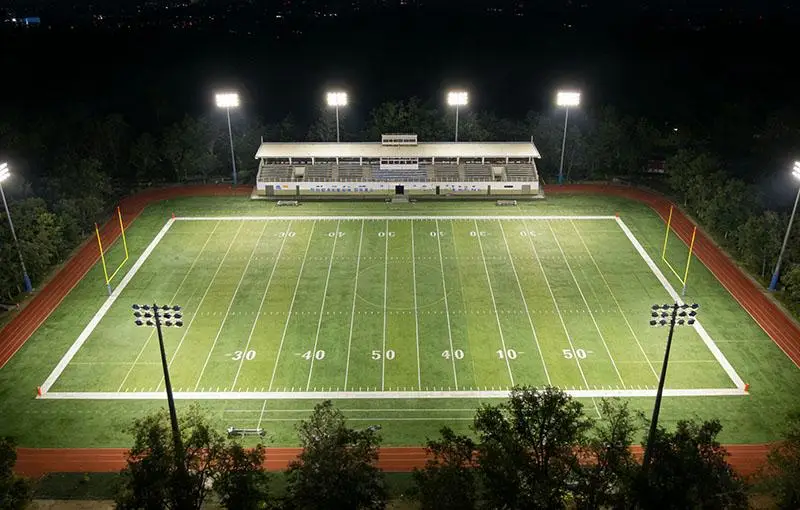
Sports field lighting standards define how a lighting system must perform, how performance is calculated and how the completed installation is tested. They cover much more than average lux. Depending on the sport and competition level, a standard may also set requirements for minimum illuminance, uniformity, glare, colour rendering, flicker, spill light, measurement grids and emergency operation.
Read the rest of this guide as a comparison, then apply the one standard your project is measured against. Mixing clauses from several sports field lighting standards produces proposals that cannot be verified.
The difficult part is that no single document governs every project. European projects often reference EN 12193, North American projects may use ANSI/IES RP-6, international football venues may follow FIFA requirements, and broadcast projects can add CIE or competition-organiser criteria. This guide explains how the main documents fit together and how to write a specification without combining incompatible values.
When you are ready to turn the selected standard into a layout, follow our stadium lighting design guide.
Why sports field lighting standards matter
Standards create a common basis for owners, designers, manufacturers, contractors and testing teams. Without a defined standard, one bidder may quote a high average lux value with poor uniformity while another includes better glare control and maintained performance. The two proposals cannot be compared fairly.
A complete standard also protects the venue after installation. It defines where measurements are taken, how the meter is oriented and which calculated values must be reported. This makes commissioning objective and helps the owner identify changes caused by dirt, misalignment or equipment failure.
Main sports field lighting standards and guidance
EN 12193 for European sports lighting
EN 12193, Light and lighting — Sports lighting, is the principal European standard for artificial lighting of commonly practised indoor and outdoor sports. The published EN 12193:2018 edition specifies design and measurement requirements for illuminance, uniformity, glare restriction and colour properties. It treats the stated values as minimum requirements and includes sport-specific restrictions on luminaire positioning.
EN 12193 uses lighting classes linked to the competition level. The applicable sport table and class should be cited directly in the project specification. A designer should not assume that every Class I, II or III value is identical across all sports.
ANSI/IES RP-6 for North American projects
ANSI/IES RP-6, Lighting Sports and Recreational Areas, provides recommended practice for indoor and outdoor sports in North America. The Illuminating Engineering Society lists the current document in its standards library and covers general design considerations, individual sports, spectators, broadcasting, glare, colour, flicker, field measurements and uniformity metrics.
RP-6 groups recommendations by sport and level of play. It should be used with applicable electrical codes, structural requirements, local light-trespass rules and the requirements of the organisation operating the venue.
FIFA lighting requirements for football
FIFA publishes a dedicated Lighting Guide and operates a Quality Programme for Floodlights. FIFA’s stadium guidance separates televised standards from non-televised use because cameras require adequate vertical illuminance, colour quality and flicker performance in addition to horizontal field lighting.
For FIFA training pitches, the guide defines three grades. The cited edition identifies average horizontal illuminance above 300 lux for standard training, above 500 lux for match practice and above 750 lux for FIFA World Cup training, with additional uniformity, colour, glare and vertical-light requirements. These values are specific to FIFA’s training-pitch procedure and should not be applied automatically to every football field.
CIE guidance for broadcast and obtrusive light
The International Commission on Illumination publishes specialist technical guidance. CIE 083:2019 addresses sports events for colour television and film systems. Other CIE publications referenced by FIFA cover glare evaluation, obtrusive light, maintenance and practical design for televised sport.
CIE documents often support a governing standard rather than replace the competition organiser’s requirements. The project brief should state which document controls if two references appear to conflict.
Governing-body and local requirements
National associations, leagues, schools and municipalities can publish their own minimums. For example, The Football Association in England provides floodlighting guidance for non-league football, while Little League publishes a detailed Lighting Standards and Safety Audit for baseball and softball.
Planning approvals may also restrict operating hours, pole height, boundary illuminance, upward light or intensity toward nearby properties. These limits can be more difficult to satisfy than the playing-area lux target, so they must be included before the pole layout is fixed.
Core metrics found in sports field lighting standards
| Metric | What it measures | Why it matters |
|---|---|---|
| Average illuminance | Mean light level across the measurement grid | Indicates overall quantity of light |
| Minimum illuminance | Lowest measured or calculated point | Reveals dark zones hidden by the average |
| U1 uniformity | Minimum divided by maximum | Shows the full range from darkest to brightest point |
| U2 uniformity | Minimum divided by average | Shows how the minimum compares with the overall field |
| Glare rating | Discomfort caused from defined viewing positions | Protects player and official visibility |
| Vertical illuminance | Light reaching vertical reference planes | Supports cameras, faces and airborne-ball visibility |
| Colour rendering | Accuracy of colour appearance | Affects player, spectator and broadcast perception |
| Correlated colour temperature | Visual appearance of white light | Supports visual comfort and camera consistency |
| Flicker or temporal modulation | Variation of light output over time | Critical for slow-motion and high-speed cameras |
| Spill and obtrusive light | Light outside the intended area | Protects neighbours, roads, wildlife and the night sky |
Maintained versus initial illuminance in sports field lighting standards
Most project decisions should be based on maintained performance, not the brightest condition immediately after installation. A maintenance factor accounts for lumen depreciation, dirt and other predictable losses. FIFA’s cited guide uses a maintenance factor of 0.90 for LED in several football-lighting tables, but another project may require a different value based on environment and maintenance practice.
The specification should state the maintenance factor and the assumptions behind it. It should also require both the calculated maintained result and a maintenance plan. Comparing one bid at initial output with another at maintained output is misleading.
How competition level changes sports field lighting standards
Higher-level competition typically demands more light and better uniformity. Broadcast introduces another step change because cameras need vertical illumination from relevant directions. Colour rendering and flicker limits also become more demanding.
Do not select a lighting class from venue size alone. Sports field lighting standards connect performance to the sport, competition and viewing task. A small venue used for professional broadcast may need a higher standard than a large training complex. Conversely, over-lighting a community field wastes energy and can increase glare and neighbourhood impact.
How to select which sports field lighting standards apply
- Identify the sport and governing body. Confirm the organisation that approves the venue or competition.
- Define the highest level of play. Include future events that are realistically planned.
- Confirm broadcast requirements. Document camera quantity, directions, frame rates and production standard.
- Check jurisdiction. Determine whether EN, ANSI/IES, national or local requirements apply.
- Review planning restrictions. Add property boundaries, roads, residences and environmental limits.
- Resolve conflicts in writing. State which requirement takes precedence for each metric.
The final specification should cite the full document number and edition, the sport-specific table, lighting class and any project-specific additions. Writing only “designed to international standards” is not testable.
Calculation and measurement grids in sports field lighting standards
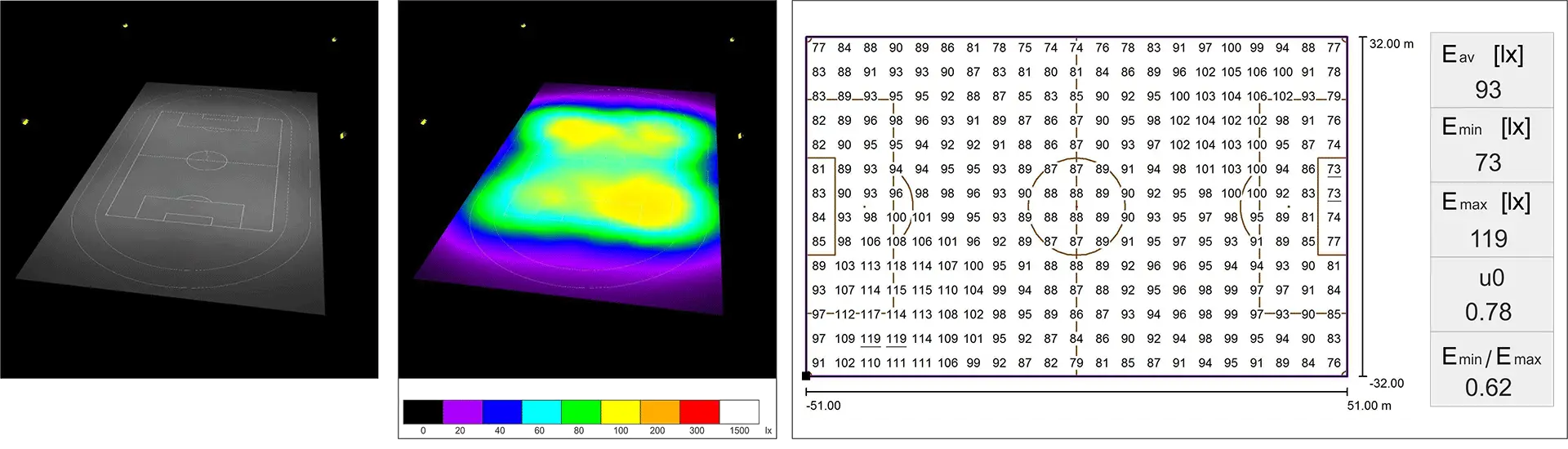
A standard normally defines a grid of points across the playing area. Calculations and field measurements must use the required point spacing, sensor height and orientation. Moving points away from known dark zones or measuring at a different height can change the result.
FIFA’s stadium procedure uses a 96-point pitch grid and measures horizontal light plus vertical light in four directions for venues that may host televised tournament matches. FIFA training pitches use a different procedure: lower grades use 40 reference points, while World Cup training uses 96. This is a useful example of why a grid cannot be copied from a different venue class.
Sports field lighting standards compliance checklist
- Full standard title, number, edition and lighting class are stated.
- Playing area and total area are shown on a scaled drawing.
- Initial and maintained calculations are clearly identified.
- Average, minimum, maximum and uniformity values are reported.
- Glare is calculated from the required observer positions.
- Broadcast calculations include the required vertical planes.
- Colour, flicker and dimming performance match the supplied driver.
- Boundary spill and intensity limits are checked.
- Photometric files match the exact luminaire and optic.
- Commissioning uses the same grid and acceptance criteria as the design.
Verification is the test of any sports field lighting standards claim: if the measurement method is not stated, the number is marketing.
Specify a system that can be verified
ROKEE can support sports field lighting standards compliance with photometric data, DIALux calculations, luminaire schedules, aiming information and product configuration. View our LED sports lighting products or send us your drawings, competition level and required standard. Final approval should always be completed by the qualified project designer and the authority governing the venue.
Authoritative references
- CEN EN 12193:2018 overview
- Illuminating Engineering Society Sports and Recreational Areas Lighting Committee
- FIFA Quality Programme for Floodlights
- CIE 083:2019
Frequently asked questions
Is EN 12193 mandatory everywhere?
No. EN 12193 is widely used in Europe, but the binding requirement depends on the contract, jurisdiction, governing body and competition organiser. Other regions may use ANSI/IES or national standards.
Is average lux enough to approve a sports field?
No. A compliant assessment may also require minimum illuminance, uniformity, glare, colour properties, flicker, spill light and measurements on a defined grid.
Which standard applies to televised sport?
The sport’s governing body and broadcaster should define the requirement. CIE 083:2019 provides broadcast guidance, while organisations such as FIFA publish sport-specific criteria.
What is maintained illuminance?
Maintained illuminance is the predicted or measured performance after expected light losses are considered. It is calculated using an appropriate maintenance factor linked to the equipment, environment and maintenance plan.
Can one calculation prove compliance with several standards?
Only if the model reports every required metric using the correct grids, planes and assumptions for each document. The specification must also resolve any conflicting requirements.
Related Posts