
CRI and TLCI both describe color performance, but they answer different questions. Learn how to specify LED sports lighting for spectators, players and broadcast cameras.
Oil Refinery Lighting Design for Hazardous Areas
Oil refinery lighting must support safe operation without introducing an ignition source into a hazardous process area. That requires two coordinated decisions: the lighting designer must deliver useful visibility for each task, while the electrical and process-safety teams must confirm that every fixture, cable entry and accessory is suitable for the classified location.
A refinery is not one uniform lighting zone. Process units, pipe racks, tank farms, loading gantries, pump areas, laboratories, control buildings and access roads have different hazards and visual tasks. A defensible design treats them separately and records the basis of every selection.

Start oil refinery lighting with the area-classification drawing
The hazardous-area classification must come from the responsible process-safety or electrical engineering team. It considers the material present, potential release sources, ventilation and the likelihood and duration of an explosive atmosphere. The lighting supplier should not guess the classification from a photograph or the name of the process unit.
In North American projects, petroleum facilities may use Class I Division 1 and Division 2 or the Class I Zone system. OSHA 29 CFR 1910.307 requires each room, section or area to be considered individually. API RP 500 addresses Division-classified petroleum facilities, while API RP 505 addresses petroleum facilities using Zone 0, Zone 1 and Zone 2.
Projects following the IEC/ATEX framework commonly identify gas areas as Zone 0, 1 or 2. Dust zones may also exist where catalysts, additives or other combustible powders are handled. Never convert a zone to a division—or a gas classification to a dust classification—without the project authority’s approval.
| Refinery area | Primary lighting task | Critical project inputs |
|---|---|---|
| Process unit and pipe rack | Valves, gauges, walkways and leak observation | Classification, mounting access, obstructions and corrosion |
| Pump and compressor area | Inspection, maintenance and safe movement | Vibration, temperature, shadows and equipment access |
| Tank farm | Stairs, platforms, manifolds and perimeter movement | Zone boundaries, long throws, wind and lightning exposure |
| Loading gantry | Connections, labels, vehicle movement and spill response | Canopy geometry, glare, classified extent and emergency operation |
| Maintenance route | Faces, steps, handrails and obstacles | Vertical light, redundancy and emergency egress |
Certification and marking must match the exact location
A familiar brand name or the words “explosion proof” are not enough. Confirm the exact model and variant on the certificate, the permitted zone or division, gas group, protection concept, temperature class or maximum surface temperature, equipment protection level where applicable, ambient-temperature range and any special conditions of use.
The European Commission explains that ATEX Directive 2014/34/EU covers equipment and protective systems intended for potentially explosive atmospheres. In the United States, OSHA requires equipment and wiring to be intrinsically safe, approved for the classified location or otherwise safe for that location. The contract should name the governing system instead of mixing ATEX, IECEx and NEC terminology in one unverified specification.
Use the existing ATEX explosion-proof lighting guide to interpret zones and markings. The present article stays focused on refinery layout and application decisions.
Set maintained performance by task
There is no single lux value for an entire refinery. Reading a small instrument, connecting a hose, climbing a stair and walking a perimeter road are different tasks. Identify the applicable local lighting standard, owner specification and safety requirements, then state maintained illuminance, uniformity, calculation plane, maintenance factor and any vertical-light requirement for each zone.
Vertical visibility is important around gauges, identification plates, valves, faces and obstacles. A plan that only reports horizontal lux at ground level can conceal dark equipment faces. Add vertical calculation planes at realistic viewing positions and check shadows created by vessels, pipes and structural steel.
Design for the maintained condition. Dirt, salt, hydrocarbon residue, weather and restricted access can reduce output between cleaning cycles. Document the assumed maintenance interval rather than compensating with an unexplained oversizing factor.
Choose optics before increasing wattage
Oil refinery lighting frequently operates among dense obstructions. A very high-output floodlight can create bright equipment surfaces while leaving the work side of a valve in shadow. Use photometric distributions suited to the geometry: wider distributions for compact work areas, controlled asymmetric distributions for routes and loading positions, and narrower beams only where the throw distance demands them.
Coordinate aiming with operator sight lines. Glare can hide a person, stair edge or small leak even when average illuminance is high. Check views from control points, walkways, ladders and vehicle approaches. Shields and revised mounting positions often solve a glare problem more effectively than dimming the whole installation.
Account for corrosion, heat and vibration
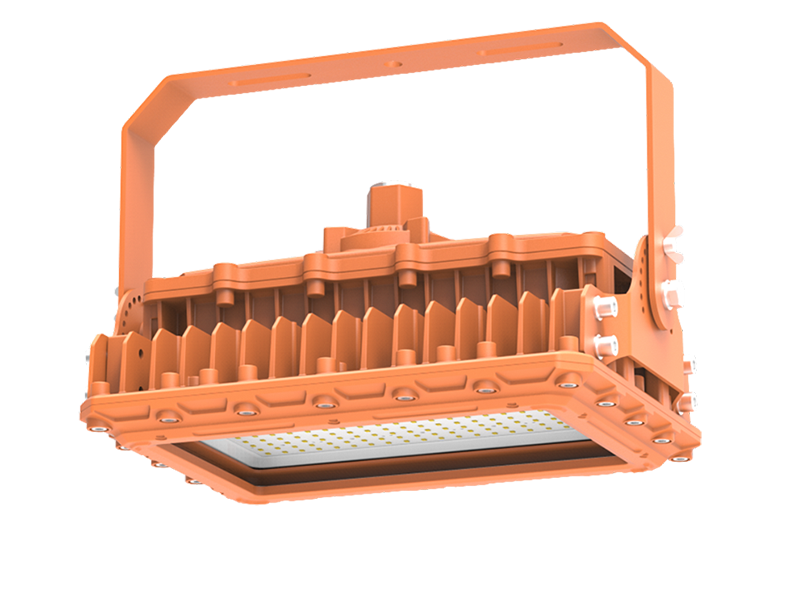
Hazardous-area approval does not automatically prove that a luminaire will resist the refinery environment. Review ambient temperature at the mounting point, solar gain, nearby hot equipment, vibration, salt exposure, chemical vapours and washdown practices. Confirm the housing finish, fasteners, lens, gasket and cable gland as a complete assembly.
Temperature class and ambient rating are related but not interchangeable. The temperature class limits the equipment’s maximum surface temperature under defined certification conditions; the ambient range defines where the equipment may be used. Both must be checked against the certificate and installation.
Ingress protection is also separate from explosion protection. An IP code describes resistance to dust and water under specified tests. It does not replace the hazardous-location marking, and it does not by itself establish chemical or corrosion resistance.
Design the installation, not only the fixture schedule
Cable entries, plugs, junction boxes, flexible connections and installation workmanship can affect the protection concept. The design package should state approved entry types, thread forms, sealing requirements, conductor temperatures, bonding and grounding, mounting torque and any restrictions in the manufacturer’s instructions.
Position luminaires so technicians can isolate, inspect and service them without unnecessary exposure to operating equipment. Record access routes and lifting requirements. If a fixture can only be reached during a shutdown, its maintenance strategy and expected cleaning interval must reflect that constraint.
Separate normal, emergency and temporary lighting
Normal process lighting, emergency egress lighting and temporary maintenance lighting serve different purposes. Determine which routes, stairs, exits, muster paths and critical operating points must remain visible after loss of normal power. OSHA’s emergency-system rules state that required emergency illumination includes means of egress lighting, illuminated exit signs and other necessary lights, and that failure of one lighting element must not leave a space in total darkness.
Temporary luminaires and portable equipment also require location-appropriate approval. Do not assume that a portable LED work light is acceptable simply because the permanent installation uses certified fixtures.
Use a verified photometric workflow
- Import an accurate three-dimensional model or site drawing.
- Separate the site into process, maintenance, access and emergency tasks.
- Overlay the approved hazardous-area classification and mounting restrictions.
- Use manufacturer-issued IES or LDT files for the exact optical option.
- Apply documented reflectances and a realistic maintenance factor.
- Calculate horizontal and vertical performance, uniformity and glare-sensitive views.
- Check shadows from vessels, piping, platforms and canopies.
- Issue an aiming schedule, fixture schedule and certificate register together.
ROKEE can support a refinery project with photometric files and layout review for its LED explosion-proof lighting range. Final classification, electrical design and compliance approval remain with the responsible project professionals and authority having jurisdiction.
Oil refinery lighting procurement checklist
- Approved hazardous-area classification drawing and governing code
- Exact certificate and marking for every scheduled model
- Gas group, temperature class, EPL or division and ambient range
- Maintained lighting criteria by task and calculation plane
- IES/LDT file matching the ordered optic
- Corrosion, ingress, vibration and chemical-exposure requirements
- Cable-entry, gland, junction-box and mounting details
- Normal, emergency and temporary-lighting strategy
- Inspection access, cleaning interval and spare-parts plan
- Final aiming, commissioning and verification records
Frequently asked questions
Does every refinery area require explosion-proof lighting?
No. The approved classification drawing defines the hazardous boundaries. Equipment inside a classified area must suit that classification; equipment outside it follows the requirements applicable to the unclassified location.
Can an ATEX light be used on every refinery project?
No. The project must specify the applicable regulatory system and marking. An ATEX certificate does not automatically satisfy a North American Class/Division requirement or every IECEx project requirement.
Is IP66 the same as explosion-proof certification?
No. IP66 addresses dust and water ingress under defined tests. Explosion protection addresses ignition risks in a classified atmosphere. A refinery luminaire may need both, but one does not replace the other.
What information is needed for a refinery lighting calculation?
Provide dimensions, structures and obstructions, mounting points, task locations, required maintained criteria, hazardous-area boundaries, surface reflectances, environmental conditions and the expected maintenance interval.
Which refinery areas need vertical-light calculations?
Typical candidates include gauges, valves, equipment labels, stairs, loading connections, faces and inspection surfaces. The project brief should identify the actual viewing direction and calculation height.
Authoritative references
- OSHA 29 CFR 1910.307 — Hazardous (classified) locations
- OSHA 29 CFR 1910.308 — Special systems and emergency illumination
- API RP 500 — Classification of petroleum-facility locations
- Directive 2014/34/EU — Equipment for potentially explosive atmospheres
Prepare a project-specific refinery lighting schedule
Effective oil refinery lighting connects process safety, certified equipment, photometric performance and maintainability in one coordinated package. For a preliminary fixture and layout review, send ROKEE the site drawing, classification schedule, mounting conditions and required lighting criteria.
Related Posts