
CRI and TLCI both describe color performance, but they answer different questions. Learn how to specify LED sports lighting for spectators, players and broadcast cameras.
What Does UGR Mean in High Bay Lighting?
UGR in high bay lighting describes expected discomfort glare from the complete installation. It is not a fixed rating that belongs to a fixture in every warehouse. The same high bay can produce a different UGR when the room dimensions, mounting height, surface reflectance, spacing or viewing direction changes.
That distinction matters because “UGR<19 high bay” is widely used as a product label. What a supplier can legitimately provide is a UGR table or a calculation made under stated conditions. What the project needs is a glare check using the actual room and luminaire layout.
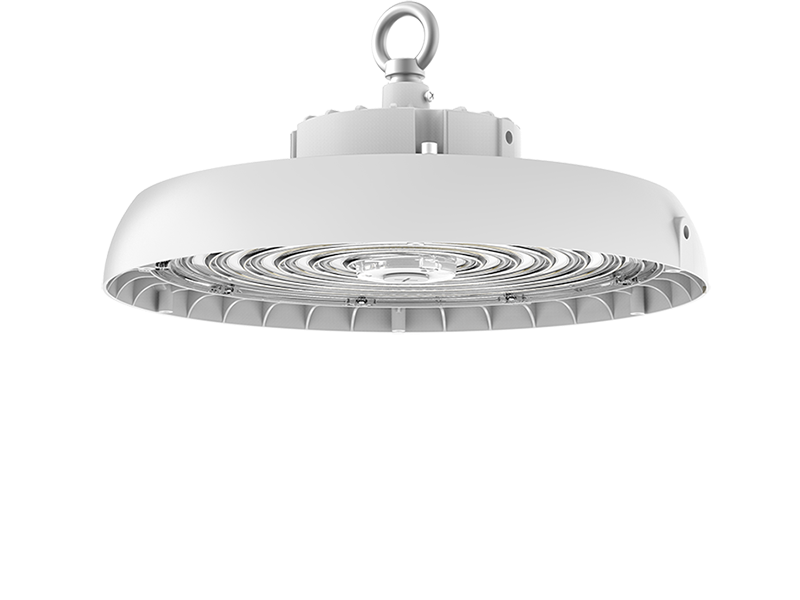
What UGR in high bay lighting measures
UGR stands for Unified Glare Rating. CIE developed the method to evaluate discomfort glare from luminaires in indoor installations. The calculation considers:
- the luminance of each visible luminaire in the observer’s direction;
- the apparent size of each luminous surface;
- the position of each luminaire in the field of view;
- the number of visible luminaires;
- the background luminance of the room.
The result is reported on a scale in which a lower number generally indicates less expected discomfort glare. Common limiting steps include 16, 19, 22, 25 and 28. The appropriate limit comes from the visual task and the applicable workplace-lighting standard; it is not a competition to specify the lowest number everywhere.
UGR 19, UGR 22 and UGR 25 in plain language
| Indicative limit | Typical design intent | Possible industrial use |
|---|---|---|
| UGR ≤ 19 | Strong glare control for demanding visual work | Inspection benches, electronics, quality control, workstations with displays |
| UGR ≤ 22 | Moderate glare control | General production, packing and active logistics areas |
| UGR ≤ 25 | Higher glare allowance | Heavy industrial work and less visually demanding tasks |
These are broad examples, not a substitute for the project standard. A warehouse may contain all three conditions: general storage, a packing line and a precision inspection station. Applying UGR 19 to the entire building may add cost without improving the areas where workers spend little time. Applying UGR 25 everywhere may leave the inspection team working under uncomfortable light.
Why UGR in high bay lighting is not a permanent fixture value
Imagine the same fixture in two buildings. In the first, it hangs 12 m above a broad warehouse with pale walls and generous spacing. In the second, it hangs at 6 m above a narrow production line with dark surroundings and several luminaires visible in a worker’s normal direction of view. The product has not changed, but its apparent brightness, position and background have.
A manufacturer’s UGR table uses standard room proportions and reflectances to make products comparable. It is useful screening data. It cannot guarantee the result in a real building with racks, cranes, mezzanines and workers looking in different directions.
What “UGR<19 high bay” should mean in a datasheet
A credible claim should state the test or calculation conditions. Look for the luminaire dimensions, emitting-surface dimensions, light distribution, output configuration, room proportions and reflectance assumptions behind the table. If a fixture has selectable wattage or several beam angles, the supplier should identify which combination produced the claim.
Be cautious when the same UGR value is printed across every wattage and optic. A 100W wide-beam configuration and a 240W narrow-beam configuration do not present the same luminance or distribution.
Why compact high-output fixtures can feel harsh
Glare is influenced by luminance—the light leaving a visible area—not only by total lumens. Concentrating 35,000 lumens into a small bright optical surface can be more uncomfortable than distributing the same output over a larger diffuser or reflector.
This is why a high lm/W number does not prove good visual comfort. Efficiency, glare control and optical precision have to be balanced. A diffuser may reduce peak luminance but also reduce efficacy. A reflector can hide direct LED images but increase fixture size. A louvre can improve shielding while changing the beam and collecting dust.
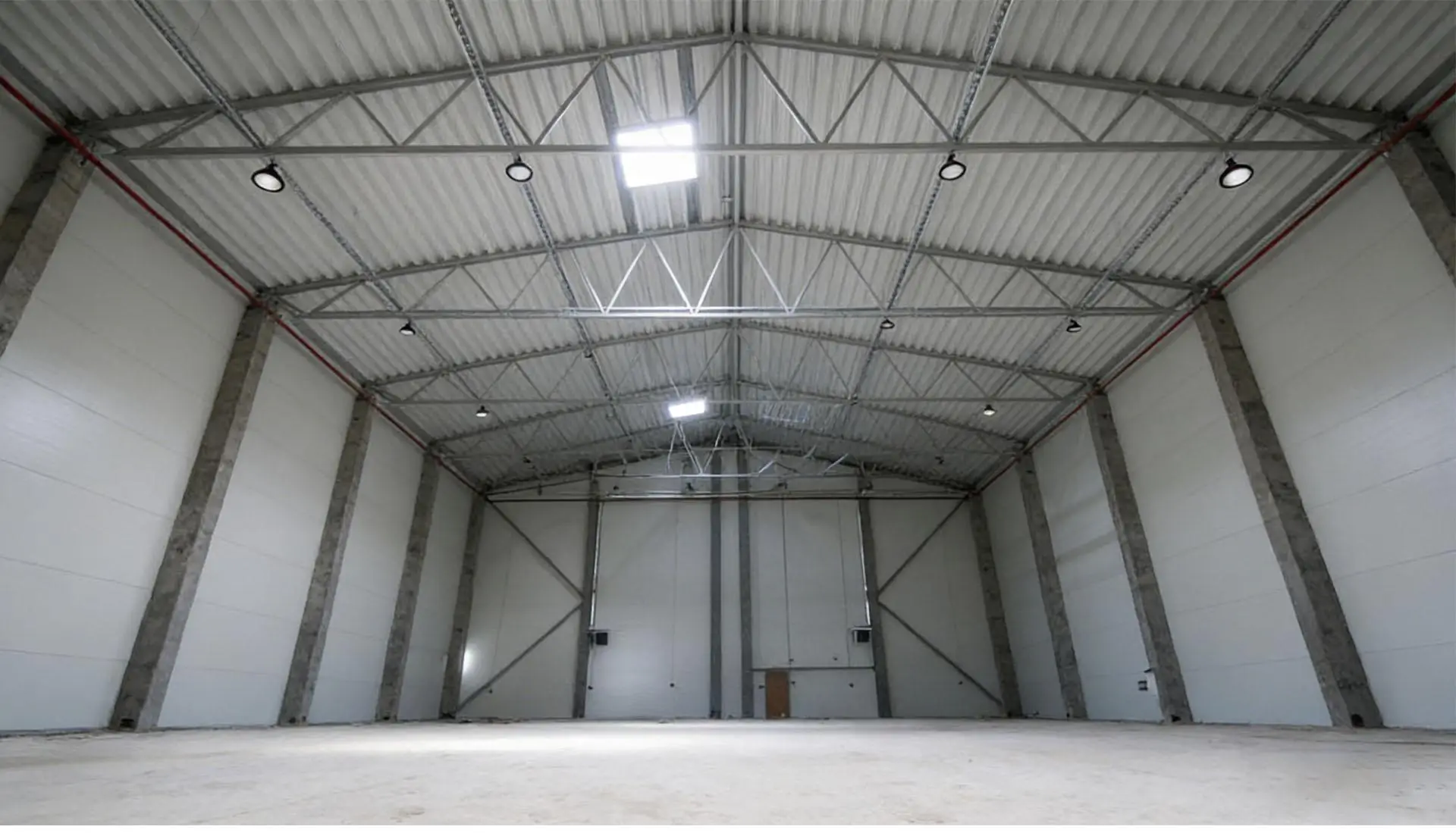
Seven ways to improve UGR in high bay lighting
- Increase the apparent luminous area. A diffuser or larger optical surface lowers peak luminance.
- Use the correct beam. A narrow high-intensity optic at low mounting height is a common source of discomfort.
- Raise the mounting position where structure allows. Greater distance changes the apparent size and viewing angle.
- Move rows out of critical sightlines. Workers looking along an aisle may see many luminaires at once.
- Add shielding or a reflector. Use the accessory’s own photometric file in the layout.
- Reduce output where the task permits. Do not solve a layout problem by over-lighting the room.
- Improve background luminance. Light-coloured ceilings and walls reduce contrast, although they cannot replace optical control.
UGR, lux and lumens answer different questions
| Metric | Question answered | Common misuse |
|---|---|---|
| Lumens | How much visible light leaves the fixture? | Treating total output as proof of a good layout |
| Lux | How much light reaches a surface? | Using average lux while ignoring dark areas and glare |
| UGR | How uncomfortable may visible luminaires appear? | Treating it as a fixed fixture certification |
A layout can reach 500 lux and still feel harsh. It can achieve a low calculated UGR at one observer position while failing at a workstation facing another direction. Lighting quality comes from reviewing the metrics together.
How to specify UGR in high bay lighting
Start with the task, not the catalogue. Mark inspection stations, packing lines, forklift routes, overhead crane operators and computer workstations on the drawing. Define the relevant observer heights and view directions. Then ask the lighting designer to calculate UGR using the exact photometric file and actual room reflectances.
The report should state:
- luminaire model, wattage, lens and accessory;
- mounting height and fixture coordinates;
- observer positions and viewing directions;
- room dimensions and reflectance values;
- calculated UGR in both principal directions;
- maintained lux and uniformity on the same layout.
If the project standard gives a UGR limit, quote that standard and the relevant task. Avoid writing “all luminaires shall be UGR 19” without a room or calculation method.
Verify UGR in high bay lighting after installation
UGR is primarily a calculated quantity, but visual inspection during commissioning is still valuable. Walk the normal routes, stand at fixed workstations and look along both fixture rows. Check whether substituted products, changed mounting heights or moved rows have altered the approved design.
Workers can also reveal views missed by the drawing—for example, a crane operator who looks upward or a picker scanning labels at the top rack. Record those positions and revise the layout if the glare is persistent.
ROKEE provides photometric files for its LED high bay lights and checks UGR in high bay lighting layouts using the actual mounting height and work zones. Use our high bay light spacing guide for the grid, or send the building and task layout for a project calculation.
Frequently asked questions
Is UGR 19 better than UGR 22?
UGR 19 indicates stricter glare control under the stated calculation conditions, but it is not automatically necessary for every area. The task and applicable standard decide the appropriate limit.
Can a luminaire be certified UGR 19?
A luminaire can have a UGR table or reference calculation, but the installed UGR also depends on the room, layout and observer. Treat “UGR 19” as conditional product data, not a universal certification.
Does a diffuser always reduce UGR?
A diffuser can reduce peak luminance by enlarging and softening the emitting surface, but its effect depends on the complete distribution and layout. It may also reduce efficacy.
Does higher mounting reduce glare?
It often improves the viewing geometry, but not in every case. The fixture distribution, observer direction and increased output needed at greater height must be checked together.
Can DIALux calculate UGR?
Yes, when the project contains the correct room geometry, reflectances, fixture locations and photometric files. The observer positions and calculation method still need to match the applicable requirement.
Authoritative references
Related Posts