
CRI and TLCI both describe color performance, but they answer different questions. Learn how to specify LED sports lighting for spectators, players and broadcast cameras.
Food Processing Lighting Requirements: Lux, IP and Hygiene
Food processing lighting requirements begin with the visual task, but they do not end with lux. A suitable system must also tolerate cleaning chemicals, moisture, low temperatures and accidental impact without creating a contamination risk. The production floor, inspection station, cold room and warehouse therefore need separate decisions rather than one fixture and one light level throughout the building.
Use this guide to prepare a project brief. Final criteria must follow the food-safety rules, electrical code and lighting standard that apply at the installation location.
Start with zones, not a catalogue wattage
A raw-material store does not need the same lighting as a colour inspection table. Draw the process route and mark receiving, storage, preparation, cooking, packing, inspection, washdown, cold rooms, circulation and external loading. For each zone, record the task height, expected dirt, cleaning method, ambient temperature and whether exposed food is present.
This zoning exercise turns broad food processing lighting requirements into measurable conditions for each room.
| Zone | Main visual need | Main luminaire concern |
|---|---|---|
| Dry storage | Labels, movement and stock identification | Uniform aisle light and low maintenance |
| Preparation | Safe handling and surface cleanliness | Cleanable housing, controlled glare and colour quality |
| Inspection | Detecting defects, colour or foreign material | Higher task illuminance and suitable spectrum |
| Washdown | Cleaning and sanitation verification | Ingress protection, seals and chemical compatibility |
| Cold room | Picking and safe movement | Low-temperature driver and condensation control |
| Packing | Reading print and checking seals | Good uniformity with limited reflections |
What the FDA minimums mean
For projects governed by the U.S. Food Code, Section 6-303.11 states minimum illuminance at defined locations. The 2022 edition specifies at least 108 lux in walk-in refrigeration and dry food storage and during cleaning, at least 215 lux at selected handwashing, warewashing and equipment areas, and at least 540 lux where employees work with exposed food or where safety is a factor. The measurement plane and exact scope matter.
These are regulatory minimums, not a complete lighting design. A fine inspection task may need more light; a glossy stainless-steel line may need better diffusion rather than more output. Confirm which edition has been adopted locally and whether another national standard applies.
Translate food processing lighting requirements into maintained values
Specify maintained illuminance, not only the initial calculation. LED output declines, lenses collect residue and room finishes change. The lighting calculation should use a documented maintenance factor based on operating hours, cleaning access and environment. If the design just reaches the target on day one, it will fall short in service.
Uniformity also matters. Bright pools separated by dim patches slow visual adaptation and can hide spills or obstacles. Ask for the calculation grid, minimum and average values, calculation height and surface reflectances.
Choose an enclosure for the actual cleaning method
An IP rating describes resistance to dust and water under specified tests. It does not automatically prove resistance to hot water, steam, oils, disinfectants or repeated pressure washing. Record nozzle pressure, distance, temperature, chemical concentration and cleaning frequency, then obtain written confirmation that the complete luminaire is suitable.
Check the lens, gasket, cable gland, fasteners and mounting hardware—not only the aluminium body. In aggressive areas, a failed gland or degraded seal can defeat an otherwise robust enclosure.
Reduce glass and fragment risk
Food processing lighting requirements often include shatter control above exposed product. Use impact-resistant lenses, secure covers and suitable mounting. Where policy calls for it, add secondary retention. The food-safety team should approve the luminaire construction and the response procedure for any breakage.
A high IK code can support impact resistance, but it does not replace a hazard assessment. Consider where fragments could travel, whether the fixture is directly above an open line and how maintenance is performed.
Control glare on stainless steel and wet floors
Stainless-steel equipment, pale panels and wet surfaces can create strong reflections. More lumens can make the problem worse. Use broader luminous surfaces, suitable optics and positions that keep reflected images away from operators’ normal sight lines. Evaluate glare at standing and seated workstations, not only from the floor plan.
Glare limits should therefore sit beside illuminance and uniformity in the food processing lighting requirements schedule.
At inspection points, local task lighting may be more effective than raising the output of every high-bay fixture. It also gives the operator control without increasing energy use across the room.
Specify colour quality for the product
CRI and correlated colour temperature should support the task. General circulation may tolerate a basic colour-rendering specification, while meat, produce, print or contamination inspection can require stronger colour discrimination. Test representative samples under the proposed light; a CRI number alone does not describe every saturated colour.
Keep colour appearance consistent across adjacent work areas. A sudden shift between warm and cool light can make product colour look different as it moves along the line.
Plan for cold rooms and temperature transitions
Cold conditions change driver start-up, lumen output and battery behaviour. Select a luminaire with a rated ambient range that covers the room’s minimum temperature. At doors and loading interfaces, consider condensation caused by repeated movement between warm, humid air and the cold space.
Place drivers where heat can escape and verify emergency-light performance at the actual temperature. A nominal wattage tells you none of this.
Use controls without compromising safety
Occupancy sensors work well in intermittent stores and service spaces, while scheduled dimming may suit predictable production shifts. Avoid abrupt darkness around moving machinery. Set a safe background level, sensible delay and manual override. Daylight dimming should be commissioned at the task plane so rooflight changes do not create visible hunting.
Food factory lighting submittal checklist
A complete submittal lets the hygiene, electrical and production teams review the same food processing lighting requirements before purchase.
- zoned photometric calculation with maintained results;
- luminaire IP and IK ratings, with test basis;
- ambient and low-temperature operating range;
- lens, gasket, coating and fastener materials;
- chemical and washdown compatibility statement;
- colour temperature, CRI and any special colour metric;
- flicker data for cameras or fast machinery;
- emergency-lighting arrangement and test method;
- cleaning access, retention and maintenance procedure.
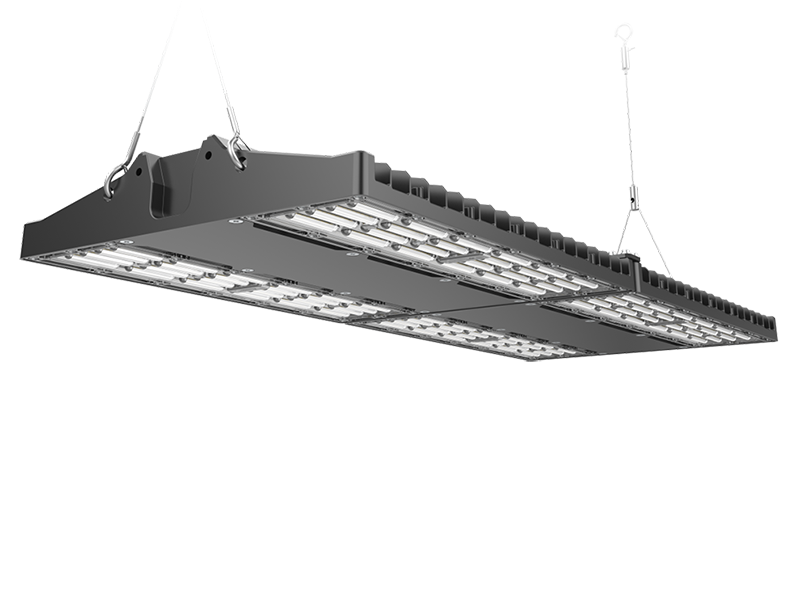
Review ROKEE’s linear LED high bay lights and LED high bay range. For a calculation, send the room dimensions, task zones, mounting height, cleaning method and target standard.
Frequently asked questions
How many lux does a food processing area need?
It depends on the task and jurisdiction. The U.S. FDA Food Code includes 108, 215 and 540 lux minimums for specified conditions, but inspection work may require a higher project value.
Is IP65 enough for food production?
It may suit some dry or damp areas, but it does not prove resistance to every washdown process or chemical. Match the complete enclosure to the real cleaning regime.
What colour temperature is best?
Neutral white is common, but the correct choice depends on product appearance, surrounding finishes and the inspection task. Compare samples before standardising a facility.
Do food factories need shatterproof lights?
Many food-safety plans require fragment control above exposed product. The accepted lens, cover and retention method should be agreed with the site’s food-safety authority.
Can occupancy sensors be used in cold rooms?
Yes, provided the sensor and driver are rated for the temperature and the delay keeps safe illumination during normal work.
Authoritative references
Related Posts