
ATEX is EU law. IECEx is a voluntary international certificate built on the same IEC…
Industrial LED Lighting Fixtures for Warehouses: Buyer’s Guide
Specifying industrial LED lighting fixtures for warehouses is an engineering task, not a shopping task. Two buildings with the same floor area can need completely different fixtures, because racking height, aisle width, task precision, ambient temperature and cleaning regime decide the optical and mechanical requirements long before anyone argues about wattage.
This guide compares the fixture families used in modern warehouses, explains how mounting height and beam angle interact, and lists the ratings, test reports and documents a buyer should demand before approving a supplier. It is written for facility managers, MEP contractors, electrical distributors and purchasing teams selecting industrial LED lighting fixtures for a new build, an extension or a metal-halide retrofit.
1. Read the building before reading any catalogue
The first page of a warehouse lighting brief should describe the building, not the product. Six inputs decide almost everything that follows.
- Clear height under the roof structure. A 6 m warehouse and a 14 m warehouse do not share an optical solution, even if the racking is identical.
- Racking height and aisle width. Narrow aisles between tall racks need light pushed down the aisle; wide open picking areas need broad, even coverage.
- Task and hazard. Scanning labels, reading pick lists, inspecting pallet damage and driving a forklift have different vertical and horizontal requirements.
- Environment. Cold store, ambient warehouse, freezer, food production, chemical storage and unheated loading dock each impose different ratings.
- Shift pattern. Single-shift storage and 24/7 fulfilment centres justify different control strategies and different driver quality.
- Existing infrastructure. Roof purlin spacing, available circuits, mounting points, voltage and any busbar system constrain the mechanical design.
Write these six lines down before comparing industrial LED lighting fixtures. Suppliers who receive this information quote configurations that already fit; suppliers who do not, quote on price alone and the differences appear during installation.
2. The five fixture families that cover most warehouses
Almost every warehouse project resolves to one or a mix of five families. Knowing which family belongs to which zone prevents the most common retrofit error: buying one fixture type for the whole building. It is also the fastest way to see whether a quotation offers industrial LED lighting fixtures as a system or as a single part number repeated across every drawing.
| Family | Best used for | Typical wattage | Watch out for |
|---|---|---|---|
| UFO high bay | Open storage above 6 m, pallet racking, wide bays | 100–300 W | Needs a beam angle matched to racking, not the widest option available |
| Linear high bay | Racking aisles, shelf lighting, low-bay picking at 4–8 m | 60–200 W | Aim direction must be adjustable or the aisle floor stays dark |
| High bay retrofit bulb | Replacing E39/E40 metal halide or sodium in existing fittings | 60–200 W | Ballast bypass, socket temperature and reflector condition decide the result |
| Vapour-tight / tri-proof linear | Food areas, cold store, wash-down zones, dusty stores | 20–80 W | Gasket and clip quality matter more than the IP number printed on the box |
| Wall pack and area light | Loading docks, apron lighting, perimeter and yard | 30–200 W | Backlight control and glare shields are usually a project requirement |
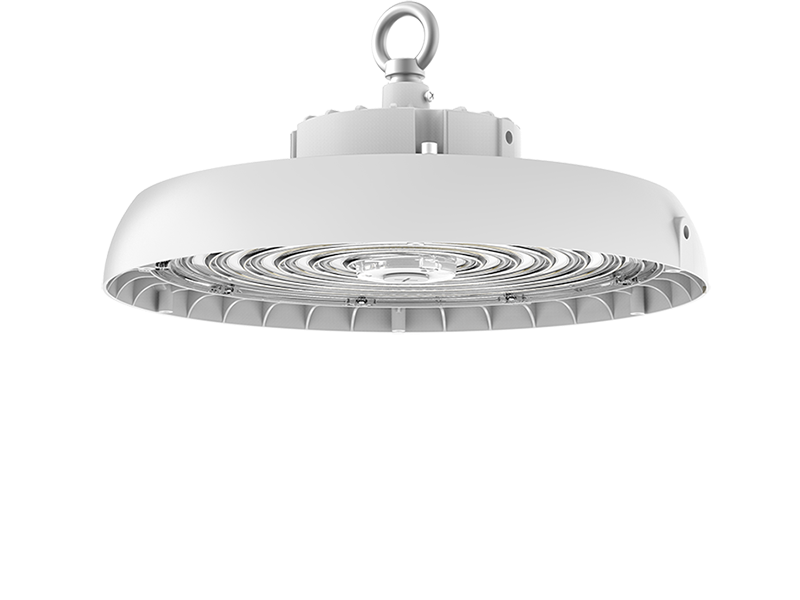
Our LED high bay light range and linear high bay range cover the first three families; the flood and wall-mounted families are covered by the LED flood light range.
3. Mounting height sets the lumen output you actually need
Industrial LED lighting fixtures are usually sold by wattage, but the useful specification is delivered lumens at the working plane. As mounting height increases, the same luminaire spreads its output over a larger area and illuminance falls. The table below is a practical starting range for warehouse storage and picking areas, to be confirmed by a photometric calculation.
| Mounting height | Typical fixture output | Typical layout | Notes |
|---|---|---|---|
| 4–6 m | 8,000–15,000 lm | Wide distribution, 5–7 m spacing | Low bay territory; linear fixtures often beat round ones |
| 6–9 m | 15,000–25,000 lm | Medium distribution, 7–9 m spacing | The most common warehouse band |
| 9–12 m | 25,000–40,000 lm | Narrow to medium, 9–12 m spacing | Upward light must be controlled to avoid rack glare |
| 12 m and above | 40,000 lm and up | Narrow distribution, 12 m+ spacing | Maintenance access cost drives the driver and warranty decision |
No output figure on its own guarantees the result; industrial LED lighting fixtures only perform when the lumen package, the optic and the mounting height agree. Do not accept a wattage-for-wattage replacement. A 400 W metal halide installation is not automatically replaced by a 150 W LED; it is replaced by whatever configuration produces the required maintained lux on the picking face with acceptable uniformity. That number comes from a calculation file, not a rule of thumb.
4. Beam angle has to follow the racking, not the room
Beam angle is the single most misused specification in warehouse lighting, and the point where most industrial LED lighting fixtures are either wasted or justified. A 120° fixture mounted at 10 m floods the rack tops and wastes light; a 30° fixture mounted over a wide picking area leaves the floor in stripes. The correct angle depends on what the light has to reach.
- Narrow aisles between tall racks: 60°–90° with the fixture centred over the aisle, so light travels down the rack face.
- Open bulk storage: 90°–120° for even coverage across the bay.
- High racking with a horizontal shelf line: asymmetric or tiltable linear fixtures aimed along the rack face.
- Dock and apron: asymmetric forward-throw optics to keep light on the ground and out of the driver’s eyes.
Ask for the IES or LDT photometric file and check the polar curve yourself, or ask the supplier to run the calculation on your drawing. A datasheet beam angle is a nominal value; the distribution file is the truth. This is also why our LED high bay lights for warehouse applications guide treats optics as a layout decision rather than a product attribute.
5. Efficacy, L70 and driver quality decide the ten-year cost
Three numbers separate a cheap set of industrial LED lighting fixtures from a low-cost one.
Efficacy, in lumens per watt, sets the electricity bill. For warehouse fixtures, 130–160 lm/W at the luminaire level is a normal current range; anything far above it deserves a test report. Be clear whether the figure is LED efficacy or luminaire efficacy, because the difference is often 15–25%.
L70 life, in hours, sets the replacement cycle. A claimed 100,000-hour L70 should be supported by LM-80 data on the exact LED part number plus an LM-79 test on the finished luminaire. Claims that reference a different LED series than the one supplied are common.
Driver quality sets the failure rate. Drivers fail before LEDs do in most warehouse installations. Ask for the driver brand and model, its ambient temperature rating, its surge rating, and whether it can be replaced without removing the fixture. In a 12 m ceiling, a driver that requires fixture removal doubles the maintenance cost.
6. IP, IK and ambient temperature: read the whole rating
Ratings are where price differences usually hide, so check them line by line. An IP65 rating describes dust and water ingress under test conditions, not corrosion resistance, not impact resistance and not UV stability. Industrial LED lighting fixtures for warehouses are frequently specified with three ratings at once.
- IP65 is adequate for most ambient warehouses; IP66/IP67 belongs in wash-down, cold store and outdoor dock areas.
- IK08 suits normal handling; IK10 is worth specifying where forklifts, pallet trucks or overhead cranes operate near the fixtures.
- Ambient temperature range must cover the real site condition. A fixture rated to 40 °C inside a roof void that reaches 55 °C will lose output and driver life.
Three environment types break otherwise correct specifications, and all three catch buyers who compare industrial LED lighting fixtures on catalogue ratings alone: cold stores where the fixture must start at −25 °C, food production areas where ammonia or chlorine-based cleaning agents attack aluminium and polycarbonate, and coastal or fertiliser storage sites where salt and chemical vapour require a corrosion-resistant housing and stainless fasteners.
7. Controls that actually pay back
Controls are where industrial LED lighting fixtures stop being a commodity and start behaving like an installed system. They are, however, often sold as a package and installed as an afterthought. Three functions deliver most of the savings.
Occupancy-based dimming is the highest-return strategy in storage areas with intermittent traffic. Fixtures drop to 20–30% output when a zone is empty and return to full output on detection. The savings depend on real traffic patterns, so the zoning should follow aisle usage, not drawing convenience.
Daylight response matters in warehouses with skylights or large loading doors, where the electric light can be dimmed for several hours a day.
Central monitoring turns maintenance from reactive to planned. A system that reports driver faults, hours run and power consumption per circuit removes the need to walk the racks with a lux meter.
Choose the protocol before choosing the fixture: 0–10 V, DALI-2, Zigbee or a proprietary mesh each imply different wiring, different commissioning tools and different spare-part strategies. Sensors integrated into the fixture reduce installation cost but complicate replacement, so decide whether the sensor or the luminaire is the long-life item in your building.
8. The documentation package to request before approval
A serious supplier of industrial LED lighting fixtures will send a documentation package without being pushed. If any item is missing, the price is not comparable.
- LM-79 photometric and electrical test report for the exact model
- LM-80 data for the LED package actually used, with the ISTMT reference
- IES and LDT photometric files for calculation
- CE declaration of conformity, RoHS statement and, where relevant, ENEC or CB certificates
- IP and IK test reports from an accredited laboratory
- Driver datasheet including surge rating and ambient rating
- Installation manual with torque values, mounting details and wiring diagram
- Warranty terms stating what is covered, for how long, and who pays removal and reinstallation
The warranty clause deserves specific attention. Five years on paper means little if the remedy excludes labour on a 12 m ceiling. Compare warranty documents, not warranty headlines.
9. Five specification mistakes we see with industrial LED lighting fixtures
- Watts instead of lux. Replacing by wattage produces either over-lighting or dark picking faces.
- One fixture for every zone. Storage, picking, dock, office mezzanine and cold room are different lighting problems.
- Ignoring the maintenance factor. A design at exactly the target lux on day one will be below target within two years.
- Buying the widest beam angle to “cover everything”. It covers the rack tops and wastes the majority of the output.
- No spare strategy. Order 3–5% spares at the same time as the main order; colour and output batches drift between production runs.
10. Procurement checklist for industrial LED lighting fixtures
| Item | What to confirm |
|---|---|
| Calculation | Maintained lux, uniformity and vertical illuminance on the picking face from real IES files |
| Fixture schedule | Model, wattage, delivered lumens, beam angle, CCT, CRI, driver and controls per zone |
| Ratings | IP, IK, ambient range, corrosion class and impact requirement stated per zone |
| Compliance | CE/RoHS plus the destination market requirements, with certificate numbers |
| Lifetime evidence | LM-79 report, LM-80 data, driver brand and replaceability |
| Delivery | Batch consistency, packing standard, lead time and spare quantity |
| After-sales | Warranty terms including labour, spare availability for the warranty period, technical contact |
Choose industrial LED lighting fixtures with a manufacturer, not a listing
ROKEE builds industrial LED lighting fixtures for warehouse, logistics and production environments, alongside commercial LED luminaires for warehouse, logistics and production environments, with photometric files, DIALux support and configuration control from sample to shipment. Review our warehouse LED high bay selection guide and our warehouse lighting design guide for the layout side of the project, then send your building drawing, racking layout and target lux for a fixture schedule and calculation.
Frequently asked questions
How many lumens per square metre does a warehouse need?
Think in lux at the working plane rather than lumens per square metre. Storage areas commonly target around 100–150 lux, picking and packing areas 200–300 lux, and inspection or dispatch checking 300–500 lux. Confirm the target with the project specification and verify it through a photometric calculation.
Are UFO or linear high bay fixtures better for a warehouse?
UFO high bays suit open storage and wide bays above roughly 6 m. Linear high bays suit racking aisles and low-bay picking because they can be aimed along the rack face. Many warehouses need both, zone by zone.
Can I keep my existing high bay fittings and only change the lamp?
Sometimes. Replacing the lamp is the cheapest route, and industrial LED lighting fixtures designed for retrofit keep the existing housing. A retrofit bulb still requires ballast bypass, a sound socket rated for the new lamp temperature, and a reflector in good condition. If the housing is corroded or the reflector is degraded, replacing the complete fixture usually gives better results at a similar total cost.
What IP rating do warehouse lights need?
IP65 is sufficient for dry ambient warehouses. Specify IP66 or IP67 for wash-down, cold store, food production and outdoor dock areas, and add a corrosion class requirement for chemical, coastal or fertiliser storage.
How long do industrial LED lighting fixtures last?
LED packages commonly reach L70 after 50,000–100,000 hours, but the practical life of the fixture is usually set by the driver and the environment. In high-temperature or high-dust buildings, driver replacement at 30,000–50,000 hours is realistic even when the LEDs are still within specification.
Authoritative references
- BS EN 12464-1:2021 Light and lighting — Lighting of indoor work places
- DesignLights Consortium: solid-state lighting qualified products and technical requirements
- IEC Webstore: luminaire safety standards and test methods
- International Commission on Illumination (CIE): publications on interior lighting and glare
Related Posts