
CRI and TLCI both describe color performance, but they answer different questions. Learn how to specify LED sports lighting for spectators, players and broadcast cameras.
Sports Lighting Glare Control: GR, Spill Light and Sky Glow
Sports lighting glare control starts with pole geometry and aiming, not with a visor added at the end. A good layout keeps high-intensity beams away from the normal sightlines of players, officials, spectators, drivers and nearby residents while still producing the required vertical light and uniformity. If the poles are too low or badly placed, no accessory can fully repair the design.
Three different problems are often bundled together as “glare”: discomfort inside the field, unwanted light beyond the site, and upward light that contributes to sky glow. They require different calculations and should appear as separate acceptance criteria.
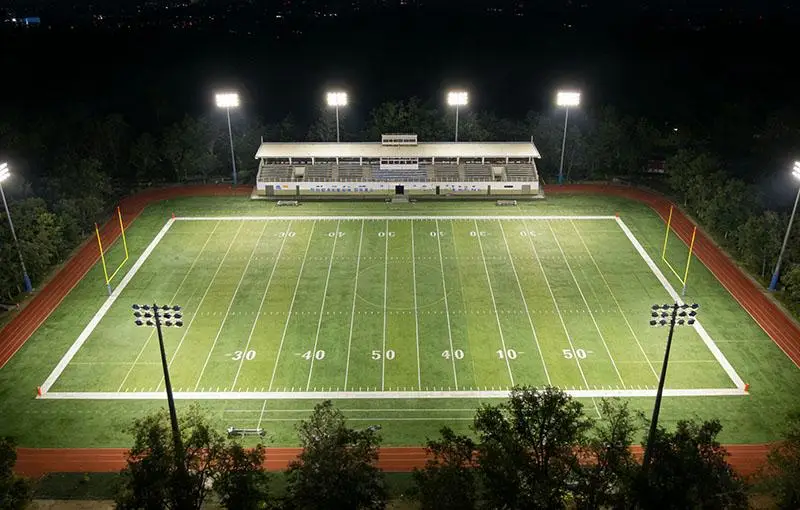
Sports lighting glare control has three separate tasks
| Problem | Where it is assessed | Typical design response |
|---|---|---|
| Player and spectator glare | Observer positions within or beside the playing area | Pole height, setback, optics, aiming and shielding |
| Spill light or light trespass | Property boundaries, windows, roads and other sensitive points | Asymmetric optics, backlight control, visors, curfew and dimming |
| Sky glow | Light emitted directly or reflected upward | Low tilt, controlled upper distribution, lower output after use |
CIE 112 describes a glare-rating system for outdoor sports and area lighting. CIE 150 deals with the effects of obtrusive light outside the installation. Using a single number for both tasks hides the actual cause of a complaint.
What GR tells you—and what it does not
Glare Rating, normally shortened to GR, predicts discomfort or impairment for defined observer positions and viewing directions in an outdoor installation. It considers the luminous intensity of the floodlights, their arrangement and mounting height, and the brightness of the illuminated area.
A GR calculation is not a permanent badge attached to a luminaire. Change the pole position, aiming angle, fixture quantity, playing-surface reflectance or observer direction and the result changes. A claim such as “low-glare floodlight” is therefore incomplete without the layout used to support it.
Ask the designer to show the calculation points and viewing directions. Goalkeepers looking toward a high ball, a baseball player tracking a fly ball and a spectator seated behind the touchline do not share the same critical view.
Pole height and setback drive sports lighting glare control
Low poles look economical in the construction budget, but they force luminaires to operate close to the players’ line of sight. To reach the far side of a field, the floodlights are then tilted upward, exposing more of the bright optical surface and increasing light beyond the boundary.
A taller pole is not automatically better, but it gives the optical designer more useful angles. The correct height is the one that allows the beam to reach its aiming zone without excessive tilt and without placing the source in a critical view. Pole locations should therefore be fixed during the photometric design, not handed to the lighting supplier after foundations have been poured.
Where existing poles must remain, compare several optic and bracket configurations before increasing wattage. More light from the wrong position generally creates more glare, not a better field.
Use more than one beam distribution
A professional sports layout rarely uses one beam angle everywhere. Narrow beams serve distant zones; medium distributions fill the centre; wider or asymmetric optics cover areas near the poles and along the sidelines. Overlap between those distributions produces uniformity without forcing every floodlight to aim at the middle of the field.
The IES or LDT file must match the exact lens and visor in the quotation. A photometric file for the bare luminaire cannot prove the performance of a unit supplied with a different shield. It is equally risky to calculate with a 15° file and ship a visually similar 20° lens.

What visors can and cannot do
A visor, louvre or external shield can reduce intensity above or behind the intended beam. It is useful when the site has a nearby boundary, houses behind a goal or a road beside a court. The accessory also absorbs useful light and changes the distribution, so the designer should calculate it as part of the luminaire rather than add it after approval.
Deep shielding is not free. It can increase wind area, add weight to the bracket and trap dirt or heat. For a high-mast installation, the mast engineer needs the effective projected area of the complete assembly, not the bare floodlight.
Aiming is a sports lighting glare control dimension
Aiming schedules are often treated as commissioning notes. They should be treated like dimensions on a drawing. Each luminaire needs a fixture ID, pole position, mounting elevation, horizontal bearing and vertical angle, plus a defined reference point.
“Aim at the penalty area” is not repeatable. A schedule that says “P2-L4: bearing 128°, tilt 34° from horizontal” can be checked after a storm, a driver replacement or mast maintenance. Lockable brackets and engraved angle scales reduce drift, but a field reading remains the final check.
Measure spill light at real sensitive locations
A property-line average can conceal a bright bedroom window or a dangerous patch of road. Identify sensitive points before the model is built:
- residential windows facing the field;
- road approaches where a bright luminaire competes with traffic signals;
- neighbouring playing areas and spectator entrances;
- shorelines, wetlands or habitats with night-time activity;
- observatories or sites governed by local dark-sky rules.
At each point, check the metric required by the authority: it may be vertical illuminance, luminous intensity in the observer direction, upward light, or a combination. Confirm the measurement height and curfew period in the design brief so that the tender can be compared fairly.
Dimming and curfews are part of sports lighting glare control
A venue seldom needs competition lighting while the grounds crew is cleaning the stands. Separate scenes for maintenance, training, matches and events reduce operating cost and lower the impact on neighbours. An automatic curfew can bring perimeter and car-park lighting down after the crowd leaves instead of relying on an operator to remember.
Controls do not excuse a poor optical design. They reduce exposure after hours; they do not prevent a goalkeeper from seeing a bright source during play. Use optics and geometry first, then controls to match output to the activity.
Do not trade away vertical illuminance
An aggressive attempt to eliminate every high-angle ray can leave players’ faces and airborne balls underlit. Broadcast cameras, in particular, need light on vertical planes from more than one direction. The design objective is controlled light, not simply less light.
Compare glare, spill and vertical illuminance in the same calculation. If one improves while another fails, change the pole or distribution rather than judging the layout from a single screenshot. The broader workflow is covered in our stadium lighting design guide, while football field lighting lux levels explains why horizontal lux alone is not enough.
What to include in a sports lighting glare control brief
- scaled field and site plan, including finished levels;
- pole coordinates, heights and structural limits;
- sport, competition level and broadcast requirements;
- critical player, spectator and camera views;
- property boundaries, windows, roads and environmental receptors;
- applicable GR and obtrusive-light limits;
- curfew times and required operating scenes;
- exact luminaires, optics, visors and photometric files;
- commissioning and post-installation measurement method.
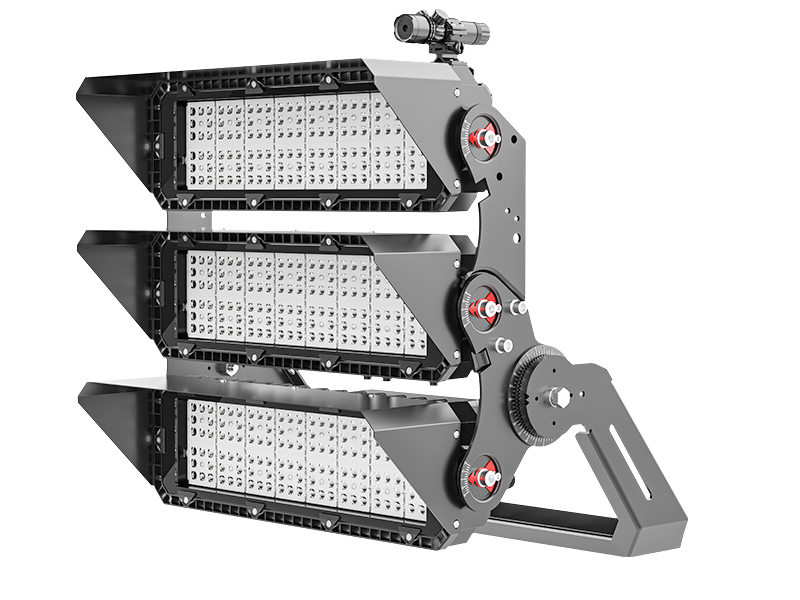
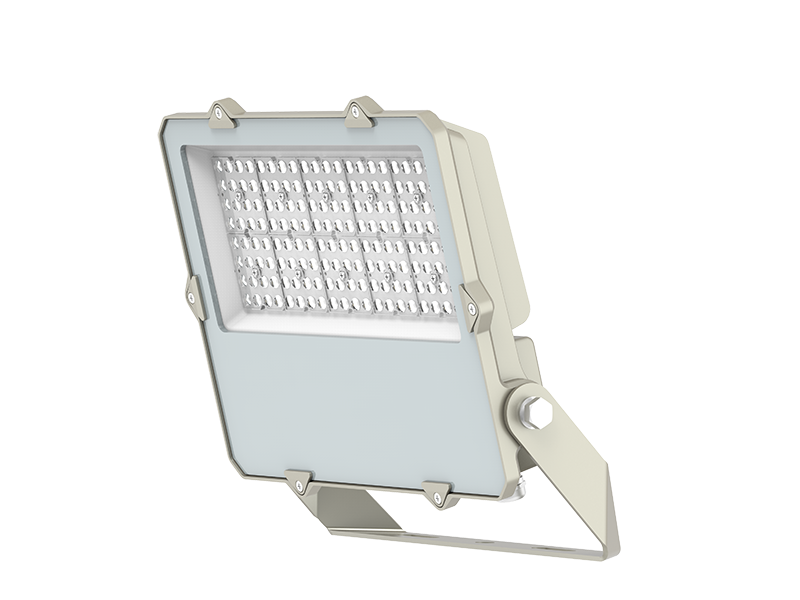
Effective sports lighting glare control still has to be modelled in the actual venue. ROKEE’s G8 anti-glare modular stadium light is one option where a project needs external shielding and selectable optics. Review the wider LED sports light range, or send the field and boundary drawing for a glare and spill-light calculation.
Frequently asked questions
What is GR in sports lighting?
GR is a glare-rating method used for outdoor sports and area lighting. It predicts glare for defined observer positions and viewing directions; it is a result of the installation, not a fixed property of one floodlight.
Does a visor reduce sports-field glare?
It can reduce selected high-angle or backward intensity, but it also changes useful output and wind area. The visor must be included in the photometric and structural calculations.
Are glare and spill light the same?
No. Glare is experienced by an observer looking within or near the lit area. Spill light is unwanted light reaching locations outside the intended area. They are assessed with different positions and often different metrics.
Can lower wattage solve glare?
Only if excessive output is the cause. Glare often comes from source position, aiming and intensity in a particular direction. A lower-wattage fixture aimed badly can still cause severe glare.
When should glare be checked?
During concept design, again with the final luminaire files, and after installation. The site check confirms that pole locations and aiming match the approved model.
Authoritative references
Related Posts