
CRI and TLCI both describe color performance, but they answer different questions. Learn how to specify LED sports lighting for spectators, players and broadcast cameras.
Marine LED Flood Lights: Salt Spray, C5 Corrosion and SUS316
Marine LED flood lights fail at joints and interfaces before they fail at the LED. Salt reaches coating edges, fastener holes, cable entries, brackets and dissimilar-metal contacts. A fitting may continue to turn on while its bracket seizes, its coating blisters or its cable gland loses integrity. For ports, shipyards and coastal sites, corrosion design has to cover the whole assembly.
Start with the environment and maintenance interval, then specify the housing alloy, coating system, stainless hardware, cable entries and test evidence. An IP66 mark alone says nothing about salt corrosion.
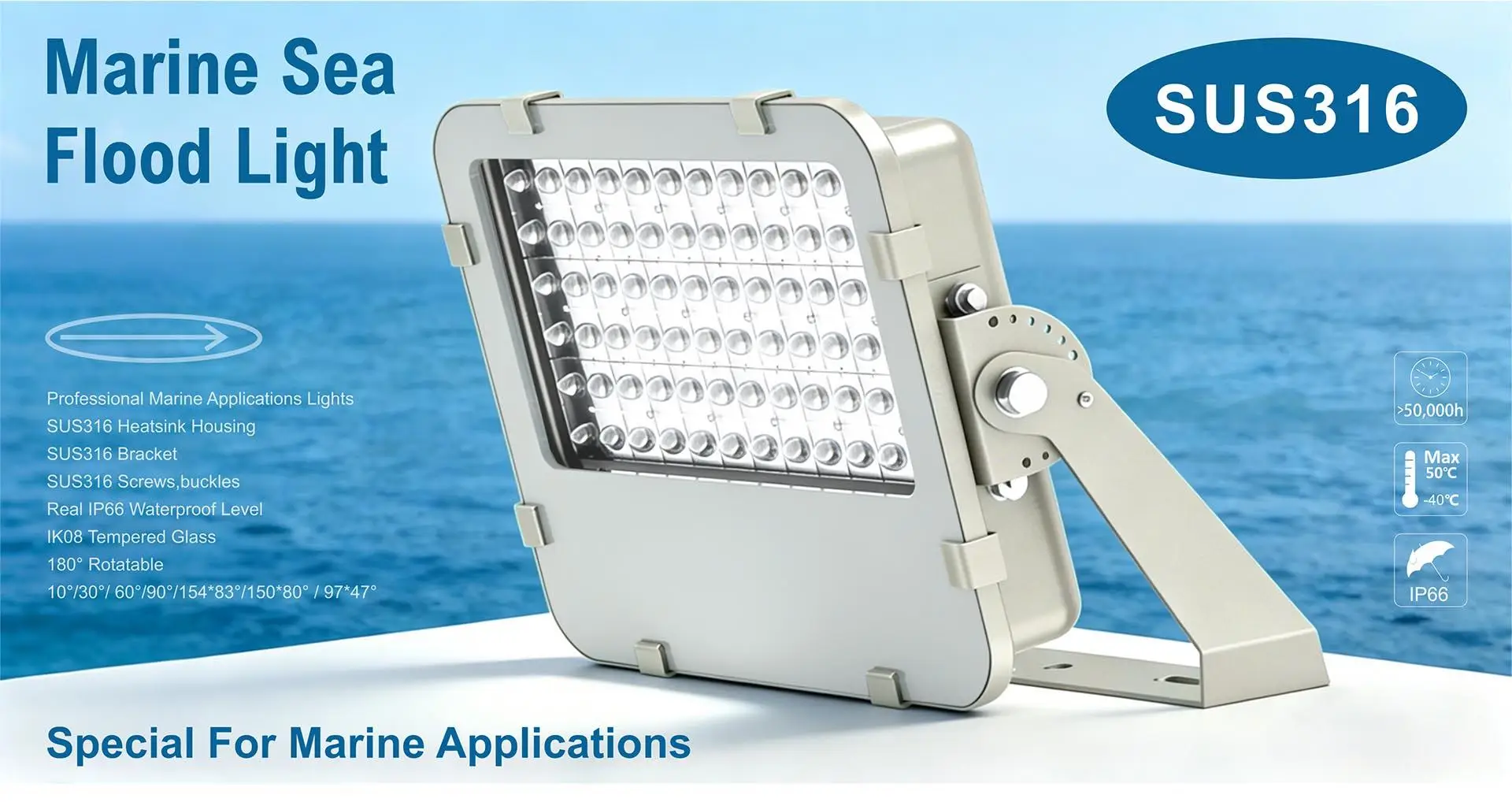
Where marine LED flood lights earn their specification
The word “marine” covers several exposure levels. A floodlight on an inland warehouse near the coast does not face the same duty as one on a jetty, a crane boom or an open ship deck.
- Coastal industrial area: airborne salt, humidity and occasional wash-down.
- Port or container terminal: salt, diesel residue, vibration, wind and difficult access.
- Shipyard or dry dock: salt water, abrasive dust, welding contamination and impact risk.
- Offshore or exposed deck: persistent salt deposition, spray, UV, strong wind and frequent wet-dry cycles.
Describe the mounting position, distance from the sea, direct-spray risk, ambient temperature, cleaning chemicals and expected maintenance access. Those details are more useful than simply writing “coastal application” in a tender.
C5 is an environment category, not a magic coating
ISO 12944 classifies atmospheric environments by corrosivity and provides a framework for choosing protective paint systems. C5 represents very high corrosivity; offshore and severe marine exposure may fall into still more demanding categories depending on the current edition and project conditions.
A supplier should not use “C5” as a standalone marketing adjective. Ask what substrate, surface preparation, primer, topcoat, dry-film thickness and test method support the claim. The system applied to the actual cast-aluminium housing matters; a certificate for a flat steel coupon does not automatically prove the complete luminaire.
How to read salt-spray tests for marine LED flood lights
ASTM B117 defines the apparatus and conditions for a controlled salt-fog test. It is useful for comparing coating systems and checking manufacturing consistency. It does not predict a fixed number of years beside the sea. ASTM itself warns that stand-alone salt-spray results do not reliably correlate with natural exposure.
Therefore “2,000-hour salt spray” should prompt four follow-up questions:
- Was the specimen a coated panel, a housing section or a complete luminaire?
- Were edges, scratches, fasteners and mounting holes included?
- What counted as failure: red rust, blistering, adhesion loss or a defined corrosion area?
- Which laboratory issued the report, and does the tested construction match the production unit?
More hours are not automatically better evidence. A clear failure criterion and a representative specimen are more informative than a large number printed without context.
Housing materials for marine LED flood lights
Die-cast aluminium keeps weight and thermal resistance under control, but alloy composition affects corrosion behaviour. Low-copper aluminium is generally preferred for severe outdoor exposure because copper-rich phases can promote galvanic activity within the casting.
The coating is only as reliable as its preparation. Poor cleaning, trapped release agent, sharp edges and thin coverage around ribs or screw holes become failure points. A marine specification should cover pretreatment, coating chemistry, thickness and curing—not just colour and gloss.
Why marine LED flood lights use SUS316 hardware
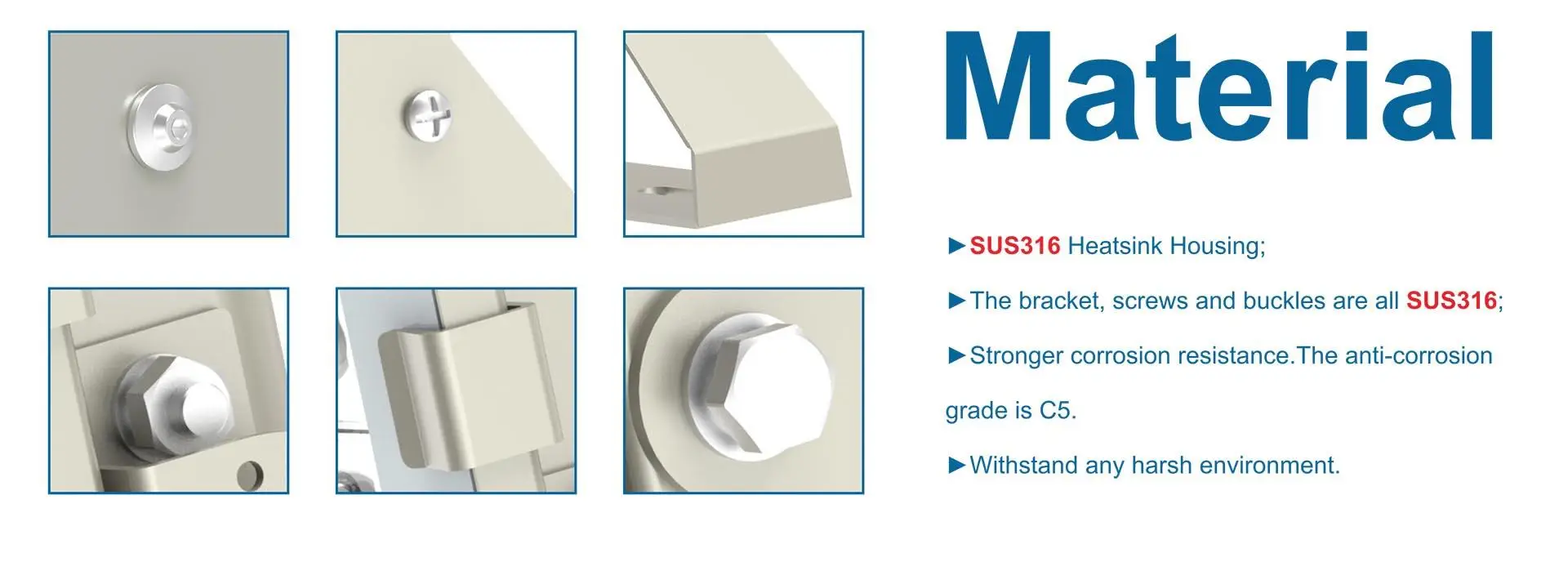
SUS316 stainless steel contains molybdenum and is commonly chosen over 304 for improved resistance to chloride environments. It is a sensible material for external screws, bolts, washers and brackets exposed to coastal salt. It does not make the complete fixture immune to corrosion.
Check the actual hardware schedule. A luminaire advertised with a SUS316 bracket may still use lower-grade cover screws, spring washers or gland components. Fasteners should also be designed to avoid water traps and allow removal after years in service.
Control galvanic corrosion
Putting stainless steel fasteners into aluminium creates a dissimilar-metal couple. In the presence of salt water, the aluminium can corrode preferentially. Good design limits the electrolyte path and electrical contact through compatible washers, isolation pads, sealants or approved anti-seize compounds.
The mounting structure matters as well. A coated aluminium floodlight fixed directly to a carbon-steel bracket on a wet jetty may fail at the interface even when each component passed its own test. Review the complete mounting stack.
IP66 marine LED flood lights are not automatically corrosion resistant
Ingress protection describes resistance to dust and water entering the enclosure under specified test conditions. It does not address salt chemistry, coating adhesion, UV exposure or galvanic attack. A marine LED flood light normally needs both an appropriate IP rating and a corrosion specification.
Cable glands are frequent weak points. Confirm the gland material, thread, sealing washer and cable diameter range. Unused entries need compatible blanking plugs. A high-quality housing with a field-installed mild-steel gland is no longer a marine assembly.
Optics and glare at ports and shipyards
Durability is only half the job. Port and shipyard lighting has moving vehicles, crane operators, reflective water and large mounting distances. High-output floodlights should use controlled asymmetric or narrow distributions where needed, keeping direct intensity out of operator sightlines and away from navigation or roadway views.
Calculate the working plane, vertical faces and critical operator positions. A broad flood beam may illuminate the apron but waste substantial light onto the water. A narrow beam may reach a distant berth while leaving harsh contrast below the mast. Several distributions in one layout normally perform better than one optic everywhere.
Electrical details for exposed sites
- Surge protection: coordinate fixture-level protection with the site distribution system and earthing arrangement.
- Vibration: specify locking hardware and verify the fixture for crane, bridge or vibrating-structure duty where applicable.
- Remote drivers: useful where access to the luminaire is difficult, but long DC runs require an engineered cable and voltage-drop plan.
- Temperature: check driver and lumen-maintenance data at the real ambient condition, including solar gain.
- Emergency operation: identify which areas need maintained lighting after a supply fault and how the controls fail safe.
A submittal checklist for marine LED flood lights
| Item | Evidence to request |
|---|---|
| Environment | Declared corrosion category and assumptions |
| Housing | Alloy specification and coating system |
| Fasteners and bracket | Material grade for every exposed component |
| Salt-spray test | Method, duration, specimen, failure criteria and laboratory |
| Ingress | IP report for the supplied enclosure and gland arrangement |
| Photometry | IES/LDT file for the exact optic and visor |
| Electrical | Driver, surge protection, voltage and control configuration |
| Maintenance | Cleaning instructions, inspection points and replaceable parts |
Maintenance begins with fresh water
Even a well-specified fixture benefits from routine removal of salt deposits. The interval depends on exposure and rainfall; sheltered fittings can accumulate more salt than surfaces rinsed naturally. Inspect coating damage, loose hardware, gland seals and blocked drainage paths. Repair chips before corrosion spreads beneath the coating.
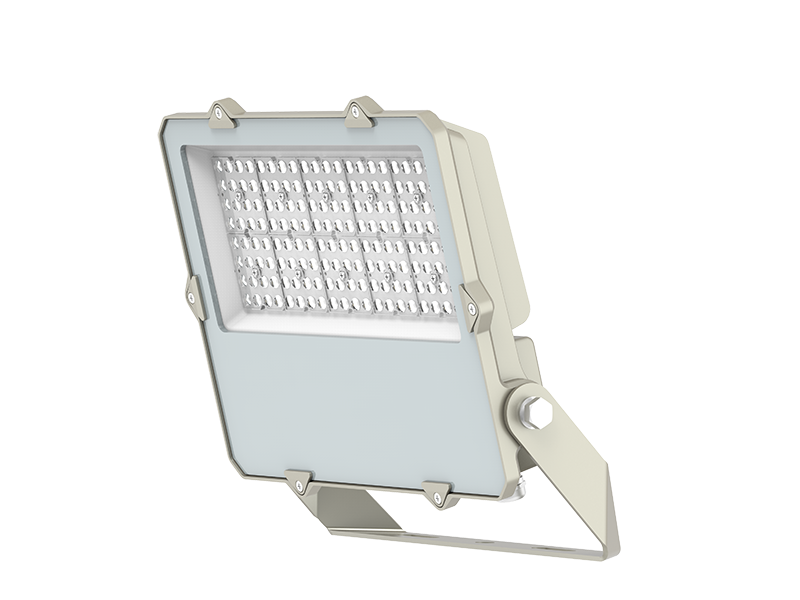
ROKEE’s G6 SUS316 marine LED flood light is intended for projects where the bracket and external hardware need chloride-resistant construction. Compare it with the broader LED flood light range, or send the exposure, mounting and photometric requirements for a project-specific configuration.
Frequently asked questions
How many salt-spray hours should a marine floodlight have?
There is no universal hour value that predicts service life. Use the project specification and compare representative tests with clear failure criteria. Review materials, coating and field exposure as well as test duration.
Is IP66 enough for coastal lighting?
No. IP66 addresses dust and water ingress. Coastal service also requires corrosion-resistant materials, coating, fasteners, cable entries and mounting interfaces.
Is SUS316 better than SUS304 near the sea?
SUS316 is generally preferred in chloride exposure because its molybdenum content improves resistance, but grade alone does not guarantee the performance of the full luminaire.
Does ASTM B117 predict years of outdoor life?
No. It creates a controlled salt-fog environment for comparative corrosion information. ASTM states that stand-alone results do not reliably predict natural service performance.
What normally fails first on a marine floodlight?
Common weak points are coating edges, external fasteners, brackets, cable glands, seals and dissimilar-metal contacts rather than the LED package itself.
Authoritative references
Related Posts