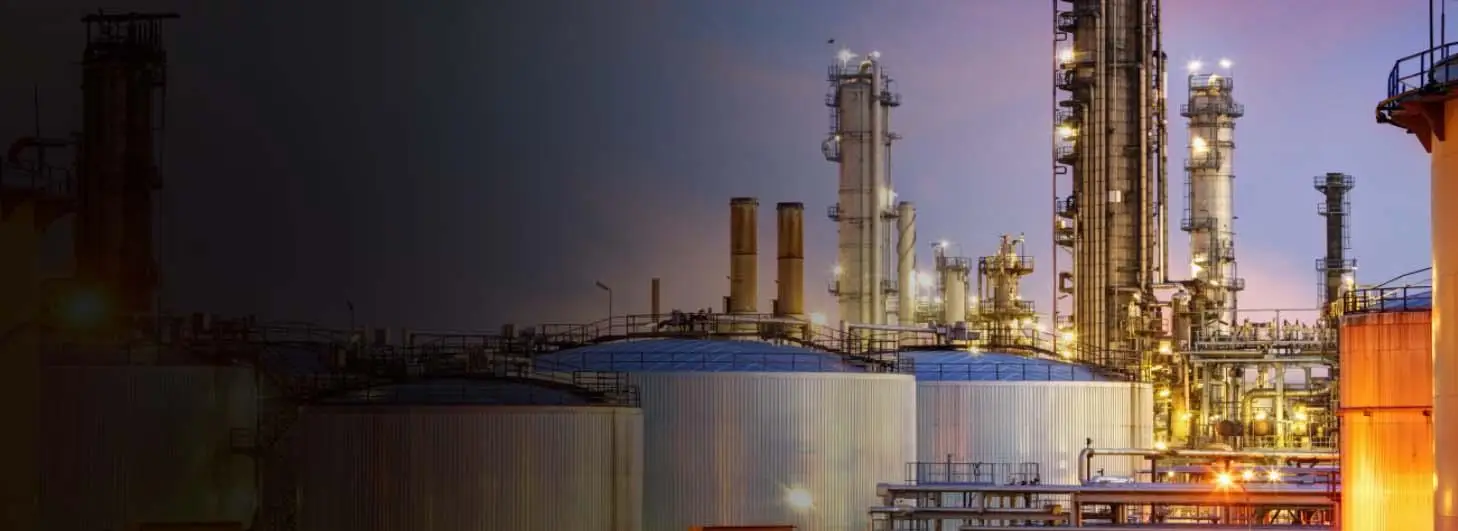
Zone-by-zone hazardous area lighting selection with ATEX-certified LED luminaires for petrochemical plants, shipyards, paint booths and dust-hazard sites.
Our sports lighting provides high-intensity, uniform illumination for stadiums and arenas. The durable systems are designed to reduce glare and ensure broadcast-quality visibility, providing reliable performance for athletes, referees and spectators in every event.
ROKEE has delivered more than 700 sports lighting projects worldwide, from national football stadiums and baseball fields to swimming pools, padel courts and indoor arenas. Every project starts with a photometric calculation, not a product list.
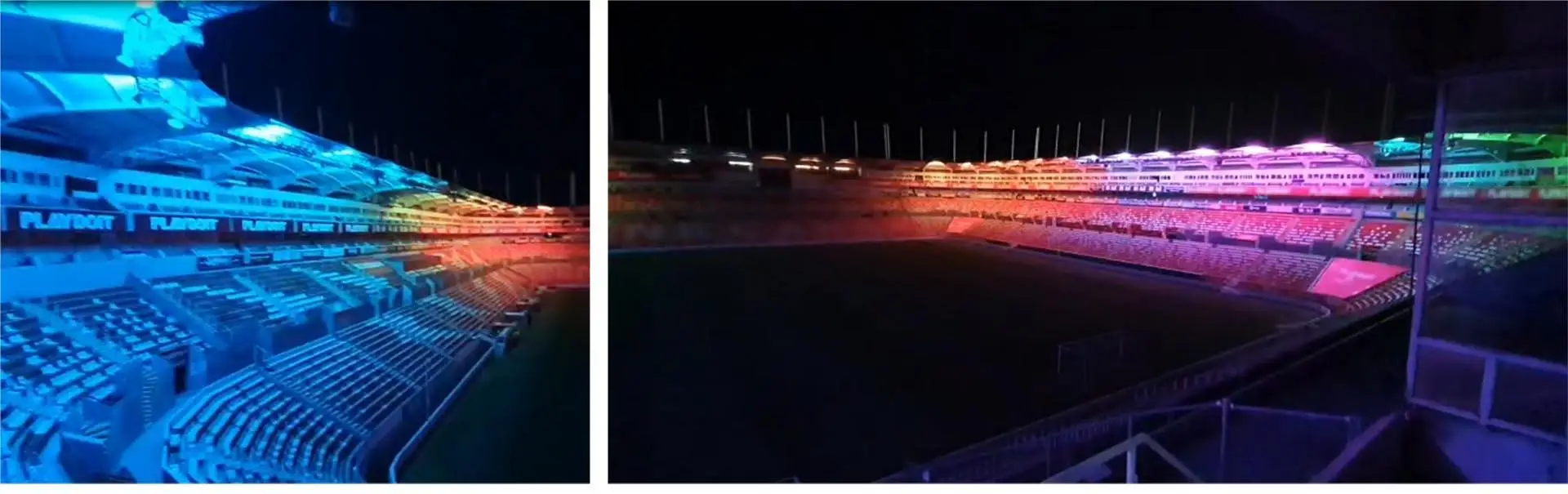
Sports We Light
The same optical platform serves very different fields, because the requirement changes with the sport, the level of play and the camera position:
- football and soccer pitches, from training grounds to broadcast stadiums;
- baseball and softball fields, including infield and outfield coverage;
- tennis and padel courts, where low mounting heights and close boundaries demand tight glare control;
- basketball courts, both indoor and outdoor;
- swimming pools, where indirect or carefully shielded optics eliminate surface glare;
- athletics tracks, multi-use community fields and indoor arenas.
What Sports Lighting Has to Deliver
Four performance factors decide whether a venue passes inspection and whether players and cameras are satisfied:
- Illuminance — maintained horizontal lux on the playing surface, set by the competition class.
- Uniformity — minimum-to-average and minimum-to-maximum ratios across the field, not just at the centre spot.
- Glare control — controlled beam edges, visors and correct aiming angles so players tracking high balls are not blinded.
- Flicker-free output — essential for slow-motion broadcast and high-frame-rate cameras.
Governing criteria vary by sport and country; FIFA’s stadium guidelines are a useful reference for football venues, while national federations and local authorities may set additional requirements.
Product Platforms
Seventeen LED sports light series cover outputs from 200 W to 4,800 W. The right platform depends on mounting height, aiming distance, required uniformity and control needs.
| Series | Power range | Key feature |
|---|---|---|
| G24 | 300–1,600 W | 5° patented narrow beam, 9.5 kg at 800 W |
| G23 | 800–1,800 W | RGB / RGBW, 26 kg at 1,800 W |
| G20 | 200–1,500 W | High-output modular platform |
| G19 | 240–420 W | Designed specifically for padel tennis courts, 100×60° lens |
| G18 | 400–1,200 W | Circular housing, RGB / RGBW options |
| G17 | 200–1,800 W | DIY quick assembly for fast installation |
| G15(B) | 1,200–4,800 W | 4,800 W for professional engineering projects |
| G14 | 300–1,500 W | Low wind resistance, fast heat dissipation |
| G12 | 200–1,200 W | Private mould, distinctive structure |
| G10(B) | 800–2,000 W | 360° rotating single module, 1.5 kg per module |
| G9 | 300–1,200 W | DMX512 dimming, RGB version, 13 mounting options |
| G8 | 400–1,800 W | 4 mm tempered glass, ideal for seaside and large outdoor venues |
| G16 | 400–1,800 W | 600 W per module, up to 8 universal mounting ways |
| G15 | 1,200–4,800 W | Single-module construction, 21 kg at 1,600 W |
| G11 | 200–1,200 W | 150 lm/W, 10°/15°/30°/60°/90°/T2 optics |
| FA | 240–1,000 W | 120 W per module, 30° and 60×100° optics |
| G6 | 400–1,200 W | Heavy-duty body, 15°/30°/100×60°, scale marks for accurate aiming |
Full specifications are listed under the LED sports light range.
Design Process
Every sports project follows the same sequence, and each step produces a document you can review:
- Project brief — sport, competition level, field dimensions, pole layout and camera positions.
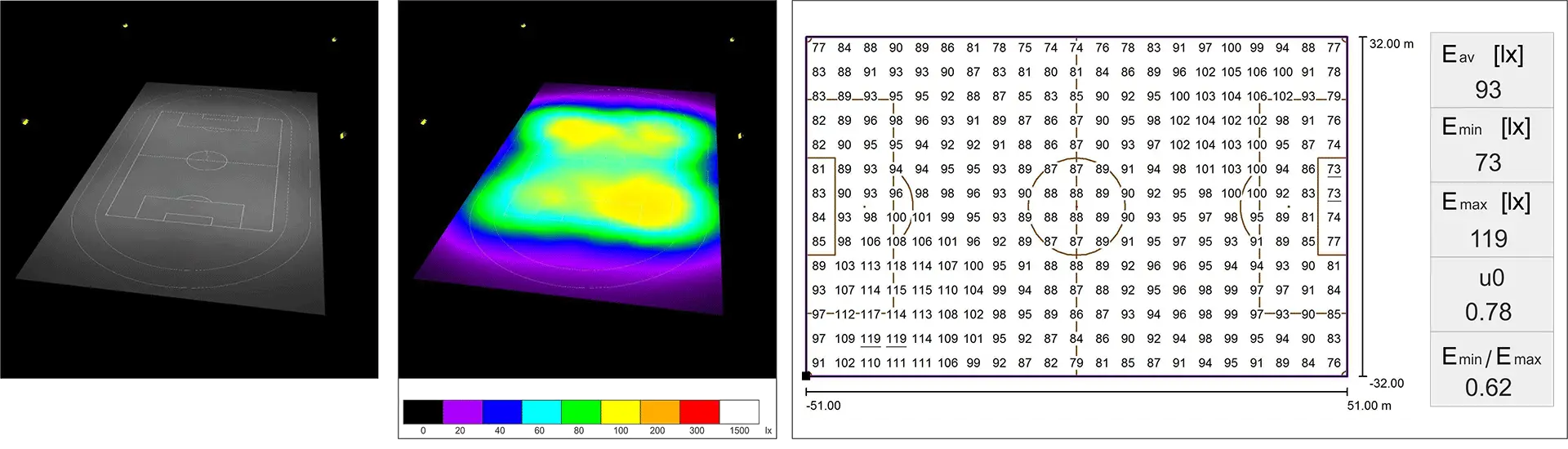
- Photometric simulation — DIALux or AGi32 calculation using real IES/LDT files, reporting maintained lux, uniformity and glare metrics.
- Product and optics selection — beam mix chosen for mounting height and aiming distance, not by wattage alone.
- Structural data — luminaire weight, wind area and bracket data for the pole or roof engineer.
- Aiming and commissioning — aiming schedule, on-site verification and measured acceptance report.
Free DIALux simulation is available for qualified projects. Send the field plan and criteria through the contact page.
New Build or Retrofit
New venues allow pole positions, aiming angles and electrical routes to be optimised from the start. Retrofit projects usually reuse existing masts, which makes the structural check and the aiming plan more important than the fixture itself.
In both cases the luminaire array must be specified against the same photometric targets. Replacing 1,000 W metal halide floodlights with LED sports lighting on a one-to-one basis rarely produces the intended result: the new optic distributes light differently, so fixture count, beam angles and aiming change together. Our LED sports lighting guide explains the planning sequence for outdoor stadiums.
Controls and Smart Lighting
Sports venues rarely need full output all day. Typical control packages include scene presets for training, competition, cleaning and event modes, scheduled switching, and DMX512 or DALI integration for show lighting.
RGB and RGBW versions of the G23, G18 and G9 series support colour scenes and dynamic effects, while the G9 series adds DMX512 intelligent dimming with thirteen mounting options. For arenas that combine sports and entertainment, lighting control is specified together with the luminaire schedule so addressing, programming and commissioning are delivered as one package.
Selected Sports Lighting Projects
- Arena DMX smart lighting upgrade — 132 high-CRI white and 30 RGBW luminaires, HD broadcast compliant, 40% energy saving. View project
- Custom stadium lights for swimming pools — anti-glare optics for night swimming with uniform surface coverage. View project
- Hong Kong stadium lighting case study — football venue retrofit with measured lux verification. View project
- American football lighting, Mexico — arena upgrade with high-CRI white and RGBW smart control. View project
- Baseball field high mast lighting — infield and outfield coverage from high mast positions. View project
More installations are listed under sports lighting projects.
Frequently Asked Questions
How many lux does a sports field need?
It depends on the sport and competition class. Training fields need far less than competition or broadcast venues, and vertical illuminance toward cameras adds further requirements. A photometric calculation for the specific field is the only reliable answer.
Can you reuse our existing poles?
In most retrofit projects yes, after a structural review of pole capacity, headframe condition and wind loading. We supply weight and wind-area data for your engineer.
Do you provide lighting design before we order?
Yes. Free DIALux simulation is available for qualified projects, including layout options, fixture quantities, aiming plan and an itemized quotation.
Request a Sports Lighting Design
Send your field plan, sport, competition level and pole details through the contact page. You will receive a photometric proposal with fixture selection, aiming plan and project pricing. For budget planning, see the stadium lighting cost guide.