
ATEX is EU law. IECEx is a voluntary international certificate built on the same IEC…
1000W LED Stadium Lights: Output, Coverage and Buying Guide
A 1000W LED stadium light is not a brightness rating — it is a power input. The number that decides whether your pitch is playable sits downstream of it: how many lumens the fixture turns that wattage into, what optic those lumens leave through, how high you can hang it, and how much output survives a 45°C evening. Two 1000W LED stadium lights from different suppliers can differ by 40,000 lumens and by half a metre of aiming tolerance.
This guide works through the numbers in the order a designer actually uses them: output, throw, quantity, then the mechanical and thermal details that decide whether the installation still performs in year five.
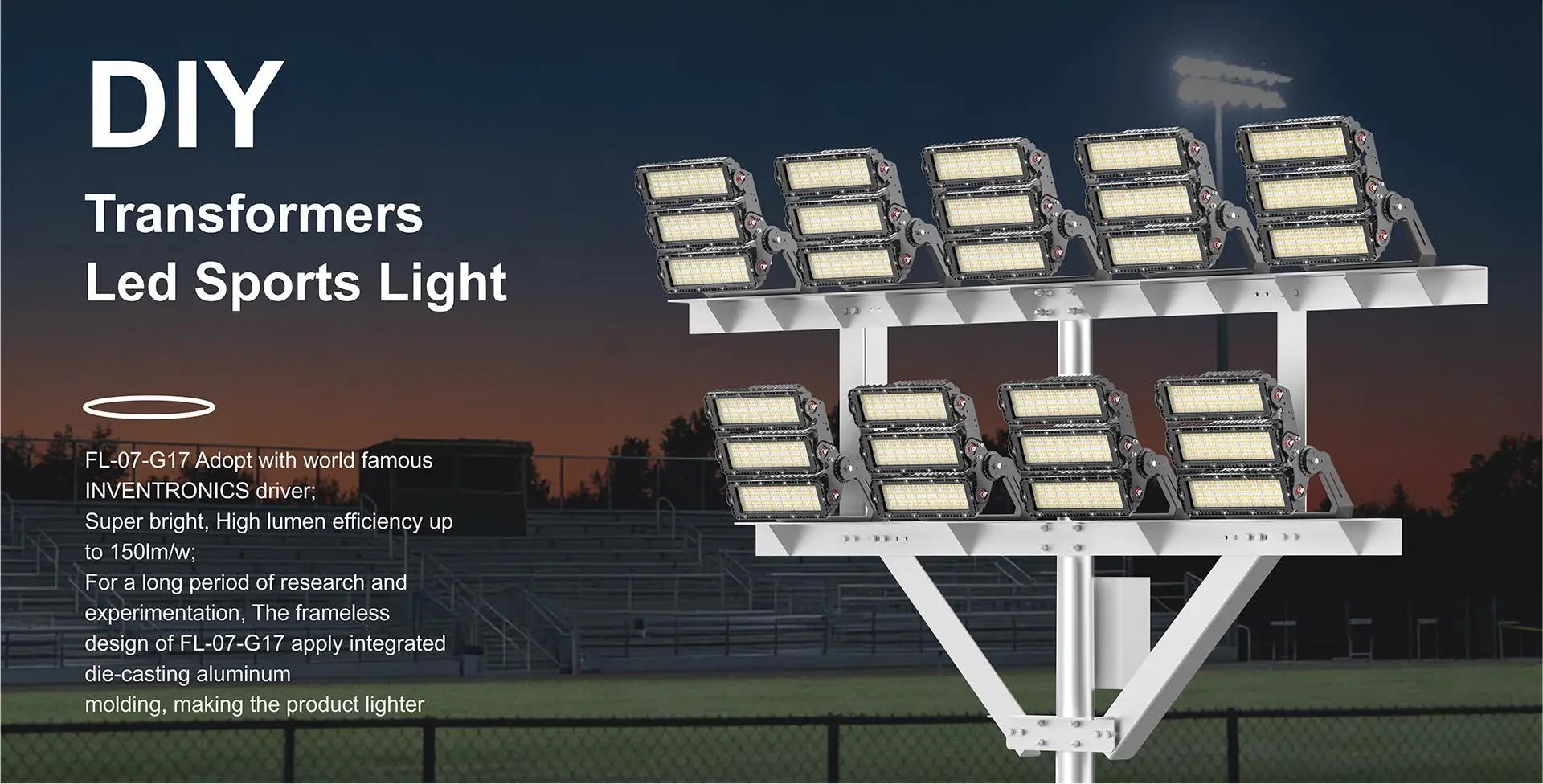
1. What a 1000W LED stadium light actually delivers
Modern 1000W LED stadium lights run between roughly 130 and 160 lumens per watt at the luminaire level, already including driver and optical losses. That puts a 1000W LED stadium light in this band:
- 130 lm/W — 130,000 lumens. Entry-level product; usually a larger LED count driven below its comfortable current, or a low-cost driver.
- 145–150 lm/W — 145,000 to 150,000 lumens. The mainstream specification for club and regional venues in 2026.
- 155–160 lm/W — 155,000 to 160,000 lumens. Premium modules with efficient optics and a high-grade driver; pays back in fixture count rather than in electricity.
Read the figure as luminaire output, not LED-chip output. Suppliers of 1000W LED stadium lights quote chip efficacy because it is 10–15% higher, and the gap is exactly what leaves the fixture as heat and optical loss. Ask for the LM-79 total luminous flux of the complete luminaire; anything else is marketing.
2. Where 1000W sits in the range
The 1000W band sits in the middle of the stadium range, and 1000W LED stadium lights are the most frequently misapplied products on it. The table below shows what each band is genuinely for:
| Wattage | Typical output | Pole height | Belongs on |
|---|---|---|---|
| 400–600 W | 55,000–90,000 lm | 8–15 m | Padel and tennis courts, five-a-side, training areas, small-sided pitches |
| 800–1000 W | 115,000–160,000 lm | 15–25 m | Full-size football and rugby pitches at club and regional level, athletics tracks, baseball outfields |
| 1200–1500 W | 170,000–225,000 lm | 20–30 m | Competition venues, larger stands, fewer poles with more output per head |
| 1800 W and above | 260,000 lm+ | 25–45 m | Televised stadiums, racecourses, multi-sport main venues |
Two consequences follow. First, 1000W LED stadium lights are the correct default for a full-size pitch with four to six poles — this is where the majority of projects worldwide land. Second, above roughly 500 lux the arithmetic stops favouring 1000W units: you end up with so many fixtures on the mast that wind load, aiming tolerance and maintenance access become the constraint, and fewer 1500W units usually win.
3. How far a 1000W unit throws
For 1000W LED stadium lights, beam angle and mounting height are a pair, and neither is meaningful alone. A tight optic concentrates output into a small footprint, which raises illuminance but demands height to spread the patch:
- 10–15° — at 25 m, a patch roughly 5–7 m across. Long-throw work from tall masts, typically the far side of a stadium.
- 20–25° — at 20 m, roughly 8–10 m across. The workhorse optic for 1000W units on four-pole pitch layouts.
- 40–60° — at 12–15 m, wide and even. Community pitches and courts where the pole cannot be tall.
The practical rule is that 1000W LED stadium lights want at least 15 m of height. Below that, the optic has to open up to cover the area, glare toward players and neighbours rises sharply, and you are paying for lumens that land behind the goal line.
4. How many 1000W LED stadium lights does a pitch need?
Working out how many 1000W LED stadium lights a pitch needs starts from the target illuminance. For a full-size pitch of 105 × 68 m (7,140 m²), required installed flux is illuminance × area ÷ (coefficient of utilisation × maintenance factor). Using typical values of 0.6 and 0.8 for a 1000W-class floodlight on a mast:
| Target average | Installed flux needed | 1000W units at 150,000 lm | Typical layout |
|---|---|---|---|
| 100 lux — training | ≈ 1.5 Mlm | 10 | 4 poles, 2–3 per head |
| 200 lux — club competition | ≈ 3.0 Mlm | 20 | 4 poles, 5 per head |
| 350 lux — regional | ≈ 5.2 Mlm | 35 | 6 poles, 6 per head |
| 500 lux — national | ≈ 7.4 Mlm | 50 | 6–8 poles, 6–8 per head |
These are order-of-magnitude figures to sanity-check a quotation, not a design. The binding requirements, including the uniformity values a layout must reach, come from BS EN 12193:2018. Two effects push the real count up: non-uniform layouts (corners always need more light than the arithmetic suggests to satisfy U1), and vertical illuminance, which is what televised and semi-professional play actually needs and which horizontal lux calculations ignore entirely. Any serious supplier of 1000W LED stadium lights will produce a DIALux or Relux file with the grid, the aiming plan and the U1/U2 values before you commit.
5. The wattage trap: 1000W is an input, not an output
The most expensive mistake with 1000W LED stadium lights is buying the number in the product name. Consider two fixtures quoted for the same pole:
- 1000 W at 128 lm/W — 128,000 lumens
- 850 W at 155 lm/W — 131,750 lumens
The lower-wattage unit delivers more light, draws 15% less power and, because it runs cooler, usually carries a better lumen-maintenance figure at ten years. If the goal is a lux target on a grid, the 850W fixture wins on every line of the project economics. If the goal is a procurement specification that says “1000W”, the 1000W fixture wins — and that is a decision about paperwork, not lighting.
This is more than a curiosity in tenders written around legacy HID wattages. If the venue needs to meet a published quality mark rather than a local regulation, the FIFA Quality Programme for Floodlights sets the reference for the relevant competition level. A 1000W LED stadium light typically replaces a 2,000W metal halide unit, so specifications inherited from a 1990s design often ask for “1000W equivalent” and end up over-specified on wattage and under-specified on delivered lux.
6. Heat and derating: the number that matters in a hot climate
Every lumen figure above is measured at 25°C ambient. 1000W LED stadium lights running through a Gulf summer or a South Asian monsoon season is not operating at 25°C, and the difference is not cosmetic:
- At 45°C ambient, expect 8–12% output loss from thermal derating on a well-designed fixture.
- At 55°C, a fixture without adequate heatsink area can lose 20% or throttle, and driver life drops sharply.
- Lumen maintenance (LM-80 / TM-21) quoted at 25°C is close to meaningless for these markets; demand the 50°C or 55°C curve.
For projects in the Middle East, Southeast Asia and Africa, this is the single specification that separates a three-year fixture from a ten-year one, and it never appears on a quotation unless you ask.
7. Mechanical limits: weight, wind load and aiming
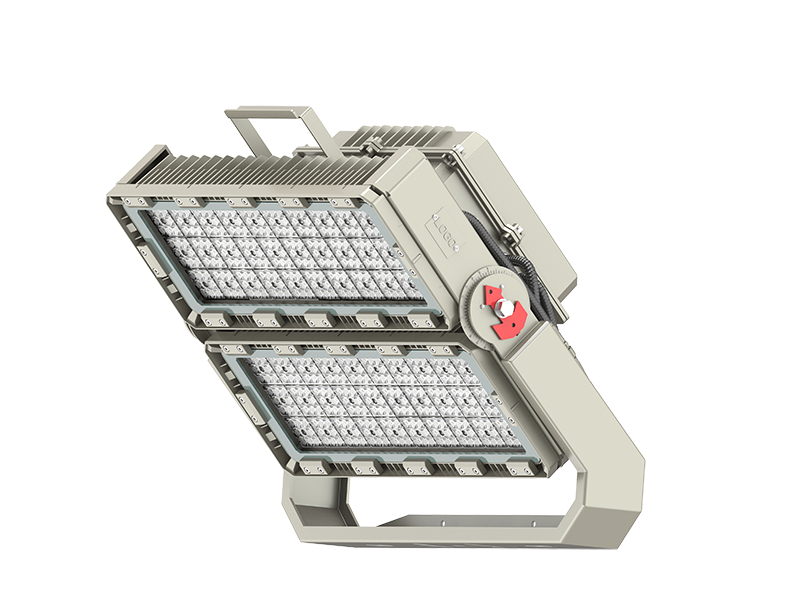
A 1000W floodlight weighs 12–20 kg depending on module count and housing. That is trivial on the ground and decisive at 25 m. Three numbers belong in the same conversation as the wattage:
| Parameter | Why it decides the project |
|---|---|
| Unit weight | Head load on the mast, and whether two people can service it from a platform |
| Effective projected area (EPA) | Wind load on the mast and foundation; a 4-module unit at 30 m can double the structural requirement |
| Aiming mechanism | Whether a graduated scale and lockable bracket allow one technician to restore the design after a replacement |
Glare control belongs here too, because it is mechanical before it is optical: a 1000W LED stadium light aimed 5° too low puts light into the players’ eyes and into the neighbours’ windows, and no diffuser recovers that. Ask for a glare class (GR) calculation in the design file, and check the aiming tolerances against the glare guidance in CIE 083:2019 for anything above club level.
8. What to ask a supplier of 1000W LED stadium lights
- LM-79 report for the complete luminaire — total flux, efficacy, CCT, CRI at the stated wattage.
- IES or LDT photometric file — without it, nobody can calculate your field, and any lux promise is verbal.
- LM-80 / TM-21 data at 50°C or higher — the derating that applies to your site, not the laboratory.
- Driver brand and model, plus the inrush current — 40 units on one contactor is a real electrical constraint.
- Weight and EPA per unit, so the mast engineer can check the head load before the order.
- IP and IK ratings — IP66 and IK08 minimum for outdoor masts; IK09 where vandalism or hail is a factor.
- Surge protection level — 10 kV is the sensible minimum for sites with overhead distribution.
- Warranty terms in writing, including what counts as a failure and who pays freight on a replacement.
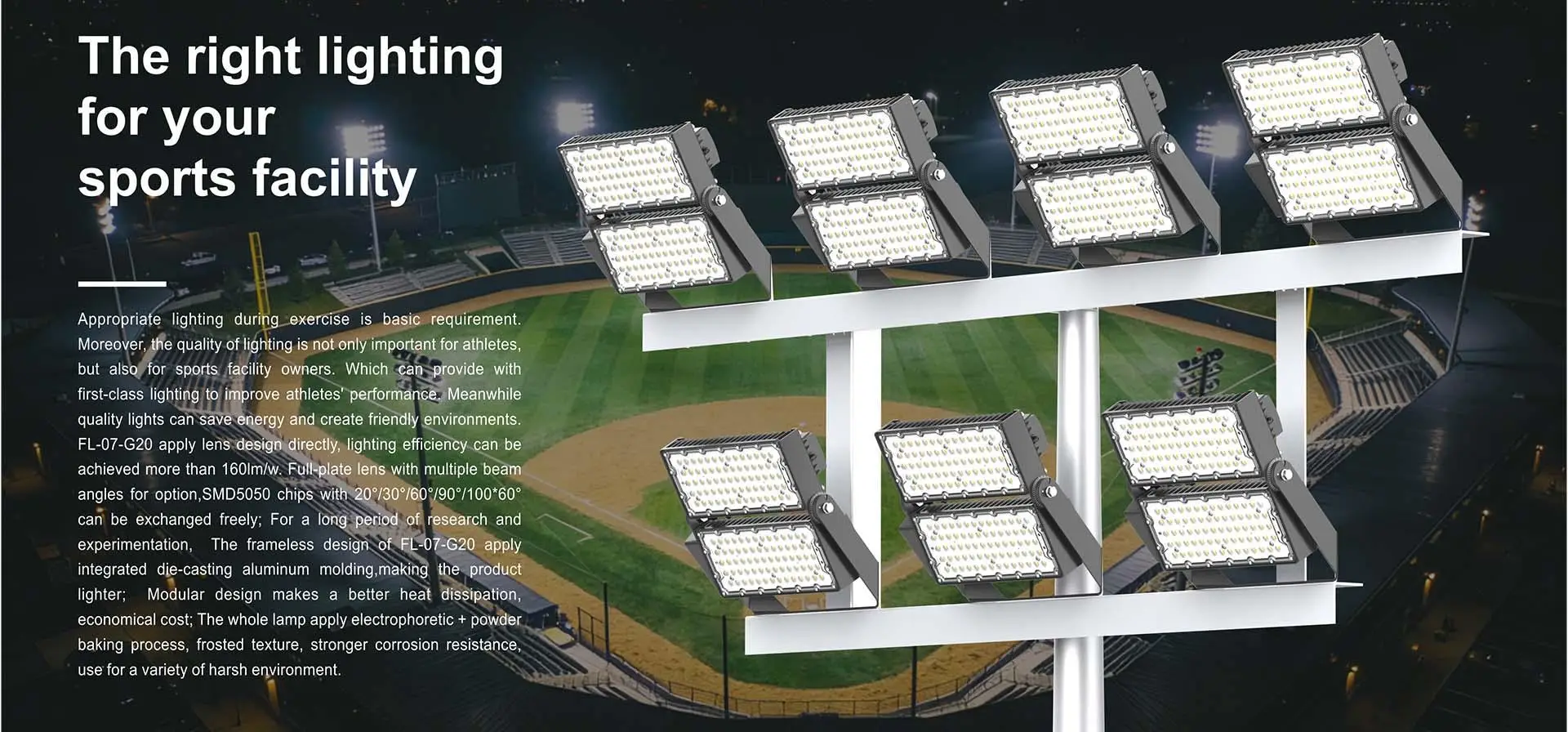
Our LED sports light range covers 200W to 4,800W in the same modular housing family, which matters more than it sounds: a single platform means the 1000W units on the main pitch and the 400W units on the training area share optics, brackets and spares. The G16 and G17 are the two platforms most projects specify at 1000W, and the G20 is the step up when the layout calls for more output per head.
9. Five specification mistakes we see repeatedly
- Specifying wattage instead of lux. It transfers the design risk to the buyer and guarantees arguments at handover.
- Buying 1000W LED stadium lights for a 12 m pole. The optic cannot spread that output without glare; a 400–600W unit at the same height usually lights the area better.
- Ignoring vertical illuminance. A pitch can hit 300 lux horizontal and still be unpleasant to play on because nothing lights the players’ faces.
- Accepting a 25°C lumen maintenance curve for a site that runs at 45°C.
- No aiming plan. Fixtures commissioned by eye drift within a season; a printed aiming schedule with angles per head is the cheapest quality control available.
10. What this means for your project
If you are lighting a full-size pitch to club or regional standard, 1000W LED stadium lights on 15–25 m poles are the right starting point, and the number you actually need is 10 to 35 units depending on the lux target. Get the photometric file first, size the count from the lux target rather than from a legacy wattage, and check the 50°C lumen maintenance before you compare prices — because that is the number that decides how the installation looks in year eight.
For the surrounding decisions, the LED sports field lighting overview covers targets by sport and the full fixture logic; the stadium lighting cost guide breaks down what drives budget beyond the luminaires; and how to choose LED flood lights for sports fields deals with optics and beam angles in more depth. If your target is above 500 lux, read football field lighting lux levels before fixing a fixture count — the vertical requirements change the layout, not just the quantity.
Related Posts